On the evening of July 8, on Chervona Kalyna Avenue in Lviv, in the residential district of Sykhiv, a so-called TCC notification group, together with police, stopped a man born in 1996 to check his documents. According to the official version, since June 12 he had been in so-called search status as a violator of military-registration rules. He was put into a car and taken to a military medical commission. By morning, according to the deputy head of the regional TCC, he was “probably already serving.”
Between those two phrases of the official chronology lay what does not fit into it: hundreds of people blocking the avenue, an overturned TCC SUV, the military uniform torn off a person working for the TCC, shots fired into the air in a residential district, a crowd that dispersed only by 3 a.m.—despite the curfew. One of the videos that spread that evening shows the episode with which, according to eyewitnesses, it all began: a man in uniform gets out of a car and strikes a passerby from behind. The head of the Sykhiv district TCC would later comment on the footage this way: “The video was taken out of context. In my opinion, it was self-defense.”
Self-defense by a blow to the back—a formula worth remembering. It describes more accurately than any analysis how Ukraine’s state machine reacted to the first truly mass street protest against the practice of forced street mobilization. And what happened over the next seventy-two hours is more important than the protest itself.
One Car, Ten Agencies
The state’s response to the events in Lviv was comparable in speed and scope to its response to a missile strike. Within a day, statements were made by the president (“a very bad story”), the head of the President’s Office, the General Staff, the Defense Ministry, the command of the Ground Forces, the military ombudsman, the Verkhovna Rada ombudsman, the mayor of Lviv, the head of the regional administration, the regional prosecutor’s office, and the SBU. One overturned car in one district of one city—ten state institutions.
The content of those statements was strikingly uniform. Head of the President’s Office Kyrylo Budanov: “If today you tear off the clothes of and beat a serviceman of your own army, think about who tomorrow will defend you from an enemy army that will beat you and tear off your clothes in the same way, only this time from you.” The General Staff: “a direct threat to defense capability.” The Defense Ministry: “the only one who benefits from such situations is the enemy.” Lviv Mayor Andrii Sadovyi: “Not yet a diagnosis, but already a symptom.” And his own appeal: “Let us finally stop calling servicemen ‘TCC employees.’”
There was one dissonant voice in this chorus—military ombudsman Olha Reshetylova, who said that responsibility for what happened lies first and foremost with the authorities and officials who for years postponed mobilization reform. But even her statement culminated in a phrase about a “special place in hell” for those who “hype the topic of mobilization”—a reproach aimed not at the system, but at those who talk about it.
The legal outcome was distributed just as asymmetrically. The actions of TCC employees—including the blow from behind captured on video—became the subject of “internal reviews,” which the agency is conducting into itself. The actions of the protesters became the subject of two criminal proceedings: obstruction of the lawful activities of the Ukrainian Armed Forces during a special period and violence against a law-enforcement officer. The SBU informed participants they could face up to eight years in prison. The first detainee—a 23-year-old Lviv resident—appeared the very next day. Nothing has been reported about the first punished TCC employee. A review versus a criminal case, “we will look into it” versus “up to eight years”—this is what the weight class of each side looks like in the eyes of the state.
The identity of the person who delivered the first blow has still not been officially established. Local public channels identified him as Roman Udut—a martial-arts coach, not a serviceman, allegedly hired, according to the same channels, to “work” with notification groups for money. The state, which identified and detained a 23-year-old protester within a day, has found no way in three days either to confirm or deny the name of the person with whom it all began.
The Chorus
Alongside the official statements, a campaign unfolded by the media wing of the mobilization system—public military figures, activists, and “opinion leaders” for whom the topic of war has long since become their main symbolic capital.
Alina Mykhailova, head of the medical service of the Da Vinci Wolves battalion and one of the country’s most quoted servicewomen, placed the blame on “impotents—the authorities who allowed all this to happen,” yet preserved the same frame: the problem is not what is being done to people, but that the state is not managing the process harshly enough. This is the same Mykhailova who, after the TCC raid at an Okean Elzy concert, demanded that the outraged “gather up their snot” and said that “absolutely everyone in this country must be busified.”
Poet and servicewoman Yaryna Chornohuz offered a choice: the front or fifteen years for treason, with a “show” trial. Dmytro Korchynskyi went furthest of all: Sykhiv should be “fully cleared by reinforced TCC groups,” all draft-age men in the district should be forcibly mobilized, and TCC employees should be allowed to shoot to kill. He ended his post with the words “We demand revenge!”
No less telling is the precedent that occurred a month and a half before Lviv. In May, C14 leader Yevhen Karas, together with a group of supporters, disrupted a rapper’s concert in Kremenchuk after the performer had released a track criticizing the TCC. The performer was forced by shouts to delete the song and publicly apologize. At the time, the episode passed almost unnoticed. Today it reads like a rehearsal.
The Apology Will Be Sincere
The main thing happened after the protest. In the following days, detentions of participants in the events were carried out across Lviv—including, judging by video footage, with the involvement of people in civilian clothes, without identifying marks or clear procedural status. Then a genre appeared online that so far has no name in Ukrainian law, but has an established form: the apology video.
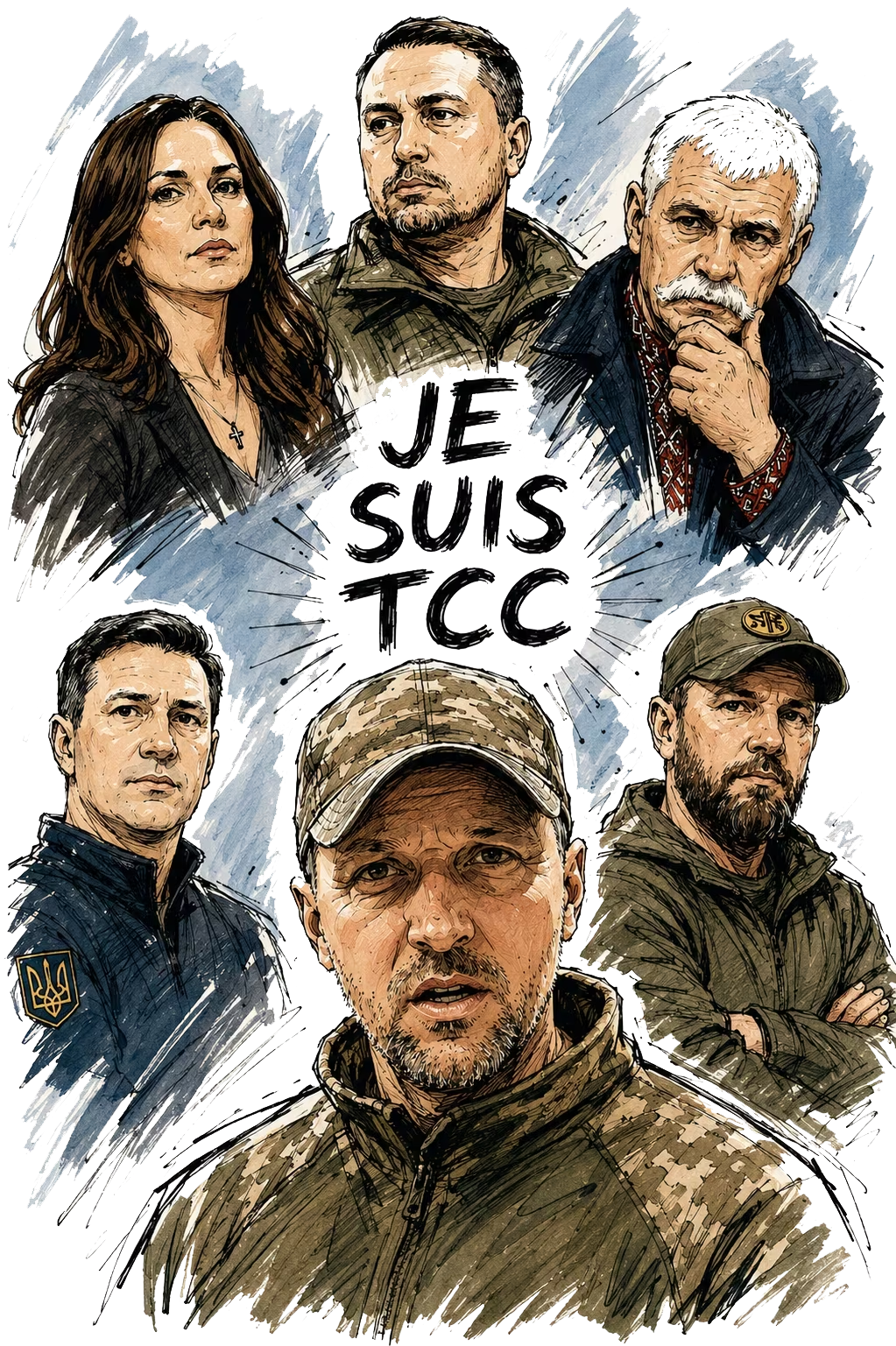
In footage published by veteran Anton Petrivskyi, detained protest participants chant “Glory to the TCC”, ask for forgiveness, and promise to join the army. Petrivskyi accompanied the publication with an explanation: an “educational conversation” had been held with the participants in the conflict. A separate video was recorded by the deputy commander of the 3rd Army Corps: it says that the “traitor has been handed over to the relevant authorities.” The logic of the genre was formulated with absolute honesty: the first apology was deemed insincere; after the conversation, it became sincere.
It is worth spelling out what is being described here. An “educational conversation” is a procedure that does not exist in any Ukrainian code. Neither the veteran nor the deputy corps commander has the authority to detain civilians, conduct “conversations” with them, or determine the measure of their sincerity. Forcing a person to chant slogans on camera is compelled speech, a form of violence that breaks not the body but the will, and for precisely that reason is considered one of the most humiliating acts in every legal tradition. The phrase “the apology became sincere” describes pressure applied until the desired result was achieved—and it was uttered with pride, publicly, in the first person.
On the same day these videos were spreading online, Lviv’s mayor reminded people that “in the fifth year of the full-scale war, Ukraine remains a state governed by the rule of law.” That claim is easy to test: over the “educational conversations”—detentions without authority, coercion into public apologies, the handing over of “traitors” to “the relevant authorities”—not a single proceeding has been opened. Over the protest, two have. The state called the crowd’s vigilante violence against a TCC employee a crime. It called the vigilante violence of people with coercive power against civilians education.
A Genre With a Genealogy
The apology video as a format has a precise birthplace. It was first put on a conveyor belt in Chechnya in the mid-2010s: people who criticized the authorities on social media were found, detained, and recorded on camera—admitting mistakes, promising to correct themselves, sometimes with physical attributes of humiliation. From there, the practice spread across Russia and became a standard tool of the security services: researchers of Russian authoritarianism identify “apologies on camera” as a separate genre of political coercion, while the phrase “educational conversation” has long since become entrenched in the vocabulary of Russian security forces as a euphemism for extraprocedural pressure. The meaning of the genre is not the apology itself—it is the demonstration to everyone else: the same will happen to you.
Every Ukrainian reader has seen dozens of such videos in Russian reports in recent years. Further comparisons are unnecessary.
The Staircase
The events in Lviv did not begin on July 8. A long staircase led to them, each step of which was once a scandal—and each was normalized by silence. Forced delivery “to clarify data” became routine. Videos of beatings during detentions stopped being news. Deaths of mobilized men inside TCC premises—cases were opened over them, but almost nothing is known about the results—were filed away as tragic incidents. Raids at concerts caused a week of arguments and were forgotten. The day before the events in Lviv, a man in Kamianske threw a grenade at a notification group—an episode that three years ago would have been the main news of the month, but passed through the feed among others.
Each time, the social contract was revised in the same direction, and each time the argument was the same: war, not now. Lviv showed what happens on the next step: forced repentance was added to forced mobilization. The reader can ask for himself what the next step looks like—the incline of the staircase is visible.
One final comparison remains. All the state statements of these days converged on one thesis: what is happening benefits the enemy. That is true—but not in the sense they meant. No enemy information operation can produce content more destructive to mobilization and trust in the army than a video in which citizens of Ukraine are forced to chant “Glory to the TCC”—filmed, edited, and proudly published by the “educators” themselves. The protest in Sykhiv was seen by hundreds of thousands. The apologies after the “conversations”—by millions. And if the unity of the nation that the state tells the world about now requires such proof, then the most uncomfortable questions for it will not arise in Lviv.
At Odesa TCC, People Were Beaten, Held and Threatened With Sexual Violence
Mobilized Man Dies in Donetsk Region With a Head Injury—His Body Was Found on a Road After Recruitment Officers Were Taking Him to a Training Center
In Dnipro, Three TCC Officers Killed a 55-Year-Old Man
A Dnipro Resident Beaten by Balaclava-Clad TCC Officers Has Been in a Coma for 22 Days