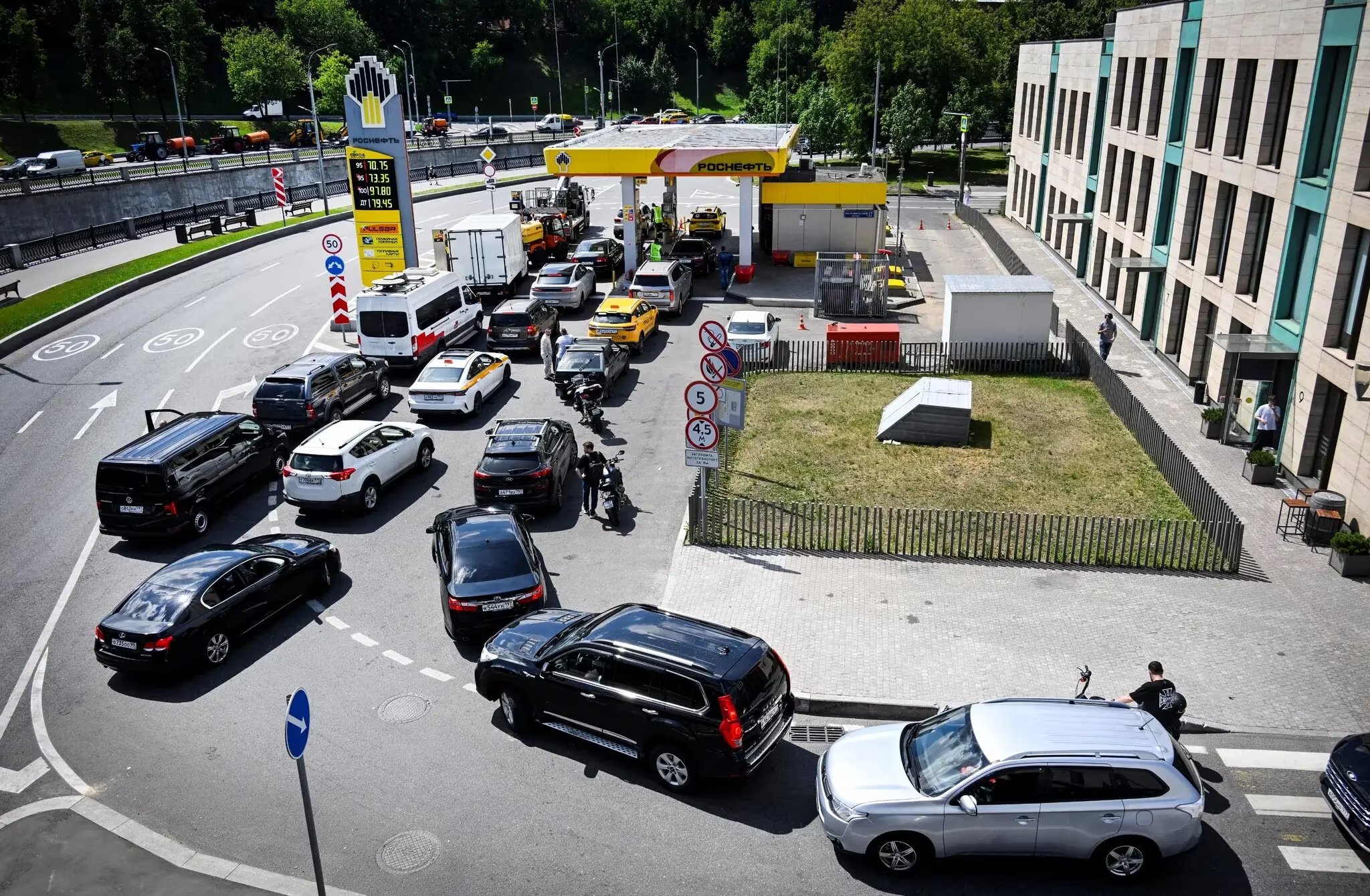
Alena Sadovnikova joined the line at a gas station in Irkutsk at 11 p.m. on a Friday—with her husband and their 18-month-old child. The family was able to fill up only at 5 p.m. the next day, after waiting at the pump for 18 hours. Irkutsk is almost 3,000 miles from the Ukrainian border.
A few days earlier, in mid-June, another gas station had told her that fuel was being sold only with coupons. “I was horrified: are we now back in the Soviet Union, where you had to get coupons to buy sausage?” Sadovnikova said in a telephone interview.
The gasoline shortage, triggered by Ukrainian strikes on Russian oil refineries, has spread beyond occupied Crimea and reached mainland regions—as far as Siberia and the Far East. In recent months Ukraine has stepped up attacks on oil infrastructure, including facilities deep inside Russia. Damaged refineries are going offline for lengthy repairs, and Russians are facing disruptions many had never seen before.
The problem has grown so large that Russian officials this week began talking about negotiations over possible oil imports from other countries—an unusual admission for the world’s third-largest oil producer.
Lines at gas stations have become the most visible consequence of the war against Ukraine for the population. In some places, drivers who had waited hours for fuel came to blows.
“The gasoline shortage is no longer just an economic problem—it is a test of the state’s ability to manage an acute crisis that strikes at the very foundation of everyday normality,” Moscow political analyst Ilya Grashchenkov wrote in an analytical note.
According to calculations by several Russian independent media outlets, only two regions have not recorded fuel shortages or sales restrictions: sparsely populated Chukotka in the Far East and Kalmykia in the south. Across the rest of the country, long lines have become routine. Crowdsourced services have appeared online where drivers mark which gas stations still have fuel. According to the newspaper Kommersant, as many as 20% of the country’s taxi drivers are staying home—it is not worth their while to wait in lines at gas stations.
Heavily populated regions around Moscow have also been hit. The Moscow refinery and a major plant in Tatarstan, roughly 600 miles east of the capital, reportedly shut down after Ukrainian attacks. The two facilities account for about 10% of Russia’s gasoline production capacity. On Wednesday afternoon, dozens of cars lined up at one of the few gas stations that still had fuel on the busy highway between Moscow and St. Petersburg.
For a country with major oil production, such scenes are unfamiliar. The older generation, which “saw empty store shelves” during the collapse of the Soviet Union, is psychologically better prepared, said Boris Nadezhdin, a 63-year-old opposition politician. “But for people in their 20s and 30s, this is a complete shock,” he said.
Fuel prices, meanwhile, are rising—despite state subsidies to oil companies intended to hold prices down. According to Rosstat, in the final week of June a liter of gasoline cost an average of $0.93—1.6% more than a week earlier.
In Grozny, prices at independent gas stations have risen from about 70 rubles ($0.90) to 100 rubles ($1.30) per liter, said Said-Khasan, a 42-year-old local resident who asked that his surname not be used for security reasons. Fuel is cheaper at stations run by the state-owned Rosneft, but long lines form there. This week, Said-Khasan drove to neighboring Ingushetia for cheaper fuel—because of restrictions, he was sold no more than 30 liters.
In southern Russia, small independent gas stations stand closed, with traffic cones and signs reading “No gasoline,” said Alexander, a 33-year-old professional driver who regularly travels through Krasnodar Krai and Rostov region and also asked that his surname not be published. Krasnodar Krai Deputy Governor Yevgeny Pergun told the local legislative assembly on Wednesday that at least a third of the region’s gas stations were not operating.
On social media, Russians are responding to the crisis with irony. In one viral post, a blogger suggested that a popular ride-hailing app would soon add a “horse” option.
The situation is hardest in Eastern Siberia and the Far East. In Irkutsk region, lines stretched so far that the authorities promised to install portable toilets along highways. On Sunday, Governor Igor Kobzev introduced a heightened state of readiness in the region—the step preceding an emergency.
Sadovnikova, who works in social media, spent the night in line with her family. They used the station’s toilet and bought food there; neighbors in the queue helped by sharing food and toys for the child.
“It was all nerve-racking and exhausting,” said Sadovnikova, 26. The next day she had to sleep off the stress. “We are trying to save gasoline and hope that by the time it runs out again, supplies will have increased.”
She is irritated that officials across the country are blaming Russians for panic buying—even though every independent gas station in her city has closed.
Energy Minister Alexander Novak insisted at a conference on Wednesday that the issue was merely a “shortage at individual gas stations” that was being “quickly resolved.”
Market data suggest otherwise. According to Ronald P. Smith, a partner at the Texas-based Emerging Markets Oil and Gas Consulting Partners, by mid-June Ukrainian drones had knocked out about a third of Russia’s refining capacity—roughly 2.2 million barrels a day. Other analysts put the losses at about 25%.
“Closing this gap will probably only be possible after several large plants restore gasoline production,” Smith wrote. “How long the repairs actually take depends on what exactly was hit.”
Beyond possible oil imports, the government is considering another step: allowing the production and sale of lower-quality gasoline with higher sulfur content, Kommersant reported, citing a draft government document. Such fuel has been banned in Russia since 2013.
The authorities usually do not disclose the scale of damage to refineries and try not to draw attention to consumer inconvenience. Putin, who generally avoids commenting on bad news, acknowledged in an interview with state television on Sunday that the country was experiencing a “certain shortage” of fuel, “but not a critical one.” Before that, he had held an operational meeting on the fuel crisis.
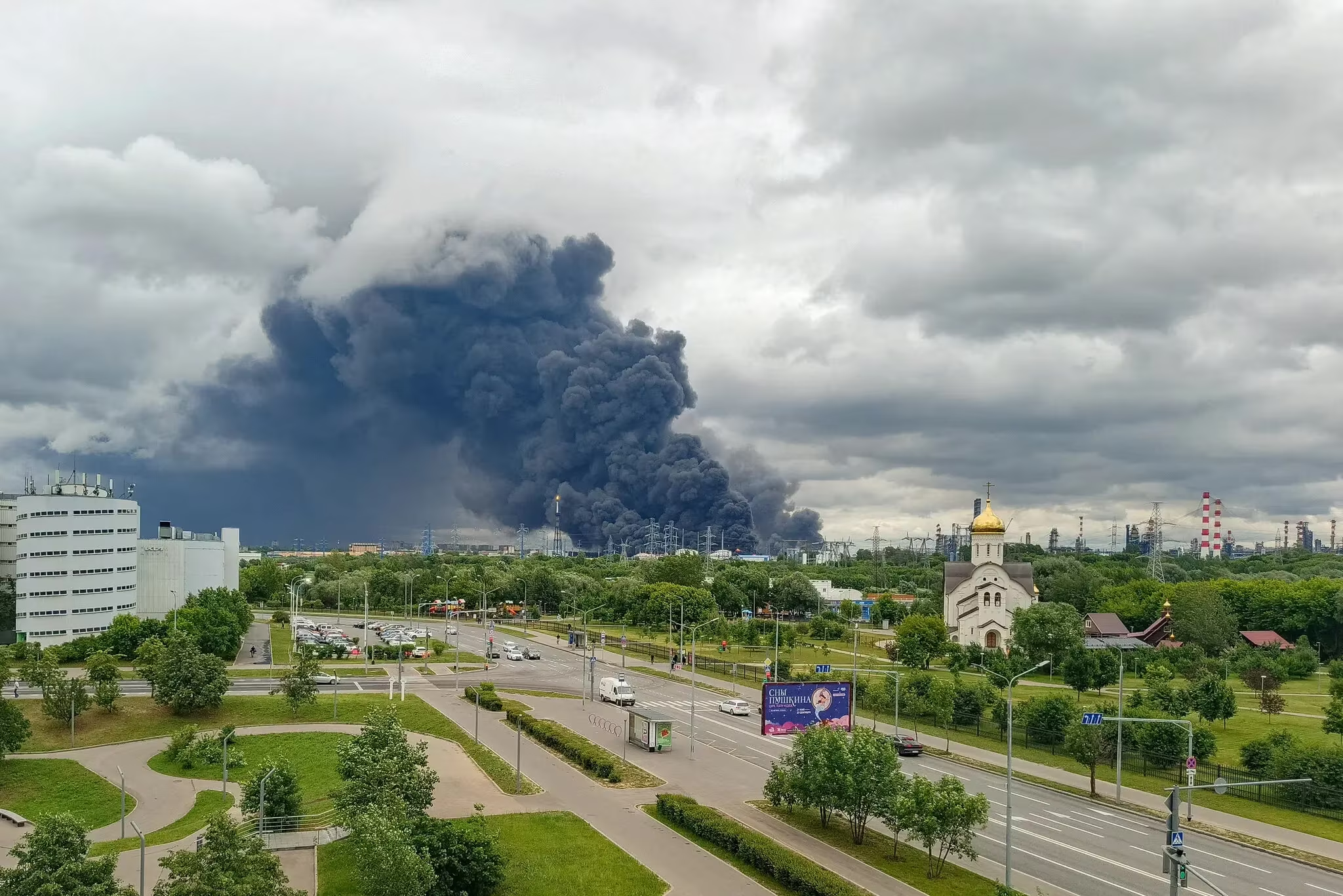
Smoke over an oil refinery after a Ukrainian drone attack on Moscow. June 2026.
The aim of Ukraine’s attacks, Putin said, is “to drive a wedge into Russian society and force Russia to stop, even for a moment, the advance of our troops on the front line.”
Many Russians tend to blame the state as a whole for the problems, but not Putin personally. Nadezhdin believes that may change: he said he increasingly sees people “coming to understand that it was Putin, through his policies, who brought us to this.”
If Russians continue to see Putin on television talking about economic growth while they themselves stand in gasoline lines, Nadezhdin said, “suspicions will arise.”
Russia Starts Buying Gasoline From India Amid Fuel Crisis
Fuel Crisis Continues in Moscow and Moscow Region
Russia Loses About 25% of Gasoline Production After Strikes on Refineries
Gas Stations in Crimea Stop Selling Gasoline From June 21