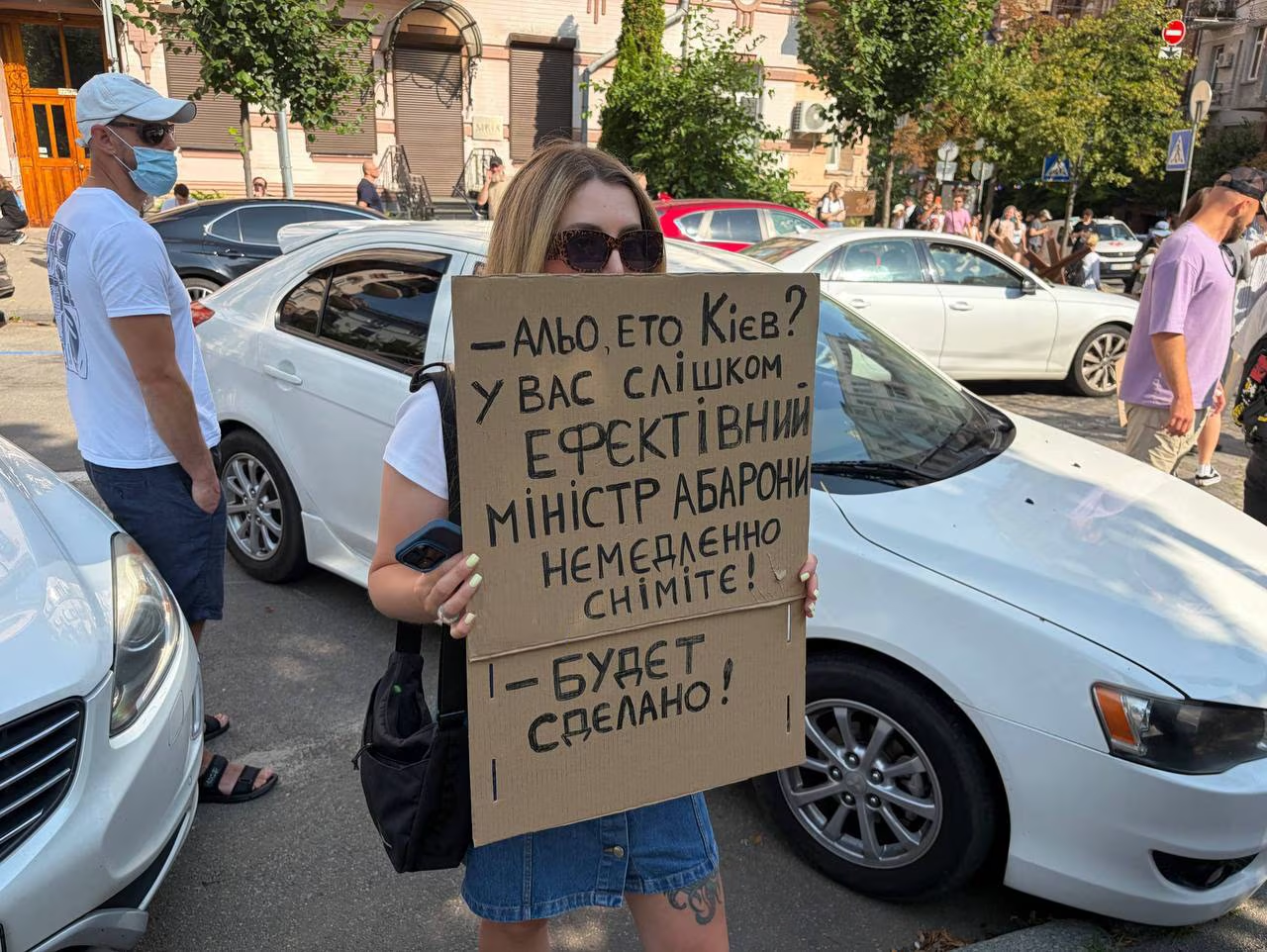
On the evening of July 15, veteran and former combat medic Dmytro Koziatynskyi published a post: come out at 9:01 a.m. on July 16, Franko Square in Kyiv, bring cardboard signs. Serviceman Serhii Hnezdilov posted a schedule of demonstrations in other cities; journalist Yanina Sokolova shared a list of locations in regional capitals. Overnight, memes, instructions for participants and lawyers’ contact details in case of arrest spread through Telegram channels.
At 9:01 a.m., after the so-called minute of silence, people stood in squares across the country—from a few dozen in Vinnytsia and Poltava to several hundred in Kyiv and Lviv. In Kyiv, they gathered in the park beside the Franko Theater, the nearest open space to the sealed-off government quarter. In Lviv, they assembled on Svobody Avenue by the Shevchenko monument. Odesa, Kharkiv, Dnipro, Kryvyi Rih, Cherkasy, Ivano-Frankivsk, Lutsk. The signs were handwritten: “Effectiveness is no grounds for dismissal,” “The rear is not where rotation is needed,” “The Kremlin thanks you for the personnel changes.” One sign photographed by UNIAN in Kyiv featured a telephone exchange in broken Russian: “Hallo, zis Kyiv? Your defense minister is too effective—remove immediately!”—“Will be done!”
There were no police cordons around the squares. In Lviv, Mayor Andriy Sadovyi stood among the protesters—and posted a photograph from the demonstration himself.
A few hundred yards from the Kyiv park, the Verkhovna Rada was in session. Lawmakers were listening to Serhiy Koretskyi, the head of Naftogaz whom Volodymyr Zelensky had formally nominated for prime minister the day before and called the “best-prepared” candidate. Under the Constitution, parliament appoints the defense minister through a separate presidential nomination, and that nominee had already been named: Ihor Klymenko, the serving interior minister and a police general. Mykhailo Fedorov, who took charge of the Defense Ministry in January, had bid farewell the previous day with a post listing 22 achievements and the work he had not managed to complete.
The Cause
Zelensky offered no public explanation. At a closed meeting of the Servant of the People faction on July 15, according to Ukrainska Pravda, he gave this account: Fedorov had failed to deliver the promised mobilization reform, while Klymenko would be able to “restore order” within the system of territorial recruitment centers. The president tied the urgency to the calendar: “Zelensky said that if Putin announces a general mobilization on September 23, after Russia’s parliamentary elections, no one will be in the mood for jokes or digital reforms. Mobilization must be sorted out before then,” one faction lawmaker recounted to the publication. Ukrainska Pravda’s sources added another remark from the same meeting: ideally, both Fedorov and Commander-in-Chief Syrskyi should be dismissed, since their conflict had become systemic—but the president “cannot do the second one now.”
One way or another, the defense minister of a country at war is changing from a man of the drone industry to a man who spent his entire career in the police—and whose mandate is to accelerate mobilization.
The Team
The call to gather in the squares was not anonymous—it remains there to be read. Koziatynskyi set the time and place. Hnezdilov circulated the schedule. Sokolova supplied the map of locations. Roughly twelve hours passed between the posts and people forming up in the squares.
Nor was the script written from scratch. In July 2025, the same people—Koziatynskyi among the initiators—brought Ukrainians into the streets for the “cardboard protests” against the destruction of the independence of NABU and SAPO. The same squares, the same props, the same aesthetic of handwritten mockery. On that occasion, the government retreated and reversed a law it had already enacted. A network that had rehearsed the protocol once mobilized more quickly the second time.
The Operators
There is no need to identify the organizers of these demonstrations—they acted openly. The more consequential question is their relationship to the dismissed minister.
Since January 22, 2026, Serhii Sternenko has served as an official adviser to Defense Minister Fedorov on the use of drones. His charitable foundation, the Sternenko Community, the army’s largest nongovernmental supplier of FPV drones, signed a cooperation memorandum with the Defense Ministry in September 2025; during 2025, it raised more than 3.1 billion hryvnias and delivered over 117,000 drones to the armed forces. On July 15, the day Fedorov’s replacement became known, Sternenko announced that his work as an adviser was over. A second adviser left with him—radio-technology expert Serhii Beskrestnov, whose call sign is “Flash.” Deputy Air Force Commander Pavlo Yelizarov submitted his resignation.
The people standing in the squares were real and unpaid. But the milieu that summoned and legitimized them—the minister’s advisers, the ministry’s partner foundation, part of the military command and the drone industry’s volunteer networks—was institutionally embedded in Fedorov’s department, and his dismissal struck directly at it.
The economics of this milieu are varied. Sternenko’s foundation subsists on donations and corporate partnerships—its partners include Monobank and PrivatBank—and states that every donation goes toward procurement. Hnezdilov hosts a podcast on hromadske, a media organization sustained by institutional donors. Koziatynskyi is a veteran with no visible organizational affiliation. What they share is not a common treasury but a resource accumulated over the course of the war: the trust of audiences measured in millions of followers and billions of hryvnias raised.
The Analogy
A week earlier, on the evening of July 8, no one had called a gathering in Lviv’s Sykhiv district. A territorial recruitment center notification team, accompanied by police, stopped a man on Chervonoi Kalyny Avenue who was wanted for violating military-registration rules. Eyewitnesses reported that he was beaten during the arrest—a video showing a serviceman striking him spread online, forcing the head of the district recruitment center to address it at a briefing, while the regional recruitment center opened an internal investigation into its own employees. A crowd gathered around the vehicle left behind—about 200 people, according to the Prosecutor General’s Office. By 2:30 a.m., the official SUV was lying on its roof. Warning shots had been fired, and two servicemen sought treatment at a trauma clinic.
The following morning, the head of the regional military administration reported holding an overnight meeting with law-enforcement officials: “Everyone must be identified and held accountable.” The Security Service of Ukraine and the police took up the search. By July 11, five participants were in pretrial detention—for 60 days, without bail, on charges carrying sentences of up to eight years. In court, 21-year-old Oleh Kuzyk explained: “Someone handed me a sledgehammer. I don’t know who. I am deeply ashamed.” Zelensky called the incident “a very bad story.”
There was also an aftermath contemplated by no legal code. The “Lviv Veterans’ Community” tracked down two participants and recorded a video with them: a group that included teenagers chants “Glory to the recruitment centers” in unison, followed by apologies to the camera and a promise from one participant to complete training and join the Armed Forces of Ukraine within a month. The serviceman who posted the recording captioned it: “We are not publishing certain elements of the ‘educational’ conversation so Facebook does not block it.” Lawmaker Oleksii Honcharenko described the episode as vigilantism. The state did not respond to the video.
The Man
Serhii Hnezdilov, who circulated the schedule for the July 16 protests, knows the cost of public gestures better than most—from personal experience. In September 2024, he publicly went absent without leave to demand fixed terms of military service: arrest by the State Bureau of Investigation, a desertion charge carrying up to 12 years in prison, three and a half months in pretrial detention—and release from criminal liability in exchange for returning to his unit. For publishing the schedule of demonstrations supporting the defense minister in July 2026, he faces nothing.
Mobilization runs through all these stories, but from different directions. Fedorov, according to the president, is being dismissed because mobilization reform was not completed. The Sykhiv crowd lands in pretrial detention for resisting mobilization in its present form. Hnezdilov was jailed for demanding limits on its duration. Yet the one protest that carries no risk—the only one of them all—does not concern mobilization itself: it concerns the person who will administer it.
By the evening of July 16, the squares will be empty. Oleh Kuzyk will remain in pretrial detention until September 6. By the president’s calculations, mobilization must be sorted out by the 23rd.
The Apology Will Be Sincere
Mobilization Without Rules
A Month Ago Zelensky Ordered the New Defense Minister to “Deal With Busification.”
Lubinets Reported 6,000 Complaints Against Military Recruitment Offices and Killings Inside Draft Centers