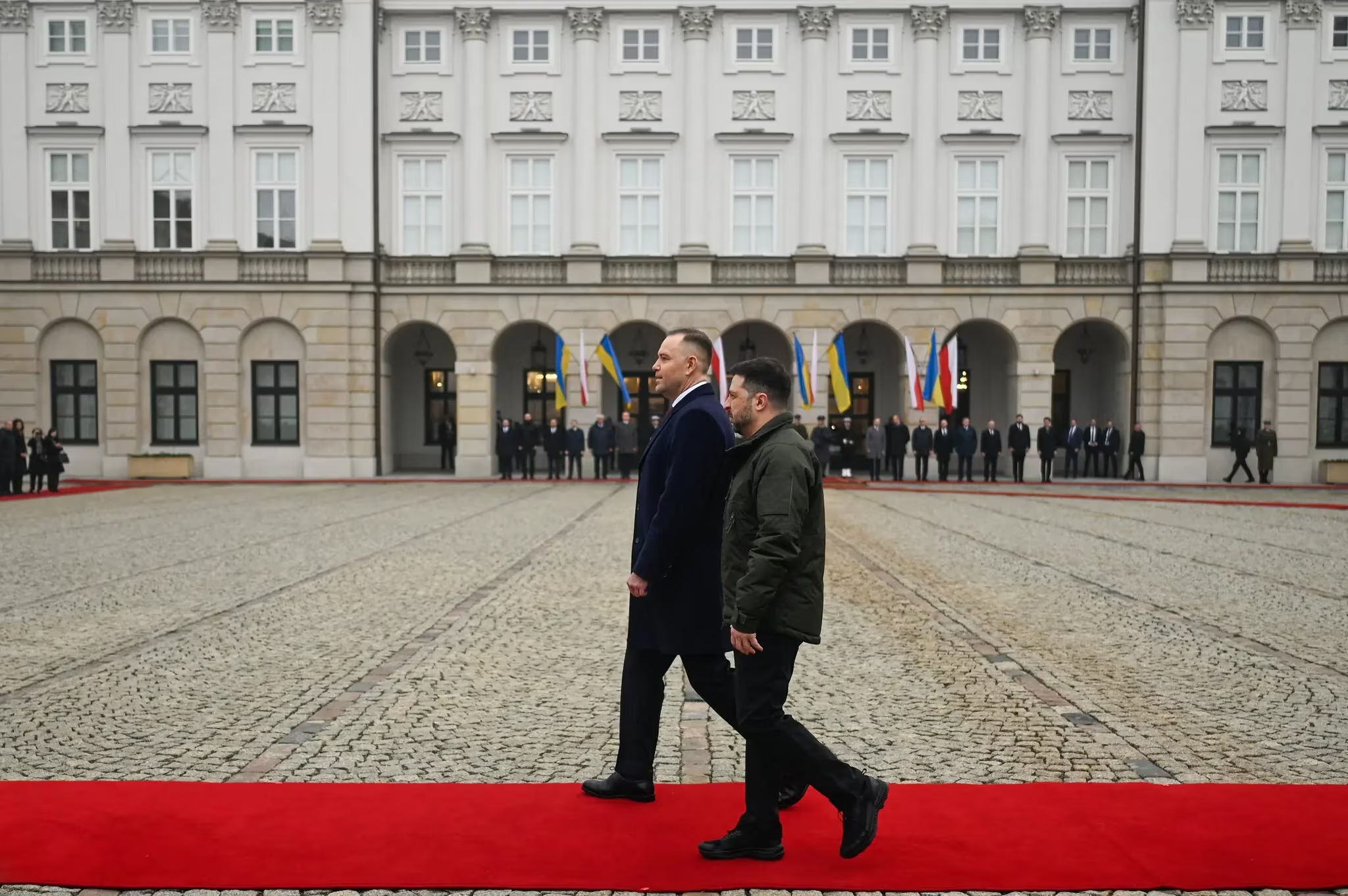
In late September 2025, Karol Nawrocki, who won Poland’s presidential election with the backing of the conservative Law and Justice party, threatened to strip Volodymyr Zelensky of the Order of the White Eagle—the highest state honor, awarded to the Ukrainian leader in the first year of the full-scale war as a symbol of alliance. The trigger was Kyiv’s decision to name one of the units of the Armed Forces of Ukraine after the “heroes of the UPA”—an organization associated in Poland with the Volhynia massacre of 1943. In response, Zelensky returned the award to Warsaw.
Behind the diplomatic demarche, many saw only another turn in the historical dispute between the two countries. But the conflict around the order is only the surface layer. Beneath it lies a far more fundamental divergence of interests, one that will fully reveal itself after the war.
Since Friday, June 19, relations between Kyiv and Warsaw have sharply deteriorated. Poland’s president, as he had previously promised, stripped Volodymyr Zelensky of the country’s highest honor—the Order of the White Eagle. In response, Zelensky sent the award back to Warsaw. All former presidents of Ukraine who had previously received the order also renounced it.
Ukrainian Foreign Minister Andriy Sybiha said Kyiv would no longer leave unfriendly actions by the Polish authorities unanswered.
“No president of another state will dictate our history to us anymore. We will mirror every step, especially if those steps are unfriendly and dismissive toward our country. The time of looking away has passed,” Sybiha said.
The formal trigger for the conflict is known: Zelensky named one of the units of the Armed Forces of Ukraine after the “heroes of the UPA.” In Warsaw, the UPA is regarded as an organization responsible for the genocide of Poles during the Volhynia massacre of 1943, and Polish President Karol Nawrocki demanded that the decision be reversed. He was supported even by his political opponent—Prime Minister Donald Tusk. Zelensky refused, after which he was stripped of the Polish award.
Many commentators reduce the conflict almost entirely to the historical dispute over the role of the UPA and OUN, as well as to politicians’ desire to score points domestically on the issue of defending historical memory. Against this backdrop, the intensity of the confrontation seems excessive, and assessments often include the idea that during the war Kyiv and Warsaw should avoid disputes that play into Moscow’s hands.
The real reasons for the disagreement, however, are much broader than the dispute over the UPA or competition over historical memory. In the pan-European context—especially given the prospect of Ukraine joining the EU—Poland and Ukraine are not only allies, but also direct competitors.
Over the past 20 years, Warsaw has done considerable work to secure for itself the status of regional leader among the eastern European countries of the EU and, on that basis, to claim the role of one of the European Union’s key states. Rapid economic development and industrial growth strengthened these ambitions. Warsaw began to aspire not merely to the role of a regional center, but also to the possibility of eventually challenging Germany’s position as the EU’s main industrial engine. Hence the tense relations with Berlin, especially visible during the rule of Jarosław Kaczyński’s Law and Justice party, and even today they can hardly be called simple.
It was in this logic that Warsaw also viewed Ukraine’s European integration—Kyiv was seen more as a ward: a source of labor, a market for Polish goods and a factor capable of strengthening Poland’s position inside the European Union. Over time, however, it became clear that Kyiv saw its place in Europe differently. Ukrainian authorities built direct relations with Berlin, London and Paris, often bypassing Warsaw. The war accelerated this process. Ukraine’s growing importance to Europe also strengthened Zelensky’s ambitions: Kyiv began to claim the role of a new regional leader of Eastern Europe—in close cooperation with Germany and France, in a configuration in which Poland risked being pushed to the periphery.
Warsaw is now speaking openly about this anxiety. A telling example was Tusk’s recent dissatisfaction that Ukraine, Germany, France and Britain had, according to him, been involved in drafting a strategy to end the war and negotiate with Russia without Poland’s participation. “Poland will not accept any agreements that are developed without its involvement,” the Polish prime minister said. For many, this sharpness looked unexpected, but in the context of the struggle for influence it is entirely logical.
The same motive had sounded earlier. The first serious signal was the 2023–2024 conflict over supplies of Ukrainian agricultural products, a ban on which Polish farmers demanded. The dispute showed that after the end of the war and Ukraine’s accession to the EU, Kyiv could become Warsaw’s competitor in several areas at once—agriculture, attracting investment, the distribution of subsidies from the European Union’s limited budget and the labor market.
The current scandal over the UPA fits the same logic. Warsaw is showing that it remains the central force in the eastern European part of the EU and that Ukrainian authorities must take this into account. But unlike previous flare-ups, when Kyiv tried to smooth over the conflict and avoid direct confrontation, this time a reciprocal demarche followed. Ukrainian authorities decided to demonstrate that they, too, are prepared to act firmly and respond step for step—the refusal of the order and Sybiha’s statement were precisely such a signal.
For now, the conflict continues to grow. Where could it lead?
For now, it is unlikely that Poland will become a “second Hungary” for Ukraine from the Viktor Orbán era—that is, that it will begin systematically blocking all military and economic support for Kyiv. As long as the government is controlled by the liberal Donald Tusk, such a scenario does not look the most realistic. An exception could be the reduction of individual support programs, such as the training of Ukrainian troops.
Still, further deterioration in relations cannot be ruled out entirely. Troubling signals for Kyiv are already coming from Warsaw. Recently, for example, reports emerged that Poland wanted to block the allocation of money to Ukraine from the European Peace Facility for the purchase of weapons until it is compensated for military assistance already provided to the Ukrainian army.
The most serious problems, however, are likely to arise during negotiations on Ukraine’s accession to the EU. It is here that Warsaw will be able to create maximum difficulties for Kyiv, putting forward tough demands on economic and other concessions—with the aim of preventing Ukraine from turning into a dangerous competitor inside the European Union. The historical issue of the OUN and UPA will almost certainly be raised: Nawrocki has already outlined his position—“with Bandera and the UPA, Ukraine will not get into the EU.” Kyiv will most likely respond with its own anti-Polish campaign.
As long as the war continues, the main attention of the Ukrainian authorities is focused on other issues. But after it ends, the Ukrainian-Polish confrontation could become one of the key themes of European politics.
Zelensky Stripped of Poland’s Highest Honor—the Order of the White Eagle
The Past as a Tool of the Present
Lech Wałęsa Removed the Ukrainian Flag From His Jacket and Withdrew Support for Zelensky After the Reburial of OUN Leader Melnyk
Kyiv Agrees to Restore Hungarian Schools and Expand Rights for the Hungarian Minority—Hungary Will in Return Support the First Stage of Ukraine’s EU Accession Talks