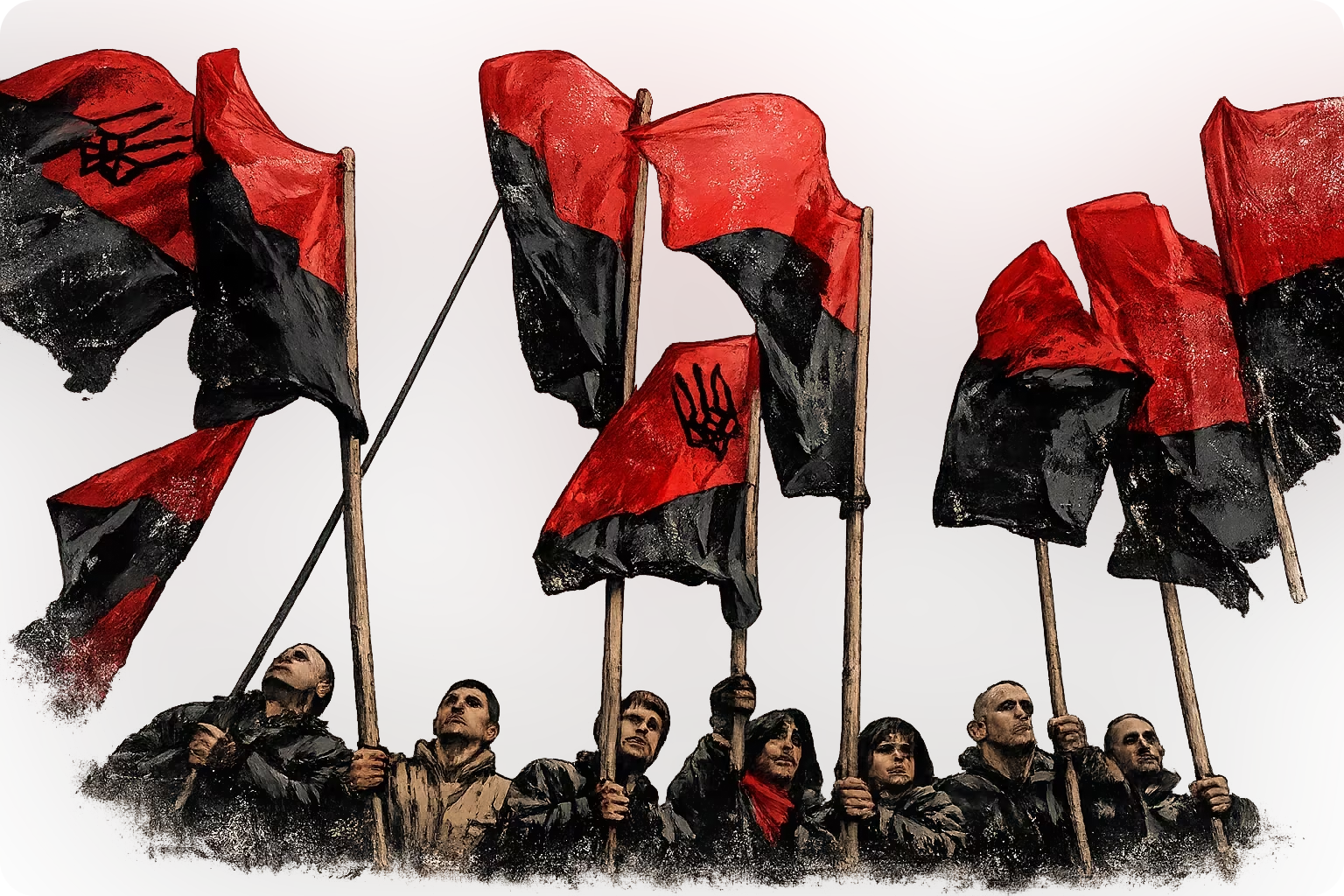
The glorification of the Organization of Ukrainian Nationalists and the Ukrainian Insurgent Army in modern Ukraine is not a grassroots movement of enthusiasts or a regional anomaly. It is state policy, formalized by law, backed by bureaucracy and assigned to a separate executive body.
The starting point was April 2015. In two days, the Verkhovna Rada passed a package of four decommunization laws prepared by the Ukrainian Institute of National Memory. One of them regulated how the OUN and UPA were presented in public space and granted them the status of fighters for Ukraine’s independence. The laws passed despite criticism—both international and domestic: a group of Western historians led by David Marples appealed to Poroshenko and Groysman to bring the provisions into line with European human-rights law. The president signed the package on May 15, 2015.
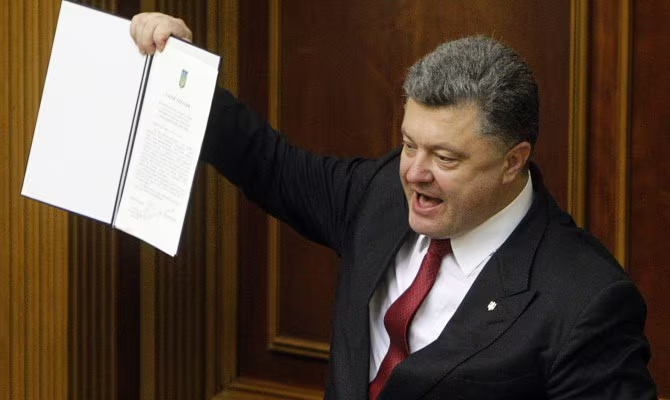
The laws signed by Poroshenko had previously been approved by the Verkhovna Rada.
The engine of this policy was the Ukrainian Institute of National Memory—a central executive body under the Cabinet of Ministers. Its longtime ideologue was the historian Volodymyr Viatrovych, whose position the academic community assesses unambiguously: he systematically downplays the involvement of Ukrainian nationalists in crimes against Jews and Poles during World War II. This is not a Russian characterization, but a consensus in Western historiography, recorded in open letters and peer-reviewed publications.
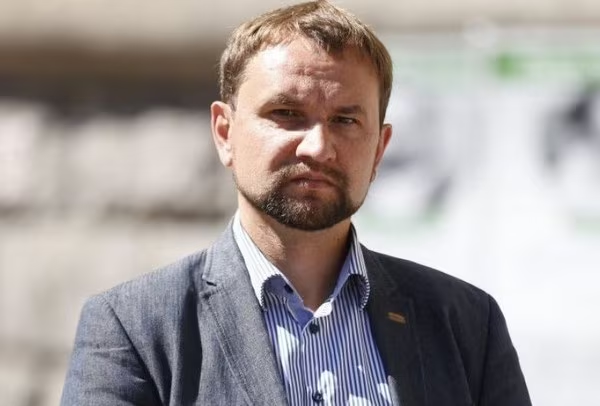
Volodymyr Viatrovych.
After 2022, the official narrative of the national-liberation struggle intensified. Russia’s full-scale invasion gave state memory policy new legitimacy and a new scale: from targeted decommunization, Ukraine moved to what researchers call decolonization—a systematic separation from imperial and Soviet heritage.
Public support followed state policy and reached historic highs after 2022. Positive attitudes toward Stepan Bandera rose from 22 percent in 2012 to 74 percent in 2022, with support today prevailing both in southeastern regions and among those who speak Russian in everyday life. According to polls from early 2026, about 83 percent view Bandera positively, and 67 percent view Roman Shukhevych positively. The state is preparing a law on a National Pantheon and is carrying out reburials of national heroes.
Russian propaganda presents Ukrainian memory policy as a single monolith—“the glorification of Nazi collaborators.” This simplification is inaccurate. Within the Ukrainian pantheon are structures with different histories and different official statuses.
The first is the UPA. The insurgent army, which emerged in 1942 from the radical wing of the OUN, fought on several fronts by the end of the war, including against the Germans. It is responsible for the Volhynia massacre—the ethnic cleansing of the Polish population. It is the UPA that the Ukrainian state officially recognized, by the 2015 law, as a participant in the struggle for independence. This is the state level of memorialization.
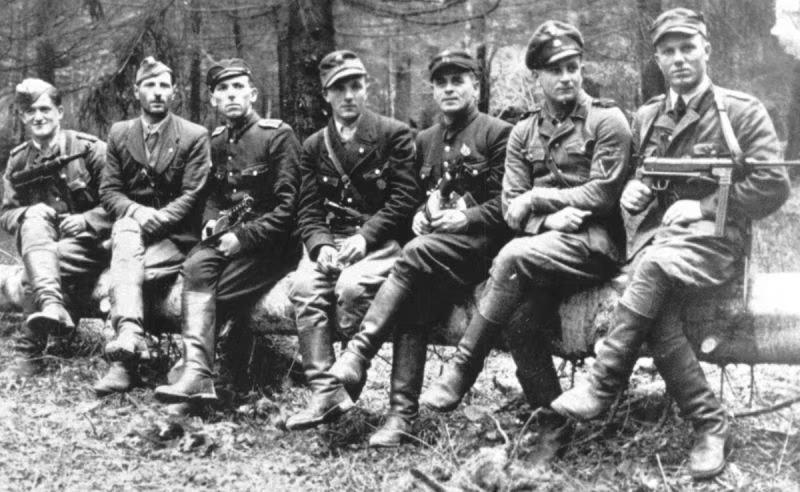
A group portrait of the UPA.
The second is the SS “Galicia” Division. Not insurgents and not an underground movement. Formed in the spring of 1943 as the 14th Waffen-SS Grenadier Division, it was under direct German command and was part of Nazi Germany’s SS troops. The distinction from the UPA is categorical: an armed nationalist underground with its own agenda is one thing; a regular unit within the SS structure is another.
At the state level, Ukraine has historically distanced itself from “Galicia.” When deputies in Ivano-Frankivsk tried in 2005 to rehabilitate local veterans of the division, this provoked a fierce dispute, and Viktor Yushchenko’s Our Ukraine bloc—even though Yushchenko was considered a nationalist politician—publicly distanced itself from the attempt to honor an SS unit. Commemorations of “Galicia”—April 28 marches in Lviv that have been held since the 1990s, local exhibitions and greetings—are a regional, primarily Galician cult, not a nationwide policy. The UPA is a state pantheon with majority support. “Galicia” is regional memory around which there is no consensus even within Ukraine’s national camp.
In practice, the boundary between these levels is not guarded by the state itself. Symbolism and rhetoric referring to World War II periodically reach the institutional level, while the state itself from time to time raises UPA figures to the highest level of official recognition. The most recent example is a presidential decree from May 2026 assigning a military unit the honorary title “named after the Heroes of the UPA,” which triggered a direct diplomatic crisis with Poland.
On May 26, 2026, President Volodymyr Zelensky signed Decree No. 440/2026. The Separate Special Operations Center “North” of the Special Operations Forces of the Armed Forces of Ukraine was given the honorary name “named after the Heroes of the UPA”—formally “with the aim of restoring the historical traditions of the national army.” Several days earlier, Zelensky had personally taken part in the reburial of one of the leaders of the OUN, Andriy Melnyk.
Warsaw’s reaction was swift. Poland’s Foreign Ministry condemned the naming. President Karol Nawrocki initiated, in the chapter of the Order of the White Eagle—Poland’s oldest and highest state honor—the question of stripping Zelensky of the order, which had been awarded to him by President Andrzej Duda on April 5, 2023. The chapter’s meeting was scheduled for June 8. By mid-June, the final decision remained postponed: according to Poland’s Rzeczpospolita, Nawrocki took a deliberate pause, while Prime Minister Donald Tusk urged the parties to seek a compromise.
Nawrocki called Zelensky’s decision a political mistake and said that by naming the unit after the UPA, the Ukrainian leader had handed Russian propaganda excellent material. Even the sharpest Polish critic describes this not as a “revival of Nazism,” but as a double cost: Ukraine is simultaneously offending Poland and supplying Moscow with arguments.
For Poland, the abbreviation UPA stands for something concrete. In 1943–1945, in Volhynia and Eastern Galicia, Ukrainian insurgents killed tens of thousands of Poles—historians’ estimates range from 40,000 to 80,000. In 2016, the Polish Sejm officially recognized the Volhynia massacre as genocide of the Polish people. In 2025, July 11—the anniversary of the beginning of the massacre—was declared a state day of remembrance in Poland.
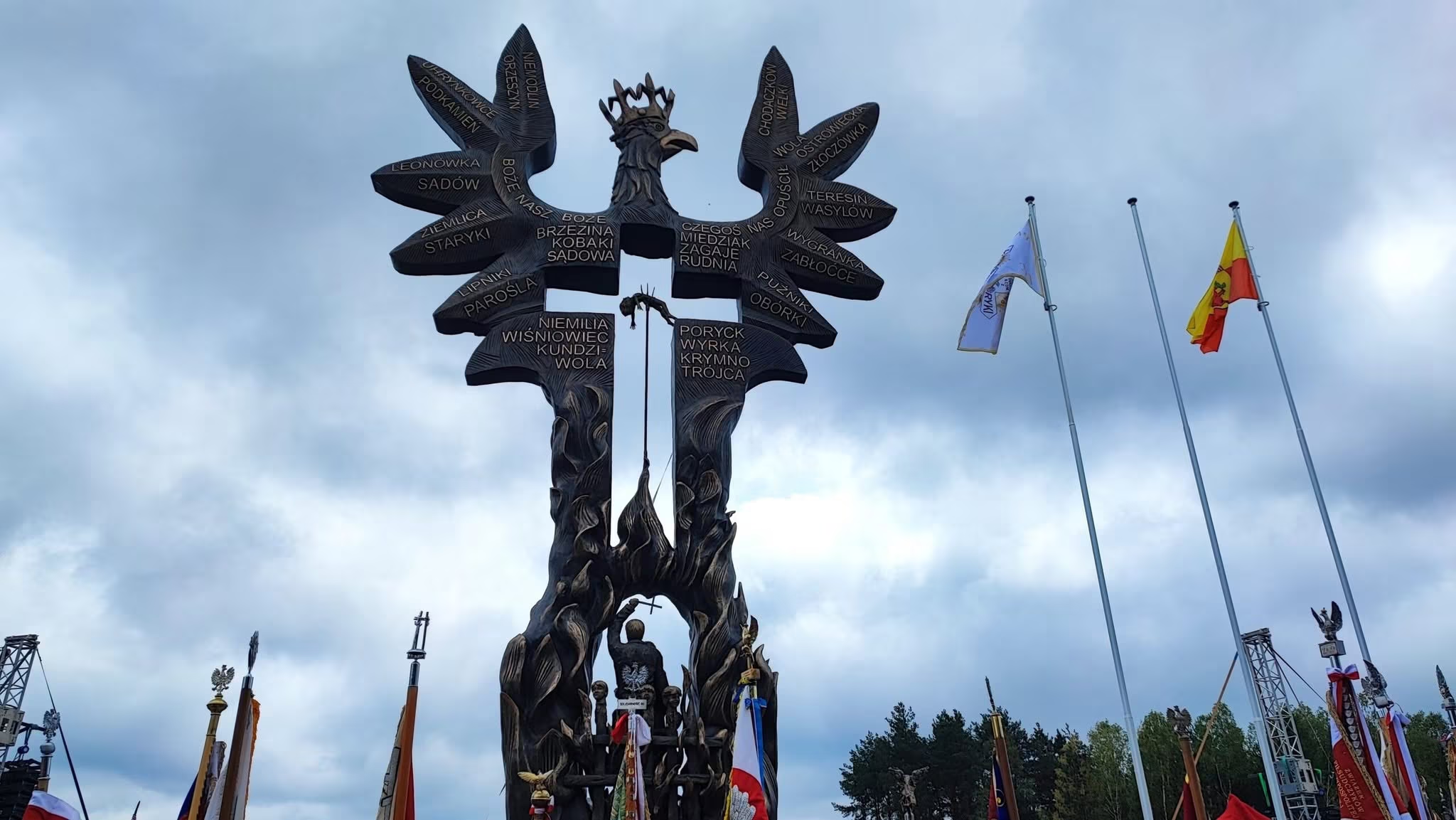
A memorial to the victims of Volhynia.
In recent years, the issue had been moving toward de-escalation. Since 2017, Ukraine had maintained a moratorium on the search for and exhumation of the remains of Polish victims of Volhynia. At the end of November 2024, the moratorium was lifted—foreign ministers Sikorski and Sybiha adopted a joint statement in which Ukraine confirmed that there were no obstacles to exhumation work. In the spring of 2025, the first exhumation took place in the village of Puzhnyky in Ternopil region, where the remains of 42 people were found. At the end of 2025, Ukraine issued new permits, and work continues in 2026. The claim that “Kyiv is blocking the memory of Volhynia” is inaccurate by 2026—there was cooperation on exhumations.
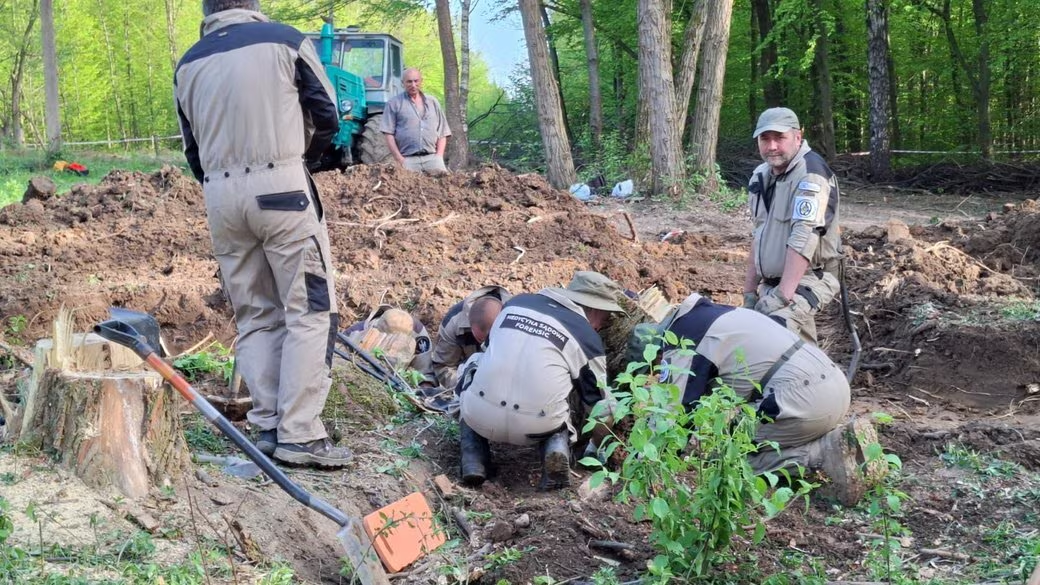
The exhumation in Puzhnyky.
In parallel with practical concessions on exhumations, the state is making symbolic gestures in the opposite direction—the UPA naming, Melnyk’s reburial—that wipe out the accumulated political capital of reconciliation.
Poland is Ukraine’s key logistical and political ally in the EU and NATO, the main corridor for Western aid. Poland has directly linked history to European integration: in July 2024, Defense Minister Władysław Kosiniak-Kamysz said that Warsaw would not be able to agree to Ukraine’s accession to the EU until the countries close the dispute over Volhynia. The glorification of the UPA affects not abstract relations, but Ukraine’s European vector.
Poland is not the only ally for which Ukrainian memory policy creates costs. The problem emerges wherever a regional or diaspora cult comes into contact with Western audiences unfamiliar with the distinctions inside Ukraine between the UPA and the SS division.
The loudest episode occurred in Canada in September 2023. On September 22, during Zelensky’s visit, the Ukrainian president addressed the House of Commons, and immediately afterward the speaker of parliament, Anthony Rota, introduced 98-year-old Yaroslav Hunka to lawmakers—as a veteran who had fought for the “First Ukrainian Division” against the Russians. The chamber, including Zelensky and Prime Minister Justin Trudeau, rose and gave a standing ovation.
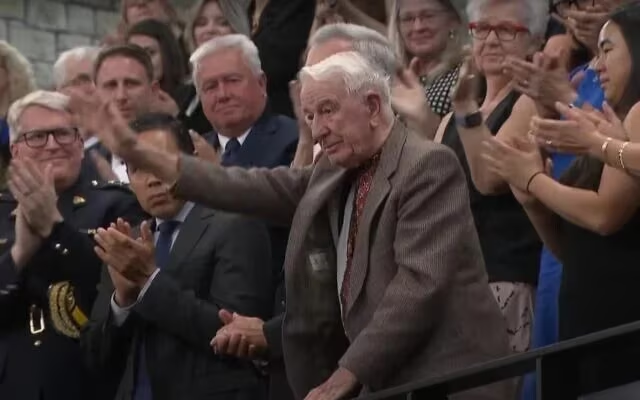
Yaroslav Hunka, a veteran of the SS “Galicia” Division, receives an ovation in Canada’s House of Commons in Ottawa. September 22, 2023.
Over the weekend, it emerged that the “First Ukrainian Division” was another name for the Waffen-SS “Galicia” Division, the 14th SS Grenadier Division under German command. The reaction came from within the Western establishment, not from Moscow. Canadian Foreign Minister Mélanie Joly called the invitation absolutely unacceptable. Canadian and Polish Jewish organizations demanded explanations. On September 26–27, Speaker Rota resigned, apologizing to Jewish communities in Canada and around the world and to Holocaust survivors in Poland. Poland’s education minister said he would seek Hunka’s extradition.
The Ukrainian side did not organize the invitation. Hunka was a constituent from the speaker’s district who had long lived in Canada, and Rota invited him personally, without informing either the government or the Ukrainian delegation. This removes direct responsibility from Kyiv for that specific incident. The status of “veteran for independence” that existed in the diaspora for decades is instantly rejected as soon as it comes into contact with a Western institution. A boundary blurred inside the Ukrainian narrative is guarded firmly in the West.
The Canadian episode is not unique. In 2021, Germany protested to Ukraine over a march in central Kyiv on the anniversary of the creation of the SS “Galicia” Division. In April 2025, an exhibition that included photographs of the same division opened at the Baltic Defence College in Tartu—an educational institution accredited by NATO. Symbols and figures normalized within part of Ukraine’s public space remain toxic for the allies on whose support Ukraine’s defense depends.
Why should the state bear these costs? If the glorification of the UPA complicates relations with a key EU ally, affects European integration and regularly creates grounds for scandals in the West—why does Kyiv not abandon it, but intensify it?
The answer in academic literature is reducible neither to the Russian version (“the revival of Nazism”) nor to simple populism. Ukraine’s historical policy is an instrument of state-building with a specific, openly declared function: separation from Russia.
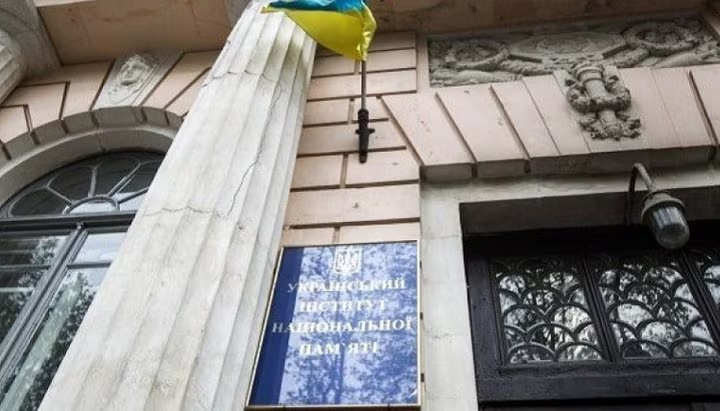
The building of the Ukrainian Institute of National Memory.
Researchers describe the evolution of this policy as a movement from the decommunization of 2015 to a broader decolonization after 2022. In an article published in Global Studies Quarterly at the end of 2025, the process is defined as the “securitization of memory”—the use of historical narratives as an instrument of state resilience and diplomacy. The Ukrainian Institute of National Memory, in the authors’ assessment, reformatted decommunization by presenting Ukraine not as a state moving away from the Soviet past, but as a country actively resisting Russian colonialism. The stated aim of the decolonization of memory is to sever cultural and historical ties between Ukraine and Russia so that new generations do not perceive Ukrainians and Russians as “brotherly peoples.”
In this logic, the glorification of the OUN-UPA is not irrational. These figures are valuable to the state narrative because they are anti-Russian and anti-Soviet: they provide an anchor for a national identity built outside the Russian historical frame. The more painful their image is for Moscow, the higher their functional value for Kyiv. The very fact that Russia uses them for its propaganda increases their symbolic weight within Ukrainian memory policy.
The same instrument that distances Ukraine from Moscow also distances it from Warsaw. Figures valuable for their anti-Russian character are, for Poland, executioners, and for Western audiences—collaborators of Nazi Germany. A state that strategically needs maximum support from the EU and NATO is spending part of that support on a historical policy whose task is a break with Russia. The priority of separation is placed above the cost in relations with allies.
The cost has not gone unnoticed within Ukraine’s expert field or among Western historians sympathetic to Ukraine. Per Anders Rudling, one of the leading researchers of Ukrainian nationalism and a consistent critic of the mythologization of the OUN-UPA, also shows how the rehabilitation of these structures is used by Russia to justify its aggressive war. The glorification is both problematic from the standpoint of historical truth and useful to the Kremlin. Sharp Polish critics point to the same thing: Zelensky’s decision on the UPA name, in Nawrocki’s words, gave Russian propaganda material.
The state is expanding the memorialization of figures whose past creates documented costs in relations with the allies on whose help it relies in the war. It is doing so under conditions in which historical policy is subordinated to a strategic priority—a break with Russia. The price of this is concrete and measurable: from linking Volhynia to European integration to the threat of stripping the president of Poland’s highest honor.