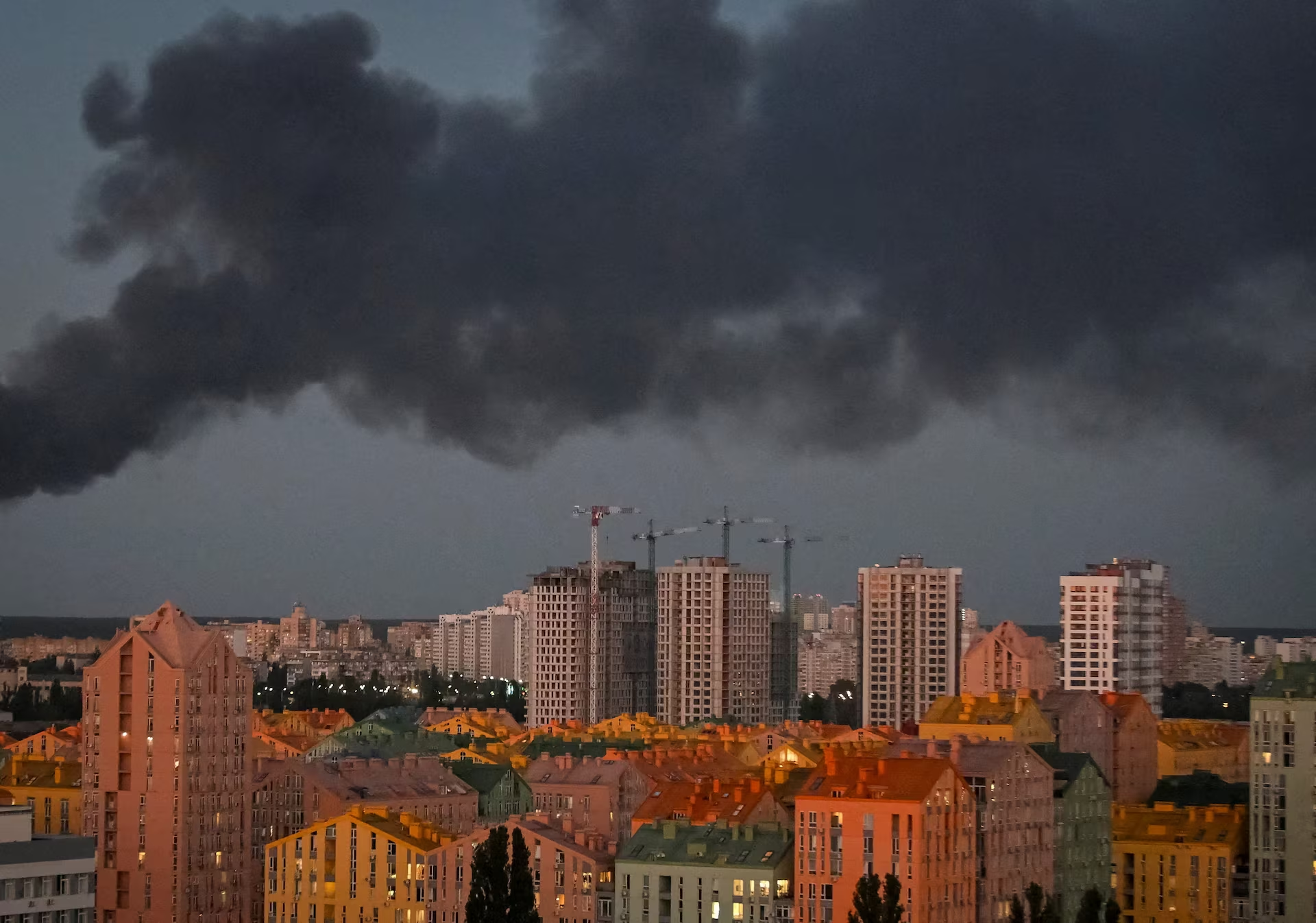
On the night of July 11, Kyiv residents woke to explosions. The air-raid siren sounded later—after six ballistic missiles launched from Russia’s Bryansk region had already reached their targets. In the morning, Ukraine’s Air Force issued a terse report: two air-launched missiles and 111 drones out of 121 had been intercepted. As for the ballistic missiles, the statement confirmed what the entire city already knew—not a single interception. It was the second consecutive night that explosions in the capital came before the warning sirens. And the first morning when citizens were told that this is how things will be from now on.
To understand what has changed, it is worth starting not with emotions, but with the calendar. On the night of July 6, Russia launched 23 Iskander-M/S-400 ballistic missiles and six Zircon/Oniks anti-ship missiles at Ukraine—not one was intercepted. On the night of July 8, there were five ballistic missiles, with the same result. On the night of July 11, there were six, and again zero. Three mass attacks in one week, 34 ballistic targets, not a single interception. Defense Ministry adviser Serhii Beskrestnov summed up the situation with a candor rare for an official: Ukraine has nothing capable of intercepting Russian ballistic missiles, and that is no secret. Air Force spokesman Yurii Ihnat calls deliveries of Patriot interceptor missiles “the number one issue,” and until then, the only guarantee of safety is shelter and reinforced concrete.
The physics is merciless and leaves no room for argument. An S-400 missile launched on a ballistic trajectory from Russia’s border regions reaches Kharkiv in about 47 seconds and Kyiv in just a few minutes. Radar detection, target classification, decision-making, command, the siren—for the entire chain, there is almost no time. Yet there is one detail that prevents the discussion from ending with an appeal to the laws of ballistics. General Ihor Romanenko was asked whether the delayed alerts were linked to launches being moved closer to the border. No, he replied—quite the opposite, launches from nearby are detected more quickly. “The reason is generally understood, but I cannot disclose it yet.” The state, then, knows why the siren remains silent. Citizens are simply not meant to know.
On the morning of July 11, the country woke up arguing—and the argument is worth reproducing almost verbatim because it reveals the outline of something larger than a debate about a single night. “Ballistic missiles over Kyiv again, and no alert. What kind of nightmare is this?” wrote some. “Ballistic missiles again without a warning... Kyiv, how are you holding up?” asked others. To some, even these questions seemed inappropriate: Kyiv residents were criticized in the comments for not knowing how to find information and for refusing to understand the differences between missile types. The response that followed is difficult to improve upon: “Sorry that people are afraid of dying and want to have at least ten minutes to run out of their homes.”
Member of Parliament Oleksandr Fediienko gave Kyiv residents a lengthy reply—and it deserves to be read carefully, because it contains something greater than a lesson on missile types. By 2026, he wrote, people should already clearly understand what a ballistic attack is: a missile reaches Kharkiv in 47 seconds and Kyiv in up to seven minutes. The capital was struck by S-400 missiles, the flight time is extremely short, and warning people in advance is “often impossible.” MPs who claim otherwise, he suggested, should volunteer at air-defense warning centers—“then you can press some additional button yourselves.” And he offered citizens the advice for which, in fact, this article is being written: “From now on, we must plan our lives on the assumption that missiles can arrive at any moment.” Everyone, the lawmaker added, chooses their own answer to the question of personal safety. Technically, everything he said is true. That is precisely why it is worth looking more closely at what is packaged inside that truth: by morning, a question that had belonged to the state had quietly become a question for the citizen.
It is worth dwelling on the phrase “everyone chooses for themselves.” It was delivered casually, almost as an aside, but it describes a far from ordinary shift. In the fifth year of the full-scale war, an unwritten register of mutual obligations exists between the Ukrainian state and the Ukrainian citizen. The citizen’s column has been steadily expanding. The citizen is obliged to fight—and if he does not go voluntarily, someone will come for him, and the methods by which that happens have long become a national controversy. The citizen is obliged not only to pay taxes but also to donate—those donations fund drones, vehicles, and equipment, things that taxes, at least in theory, are supposed to cover. The citizen is obliged to work so there is income to tax. The citizen is obliged not to panic, not to demoralize society with despair, and to refrain from excessive criticism, because these are wartime conditions.
The state’s column in that register has always been shorter, and the war has naturally shortened it further—the protection of Ukraine’s skies depends in part on decisions made in foreign capitals, and the shortage of Patriot missiles was not created in Kyiv. But one line remained intact through all four years, applying equally to everyone: the siren. The cheapest of the state’s obligations. Once a person heard it, they received a few precious minutes and could decide for themselves whether to run to a shelter or go back to sleep. Now citizens are being told that even this line is no guarantee, only a lottery, and that their safety is henceforth a matter of personal “choice.” The failure of a public function has quietly been rewritten as the failure of an individual who did not plan life responsibly enough. The logic is familiar: if you did not donate, you are complicit; if you did not report to the enlistment office, you are a draft dodger; if you did not make it to shelter in time, you chose that answer to the question of your own safety. In this construction, responsibility always flows in the same direction—downward, toward those with the fewest resources to bear it.
But let us assume a citizen decides to follow the MP’s advice literally. Planning life on the assumption that a missile can arrive at any moment is not a figure of speech—it is an instruction. So let us follow it. You cannot reach a shelter from the twenty-second floor in time—Fediienko himself acknowledges that—which means living or working above the third floor is out of the question. A school three minutes from the nearest shelter does not qualify: there are no three minutes, only 47 seconds. An office in a glass high-rise, a queue at a government service center, a shopping mall on a Saturday, a subway carriage during rush hour—well, no, the subway actually works, perhaps people should simply live there. What remains to be explained is how, under such planning, people are supposed to go to work, pay taxes, or send their children to school on September 1.
The trap is that the state absolutely cannot afford for citizens to follow this advice. A country at war depends on millions of people who wake up every morning and behave as though the missile will not arrive: they open cafés on the ground floor, sit in offices on the twentieth, take their children to school, and through their taxes pay, among other things, the salary of MP Fediienko himself. The siren was the mechanism that made this possible. It divided the day into dangerous time and ordinary time: fifteen minutes in a shelter in exchange for the right to live almost normally during the remaining hours. Remove that distinction, and every minute becomes dangerous. There are only two rational responses: paralysis or departure. Here the MP’s advice reaches a level of honesty that its author probably never intended: the only people who truly planned their lives around the idea that a missile could strike at any moment are the hundreds of thousands who left the country. They are routinely condemned for having made precisely that choice.
The opposition, naturally, saw something else in the events of July 11. A second consecutive attack without a warning, political opponents of the government argue, proves that tens of billions should not have been diverted from weapons procurement into public-relations projects, that funding should go to the best rather than to “their own people,” and that the authorities ought to focus on defense instead of ratings and elections. That is the framework of political struggle, and its budgetary arithmetic deserves the same caution as any other electoral arithmetic. Yet something else is more revealing: the debate over who is responsible for the silent siren is taking place among MPs, bloggers, and commenters—but not where it ought to be taking place. After three attacks, the Air Force has explained nothing to citizens beyond the numbers in its daily report. The general says he knows the reason but cannot disclose it. The MP suggests that his colleagues go press another button.
A state may genuinely be unable to intercept a ballistic missile—that is a tragedy, and responsibility for it is shared across many capitals. But a state cannot genuinely be unable to explain itself, apologize, and say: we know about the problem, and here is what we are doing. The inability to protect is a circumstance. Refusing to account for oneself is a choice. And when, instead of an explanation, citizens are told to reorganize their lives around the missile, they are entitled to ask what, exactly, remains on the other side of that register of mutual obligations.
The social contract in a country at war is a load-bearing structure, not a decorative one. It is the answer to the question of why people stay, pay, endure, and send their children to school beneath a sky that is not secure. Every line the state quietly erases from its own column is erased from that answer as well. The siren was inexpensive. Its silence will prove costly—and the accounting will not take place at warning centers, but in kitchens where people calculate how many seconds it takes to descend from the twenty-second floor.
Russia’s Night Attack on Kyiv Killed More Than 10 People
Reuters: Patriot Missiles for Ukraine Will Likely Be Produced in Germany
Russia Upgraded Missiles to Bypass Patriot
Ukraine Asked for a Sufficient Number of Patriot Air-Defence Systems Throughout the 44 Months of War (But Received Only a Handful)