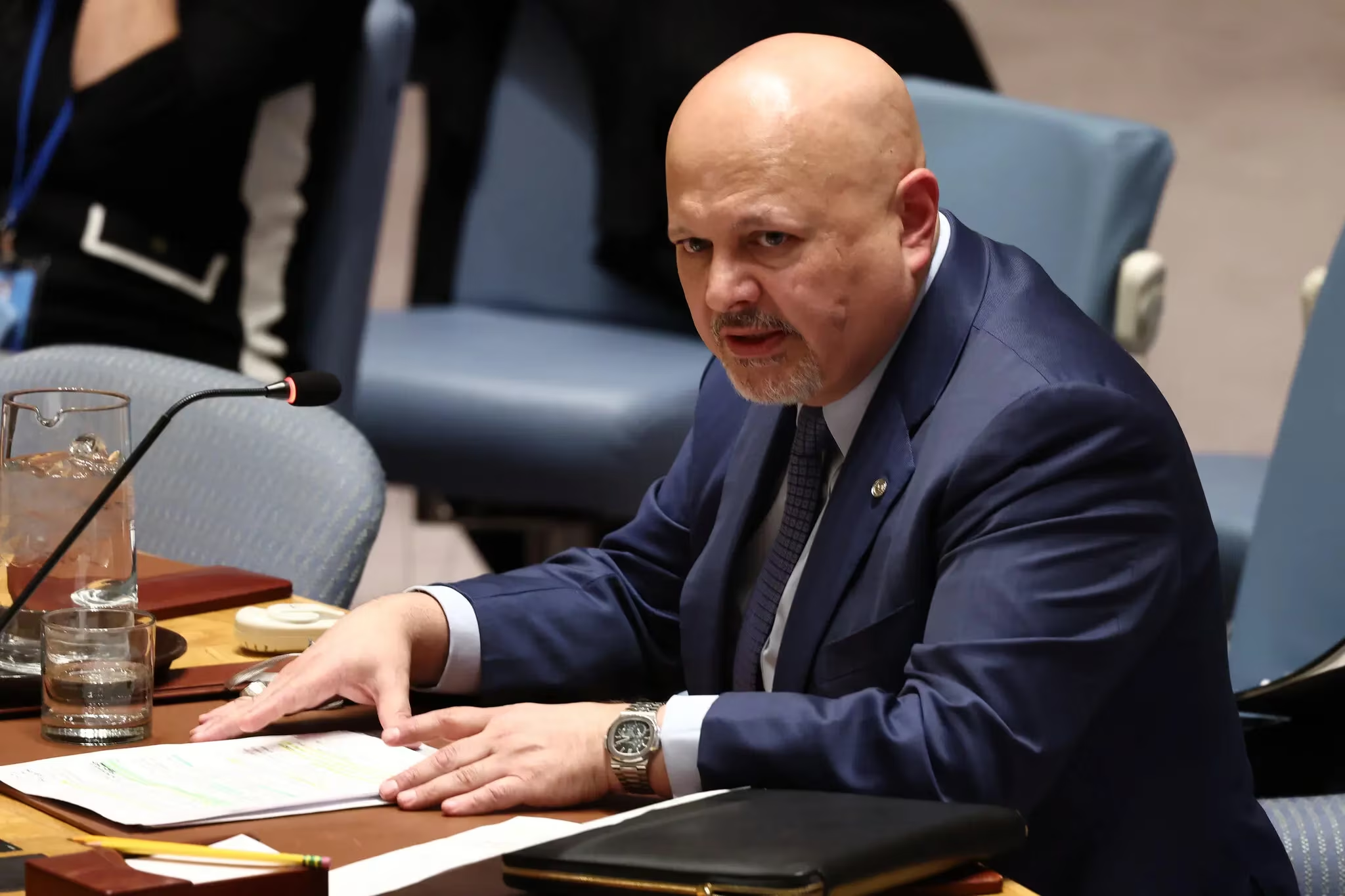
Member states of the International Criminal Court will discuss the possible removal of ICC chief prosecutor Karim Khan this month over allegations of sexual harassment, The New York Times writes.
The trigger was an internal court report reviewed by the newspaper. It says Khan abused his position by entering into a sexual relationship with a subordinate.
For the ICC, this is one of the most serious crises since its founding 24 years ago. It could further weaken the court, which is already under pressure from sanctions imposed by Donald Trump’s administration over investigations involving Israelis and Americans.
The confidential findings of the Bureau of the Assembly of States Parties—a 21-member executive body—were made after a lengthy investigation.
The bureau concluded that Khan committed sexual harassment by entering into a sexual relationship with a junior employee in his office. The report also says he later tried to persuade the complainant not to pursue the allegations against him.
The document says Khan never directly denied having a sexual relationship with the subordinate, despite being given 30 opportunities to do so. He told UN investigators that the “main question” for him was whether the complainant might have recordings compromising him.
When the case materials showed that no such recordings existed, his later denials, in the bureau’s assessment, were “devoid of credibility.”
After preparing its findings, the bureau earlier this month suspended Khan from his post while states parties consider possible disciplinary measures.
Khan’s lawyer, Dominic Garner, said the findings were “unlawful, procedurally unfair and unsupported by evidence.” According to him, Khan denied “each specific allegation of sexual interaction of any kind” in a conversation with a UN investigator.
An ICC representative did not immediately respond to a request for comment.
Khan’s removal would be an unprecedented step for the court. However, analysts and experts note that keeping him in office could seriously damage the ICC’s work and reputation.
“It is hard to see how Khan can continue in a job that requires total adherence to the truth if at least two-thirds of the bureau’s member states found his credibility to be completely undermined,” said Kenneth Roth, former executive director of Human Rights Watch.
The woman who filed the complaint told UN investigators that Khan’s sexual harassment gradually intensified.
At first, she said, it involved excessive familiarity during a work trip to London. Then, according to a summary of the UN investigation’s findings, there were episodes in his office in which he “grabbed and touched her breasts, tried to reach her pelvic area and kissed or sucked her ear or neck.”
Later, the woman said, the harassment escalated into unwanted sexual acts. She told investigators that because of the difference in status between them, she “could not say no.”
The disciplinary process began after the allegations became public in May 2024.
The UN Office of Internal Oversight Services investigated the allegations at the court’s request and prepared a brief report in February.
A panel of judges selected by the ICC bureau then reviewed the UN investigators’ report and prepared its own report in March. The New York Times writes that it has copies of both documents, as well as the bureau’s findings.
UN investigators found evidence that Khan had engaged in “nonconsensual sexual contact” with the complainant. However, the judicial panel unanimously decided that the evidence did not meet the “beyond reasonable doubt” standard needed to establish misconduct.
After that, the ICC bureau examined the UN report and the judges’ report and formulated its own findings.
The bureau concluded that the UN investigation had confirmed the complainant’s credibility and found no evidence that the allegations brought her personal or professional benefit. On the contrary, the report says the complaint against Khan caused her significant personal and professional harm.
The bureau found “beyond reasonable doubt” that the prosecutor had a sexual relationship with the complainant and that, given such an imbalance of power, the relationship “could never have been acceptable.”
In the bureau’s assessment, such a relationship caused “extreme harm” to the normal functioning of the court and ran counter to the requirements of Khan’s office. The ICC statute provides that the chief prosecutor must be a “person of high moral character.”
At the same time, the bureau did not make a finding on whether Khan retaliated against other court employees who reported possible sexual misconduct. The UN investigation said such indications had been found.
Khan’s lawyer said the bureau was unfairly basing its findings on a theory of “consensual sexual relations made unacceptable by a power imbalance,” because the complainant herself had described the relationship not as consensual but as nonconsensual.
On July 24, the full Assembly of States Parties to the ICC is due to vote on whether Khan will keep his post.
ICC Prosecutor Karim Khan, Who Sought Arrest Warrants for Putin and Netanyahu, Is Removed From Office
ICC Prosecutor Says He Faced Threats Over Israel Cases