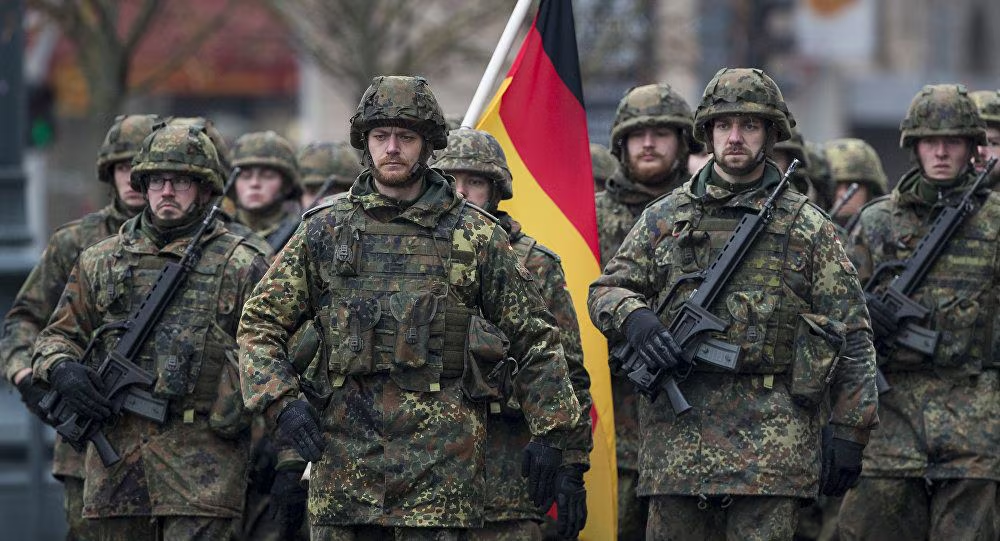
The government plans to increase the Bundeswehr’s strength to at least 260,000 troops by 2035. About 185,000 people currently serve in the German army.
The military buildup is linked to threats from Russia and uncertainty over future security guarantees from the United States.
In November, Berlin introduced a new model of voluntary military service that provides for the mandatory registration of 18-year-old men. The first results, however, have been weak: from January to May, the program attracted only 530 recruits, although the authorities contacted about 300,000 young people.
Thomas Röwekamp, head of the Bundestag’s defense committee, told AFP that if the voluntary model fails to meet the targets, Germany will have to return to conscription.
“We must make this decision by July 31 next year,” he said.
This would not mean universal conscription. If mandatory service is restored, of the roughly 350,000 men who turn 18 each year, the army would call up only the number needed to meet the annual plan.
Röwekamp said the army has an especially acute need for career and contract soldiers. They are needed to operate complex systems—fighter jets, ships, tanks and Patriot air-defense batteries.
The prospect of a return to conscription has already prompted several large protests in Germany. Mandatory military service in the country was suspended in 2011.
Röwekamp noted that the government is not discussing the real needs of defense sufficiently with the younger generation. He also repeated Berlin’s assessment that Russia may be capable of attacking a NATO country by 2029.
Against this backdrop, German lawmakers are advocating independent European rearmament. It is intended to reduce dependence on the United States in the event of a reduction in the American military presence under Donald Trump and amid broader doubts about Washington’s reliability during simultaneous international crises.
According to Röwekamp, the future development of European defense should be based on military needs, not on the interests of national industrial groups. As an example of the failure of the old model, he cited the FCAS fighter-jet project, which has effectively broken down because of rivalry between Dassault and Airbus.
Berlin hopes the NATO summit on July 7–8 in Ankara will allow the alliance to demonstrate unity. It will take place after the recent G7 meeting in France, where Trump outlined a tougher position toward Moscow.
Röwekamp said one of Vladimir Putin’s main goals is to split NATO’s defense alliance. For that reason, he said, it is important for European allies to show a shared readiness to act together.
Germany Postpones the Return of Military Service
Germany Deploys Troops Near Belarusian Border to Deter Russia
Germany Adopts a Military Strategy for the First Time in Its History—Russia Is Named Europe's Main Threat
The U.S. Plans to Sharply Reduce Its Military Contribution to NATO—Fighter Jets, Bombers, Ships and Submarines