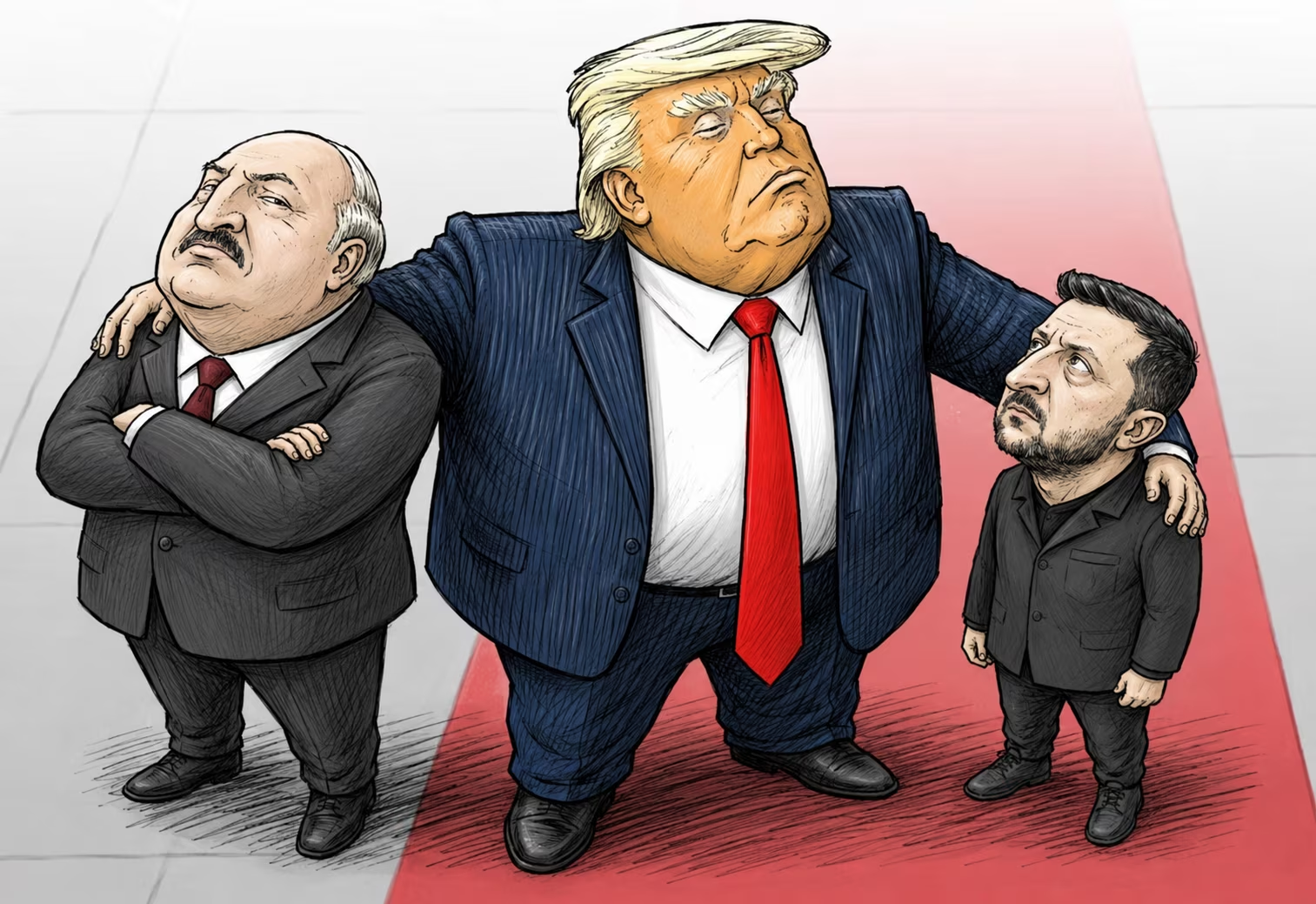
On May 26 in Kyiv, during a summit of 24 countries, Volodymyr Zelensky shook hands with Sviatlana Tsikhanouskaya—the challenger to Alexander Lukashenko in Belarus’ 2020 presidential election. He accompanied the gesture with a remark that sounded almost mocking: Lukashenko, he said, had recently suggested that the presidents of Ukraine and Belarus should meet—“Lukashenko said it, but Tsikhanouskaya came instead.” The next day, May 27, Zelensky sent Donald Trump a letter requesting additional air defense systems and interceptors and almost immediately received a public rebuke from Congresswoman Anna Paulina Luna: “You are delaying the peace deal, Volodymyr.”
Zelensky is now running parallel pressure campaigns against both Minsk and Washington. The paradox is that neither side is fighting Ukraine more aggressively today than a month ago. What changed is something else: Minsk and Washington have started talking to each other.
The US-Belarus thaw is the central story behind all of this. In December 2025, Minsk released 123 political prisoners, including Nobel laureate Ales Bialiatski and opposition figure Maria Kolesnikova, in exchange for sanctions relief on the potash sector. In March 2026, another 250 followed. After talks with Lukashenko in Minsk, Trump envoy John Cole openly described the goal as normalization of relations. According to him, if the roughly 1,000 remaining prisoners are released, the rest of the sanctions could also disappear, and a Lukashenko visit to the United States is being discussed in the longer term.
For Washington, it is a relatively cheap lever: a humanitarian result combined with an attempt to pull Minsk at least slightly away from total dependence on Moscow. For Kyiv, it is a strategic problem.
Since 2022, Belarus has been treated by Ukrainian diplomacy as a co-aggressor. Russian forces attacked Kyiv from Belarusian territory, and Russian tactical nuclear weapons are now stationed there. As long as Minsk remains internationally isolated, that framework functions without difficulty. But Washington’s rehabilitation of Lukashenko breaks it apart: the co-aggressor becomes a country with which the United States is “normalizing relations.”
Hence Kyiv’s three countermoves—which may appear disconnected from the outside but in reality target the same issue.
The first move is the northern threat. In early May, Zelensky repeatedly warned about preparations for a new offensive on Kyiv from Belarusian territory, ordered additional pressure on Minsk, and did not rule out a preemptive strike against the “de facto leadership of Belarus.” The problem is that even Ukrainian military officials do not confirm the alarm. Ukraine’s State Border Guard Service reports mining operations and fortification construction along the border, but not troop movements or preparations for an attack. Part of the Ukrainian command and independent analysts consider a large offensive from Belarus unlikely—Russia simply lacks the available forces, with its troops tied down in the east and south. Military officials note that the real signal of danger would be the formation of major strike groupings, and so far there is no evidence of that.
The second move is Tsikhanouskaya instead of Lukashenko. Her reception in Kyiv on May 26 was not a matter of diplomatic courtesy. Lukashenko had publicly proposed a presidential meeting, which for him would have been a step toward legitimacy precisely as relations with Washington were warming. Zelensky responded by deliberately elevating the status of the opposition: for the first time, Kyiv officially hosted the self-appointed head of Belarus’ United Transitional Cabinet and discussed opening her representative office in the Ukrainian capital. In effect, this was a refusal to recognize Lukashenko as someone worth negotiating with at all.
The third move is sanctions. After meeting Tsikhanouskaya, Ukrainian Foreign Minister Andrii Sybiha stated openly that Ukraine opposes easing sanctions on Belaruskali. In other words, Kyiv officially opposes the very deal on which the entire US-Belarus track currently rests.
At the same time, Zelensky is redefining America’s role. Formally, the issue is air defense. After Sunday’s massive strike—when Ukraine intercepted only 11 out of 30 ballistic missiles and Russia also launched two Oreshnik missiles—he appealed to Trump for additional interceptors and linked ballistic defense to the very possibility of negotiations: as long as Russia relies on missile attacks, he argues, its interest in diplomacy is not genuine. That is legitimate wartime lobbying.
But within the broader narrative, it is framed differently—as evidence of Washington’s passivity, unwilling to provide either sufficient weapons or new sanctions. The context reinforces the effect. Trump is pushing in the opposite direction: imposing deadlines on Kyiv to accept a peace plan while linking them to weapons deliveries and intelligence sharing, as Republicans such as Luna call for ending funding altogether. For Zelensky, Washington’s reluctance to increase pressure on Moscow and its readiness to strike deals with Minsk are part of the same picture: the United States is stepping away from its role as guarantor of a maximalist strategy.
That leads to the core strategic bet. Zelensky wants the outcome of the war to be decided in Europe, not in a Washington-Minsk-Moscow triangle. Europe supports his line; Washington negotiates. Entrenching the principle that “Europe decides” means preserving maximal conditions for Kyiv while preventing Belarus from re-entering Western diplomacy.
The irony is that Europe still finances the Russian war effort. The United States banned imports of Russian oil and gas back in 2022. The EU is only gradually phasing them out: in 2025, Russian gas still accounted for around 13 percent of the bloc’s imports—more than €15 billion a year—and a full ban has been postponed until the end of 2027, with Hungary and Slovakia continuing to defend Russian supplies. Washington, which Kyiv accuses of passivity, no longer pays Russia. Brussels, on which Kyiv is placing its bet, still does.
None of this means Kyiv’s concerns are entirely manufactured. Belarus remains a Russian satellite hosting Russian nuclear weapons, and caution along the northern border is justified. Tsikhanouskaya’s movement is a real democratic opposition, not a project invented in Kyiv. But the timing—the pressure on Minsk, the symbolic embrace of the opposition, resistance to the potash deal, and the reframing of America’s role—forms a coherent logic driven less by military danger than by diplomacy. Kyiv is trying to prevent two things at once: Belarus emerging from isolation and decision-making over the war shifting away from Europe.
A month of negotiations has not moved the front line. What has moved is the diplomacy surrounding it—and it is against those diplomatic shifts, not against tanks, that Zelensky is now fighting a two-front media war.