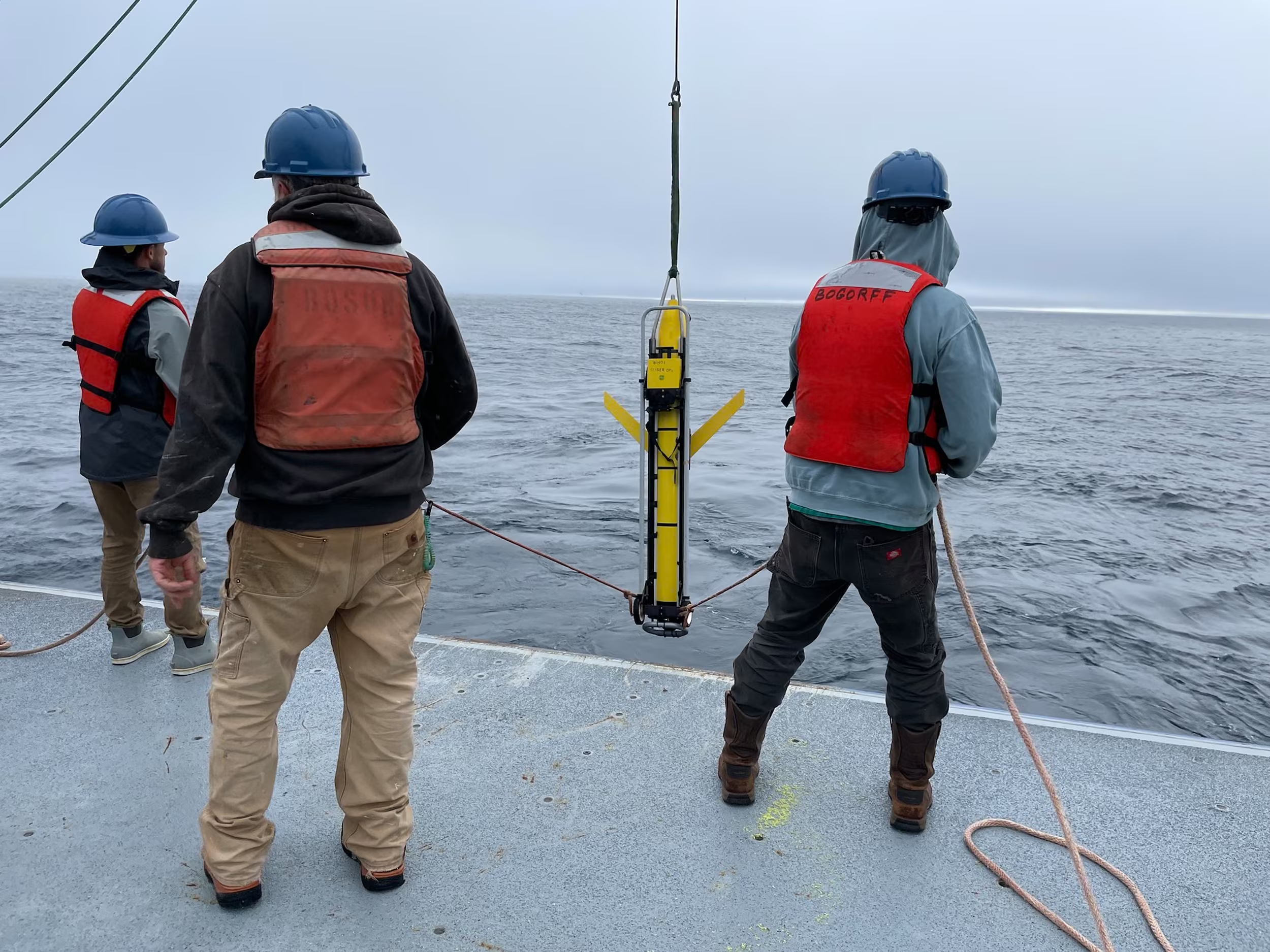
The Trump administration plans to dismantle a $368 million deep-sea observation system that for more than a decade has provided important data on ocean processes and climate change.
In a notice, the U.S. National Science Foundation said it had “initiated descoping of the Ocean Observatories Initiative”—a major ocean-observation network comprising more than 900 instruments. They collect data on the state of the ocean, including current patterns, climate variability and marine biodiversity.
The notice, published on May 21, came several days after Trump fired all members of the independent board that oversees the National Science Foundation. The document outlines plans to remove all underwater infrastructure from observation sites off the coasts of North Carolina, Oregon, Washington and Alaska, as well as from the Irminger Sea—a marginal sea between Greenland and Iceland.
Some scientists voiced alarm over the decision. Democratic lawmakers said they would oppose it. Senator Chris Van Hollen of Maryland called the administration’s move “shortsighted” and warned that it would “end up costing American taxpayers more, not less,” The New York Times reported.
Democratic Senator Sheldon Whitehouse of Rhode Island wrote on X: “Fossil fuel is heating our oceans by the zettajoule, so Trump’s corrupt fossil fuel cronies want to turn off the monitors.”
After the announcement, OOI’s principal investigator, Jim Edson, said the NSF plan envisions a phased recovery of equipment and dismantling of infrastructure over roughly 15 months. “As infrastructure is recovered from each array, associated real-time data streams and observational capabilities at those sites will cease,” Edson said.
The decision will bring an end to more than a decade of continuous ocean monitoring: the system began operating in June 2016.
Edson called the network “the most advanced, continuously operating ocean-observing system in the world” and added: “We are deeply grateful for the extraordinary efforts of the scientists, engineers, operators, educators, students and partners who made this infrastructure possible and continue to advance its legacy through the use of the data collected.”
The dismantling of OOI is another move by the Trump administration to roll back scientific and climate initiatives. It also follows Trump’s efforts to expand deep-sea mining and weaken fishing rules—a course that has raised concern among oceanographers and climate experts.
Hilary Palevsky, a professor at Boston College who specializes in marine biogeochemistry and oceanography, pointed to the significance of the data that will be lost, especially given the complex engineering work required to install and maintain such instruments.
“One of the real strengths of OOI, and autonomous data collection more broadly, is that scientists like me do not need to have either the expertise or the resources to deploy this kind of infrastructure ourselves,” Palevsky said. She said the instruments can operate “in the atmosphere, at the ocean surface and withstand really deep mixing and waves below the surface.”
“Over the more than 10 years that these systems have been deployed, they have gotten better and better. And the data return has also gotten better and better over time… the scientific community had just reached the point where it could fully use the data already collected by then… I am really disappointed that this important data set will not continue,” she said.
Palevsky also warned that rebuilding such a network in the future would be difficult. “If we want to put these instruments back in the water, we will need people who know how to do that, and the team with that knowledge is being dismantled along with the infrastructure programme itself,” she said.
“We potentially risk a gap in the ability to rebuild the expertise for tasks we have only just learned how to carry out,” Palevsky added.
For Palevsky and her students, OOI data helped them study the biological productivity of the ocean and its role in carbon sequestration—the process of capturing and storing carbon dioxide—as well as deep-ocean processes, marine ecosystems and fisheries.
OOI data were also used in studies of the Atlantic meridional overturning circulation, a major current system in the Atlantic Ocean. Some research suggests it may be more vulnerable to collapse than previously thought, with potentially serious consequences for the global climate.
“One of the important processes in the AMOC is what we call convection: very deep mixing of surface waters with the deep ocean, which happens in winter, mainly because the ocean surface cools sharply as the atmosphere becomes very cold in winter and powerful windstorms pass over the ocean surface,” Palevsky said.
“Thanks to observations at this site, we obtained really important data on how this process occurs specifically in the Irminger Sea and how its drivers change from year to year,” she added.
According to Palevsky, the consequences of dismantling OOI extend far beyond the ocean-science community, especially as climate change intensifies extreme weather events around the world.
“When we reduce the amount of available data, observations and science more broadly that is needed to understand what is happening in the climate system, it becomes much harder for society to understand what we are facing and what we need to do to plan and adapt,” she said.
NSF media-affairs director Mike England said the programme is not being shut down entirely: “NSF is not cancelling the Ocean Observatories Initiative. The descoping decision is consistent with NSF’s broader strategy to take a more flexible approach to supporting evolving scientific priorities and emerging technologies, as well as prudent lifecycle management within the research-infrastructure portfolio.”