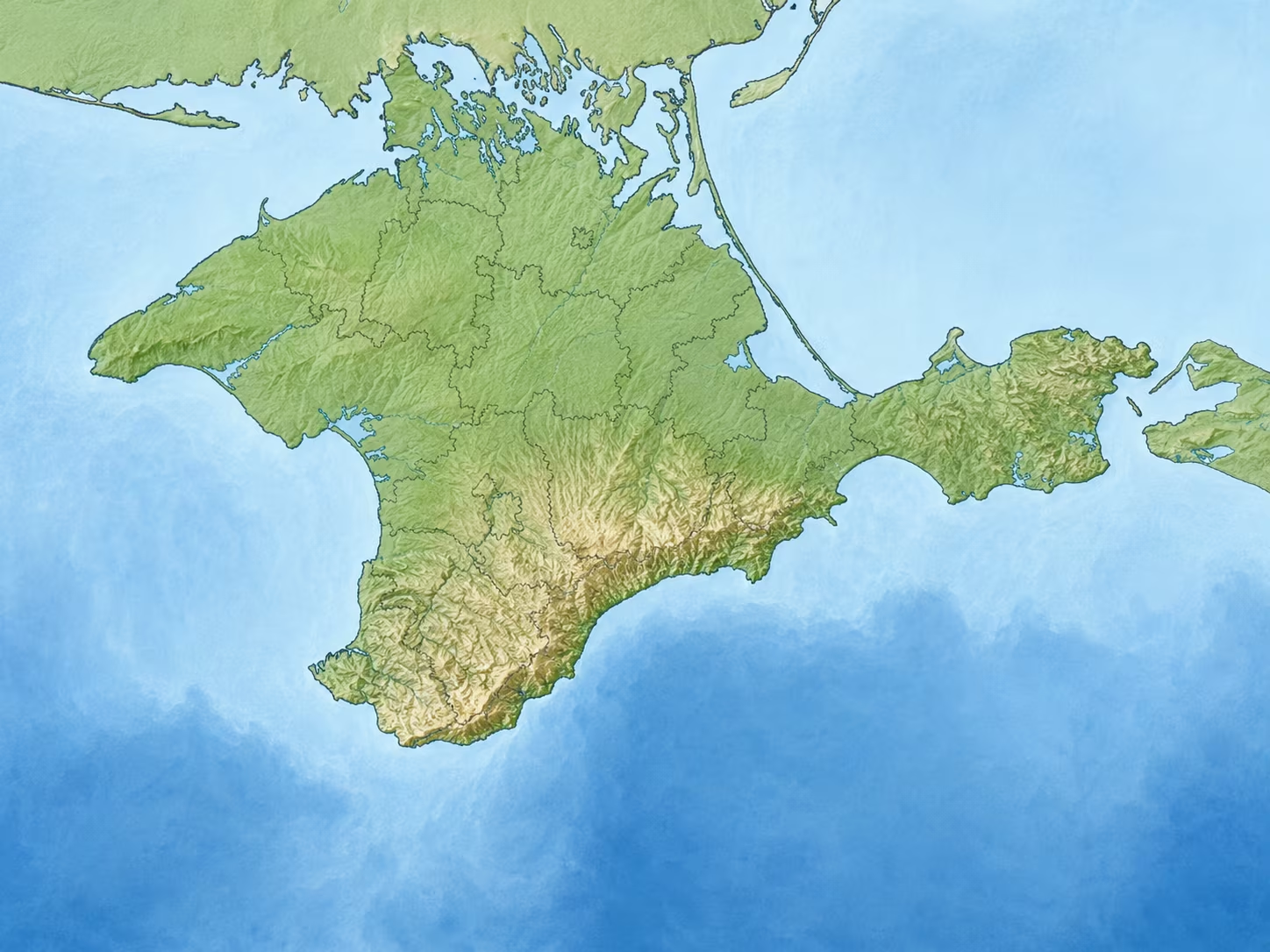
On June 15, the Permanent Court of Arbitration in The Hague brought to an end nearly a decade of arbitration proceedings between Ukraine and Russia. The dispute concerned the rights of a coastal state in the Kerch Strait, the Sea of Azov, and the waters of the Black Sea around Crimea. Kyiv sought to have Russia recognized as having violated the UN Convention on the Law of the Sea and to obtain $1.94 billion in compensation. Ukraine did not receive an unequivocal ruling in its favor.
The two sides’ reactions were mirror images. Russia’s Foreign Ministry called the verdict “the collapse of efforts to challenge the sovereignty of the Russian Federation over the Crimean Peninsula.” Ukraine’s Foreign Ministry called it “another confirmation that the Russian Federation systematically disregards the norms of international law.” The text of the ruling does not fully support either formulation.
What the Tribunal Considered
Ukraine initiated the proceedings on September 14, 2016—after Russia extended its own regulations to the annexed peninsula and built the Crimean Bridge. The arbitral tribunal was formed under the rules of the UN Convention on the Law of the Sea (UNCLOS).
Kyiv put three groups of issues before the arbitrators. The first was to recognize that Russia’s actions in the waters around Crimea and in the Kerch Strait violated Ukraine’s rights as a coastal state: its sovereignty, sovereign rights, and exclusive jurisdiction over oil and gas exploration and production, fishing, and the preservation of archaeological and historical sites. The second was to establish that Russia was violating the right of transit passage through the Kerch Strait, that Russia’s administration of the strait was unlawful, and that the Crimean Bridge impeded the free passage of Ukrainian and foreign vessels. The third was to record that, during the construction of the bridge and after an oil spill near Sevastopol in May 2016, Moscow failed to meet its obligations to protect the marine environment by refusing to cooperate and exchange information.
In addition, Ukraine demanded that Russia be ordered to withdraw vessels from Ukrainian maritime zones, restore access to data on oil reserves, resume the exchange of environmental and archaeological information, agree on modifications to the Crimean Bridge, pay compensation with interest, and provide guarantees that the violations would not be repeated.
Why the Ruling Cannot Be Considered a Victory for Moscow
The tribunal did not confirm the legality of Russia’s actions in the Sea of Azov and the Kerch Strait—and still less did it establish the legality of Crimea’s annexation.
Relying in part on the 2003 Russian-Ukrainian Treaty on Cooperation in the Use of the Sea of Azov and the Kerch Strait, the arbitrators determined that the Sea of Azov and the Kerch Strait are internal waters of both states. It follows from this that the maritime zones provided for under UNCLOS—the territorial sea, the exclusive economic zone, and the continental shelf—do not exist in these waters. That is why the tribunal could not uphold the first two groups of Ukraine’s claims: the legal framework on which Kyiv relied does not apply to these waters.
The arbitrators declined to examine Russia’s actions for compliance with the 2003 treaty itself—the tribunal, created to resolve disputes under UNCLOS, has no competence to do so. At the same time, the ruling expressly allows that violations may have been committed. The verdict is not a justification of Russia’s actions.
What the Court Nonetheless Recognized in Russia’s Favor
The tribunal resolved two issues in Moscow’s favor. The closure of Russia’s territorial sea in the Black Sea at the entrance to the Kerch Strait from the Novorossiysk side was recognized as lawful—in accordance with Article 25(3) of UNCLOS.
The re-registration of jack-up drilling rigs under the Russian flag was also recognized as lawful under Article 91 of the convention.
In view of all its findings, the tribunal did not order Russia to compensate Ukraine for damages.
Where Ukraine Won
On the environmental part of the case, the ruling went against Russia. The tribunal found that, during the construction of the Crimean Bridge and after the oil spill near Sevastopol in May 2016, Moscow violated its obligations to protect the marine environment: it failed to properly exchange information with Ukraine and did not carry out an environmental-impact assessment. The arbitrators, however, also awarded no compensation for these episodes.
What the Verdict Changes
From a legal standpoint, the ruling definitively established the navigation regime through the Kerch Strait: neither transit passage nor innocent passage applies there. Previously, this question had remained a matter of debate among specialists. The only issue still open is the precise scope of foreign vessels’ navigation rights in the Sea of Azov.
Ukraine will most likely be unable to return to court over this dispute. The 2003 treaty does not provide for judicial settlement of disagreements—the parties are left only with diplomatic tools.
The ruling is unlikely to affect the practical situation in the Black Sea, the Sea of Azov, or the Kerch Strait. In political terms, the outcome is close to zero for both sides: Ukraine won almost nothing, but Russian officials’ claims of victory are not supported by the text of the verdict either. One thing can be stated: the tribunal’s key conclusions on navigation and on the violation of Ukraine’s sovereign rights clearly diverged from Kyiv’s expectations.