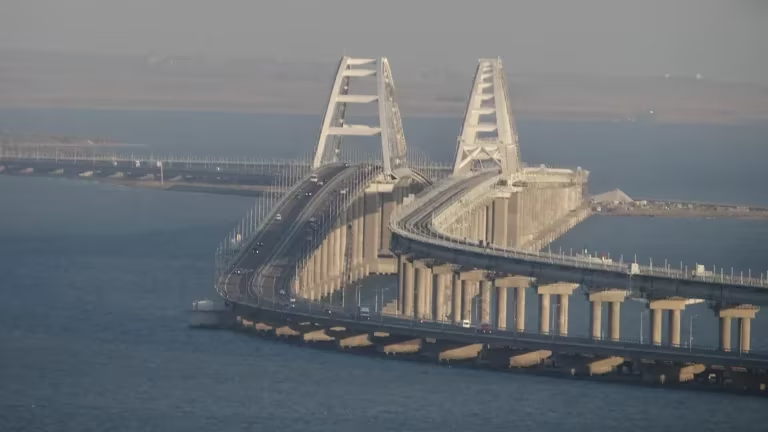
An arbitration tribunal in The Hague has concluded a decade-long dispute between Ukraine and Russia over coastal-state rights in the Black Sea, the Sea of Azov and the Kerch Strait.
The court rejected most of Ukraine’s key claims. The arbitrators refused to award Kyiv compensation for hydrocarbon extraction and the use of other resources off the coast of Crimea, did not uphold the demand to dismantle the Crimean Bridge, and did not recognize inspections of vessels in the Kerch Strait, as well as a number of other Russian actions, as violations of international maritime law.
The court also concluded that after the collapse of the USSR, the Sea of Azov and the Kerch Strait retained the status of internal waters of Russia and Ukraine. On that basis, the arbitration tribunal did not recognize the Kerch Strait as an international strait subject to the transit-passage regime for vessels of all states.
At the same time, the arbitrators found that Russia violated a number of provisions of the UN Convention on the Law of the Sea when building the Crimean Bridge, the power bridge and gas pipelines across the Kerch Strait. The violations concerned insufficient environmental-impact assessment, incomplete publication of environmental documentation and inadequate international cooperation on protecting the marine environment.
However, the court did not order Russia to pay compensation, cease any actions or provide additional guarantees. The arbitrators considered that recognition of the violation itself was sufficient as a legal remedy. Each side will also bear its own legal costs.
The arbitration tribunal separately emphasized that it did not consider the question of Crimea’s status and did not issue a ruling on sovereignty over the peninsula. At the jurisdiction stage, the court had already concluded that disputes over territorial sovereignty fall outside the scope of proceedings under the UN Convention on the Law of the Sea.