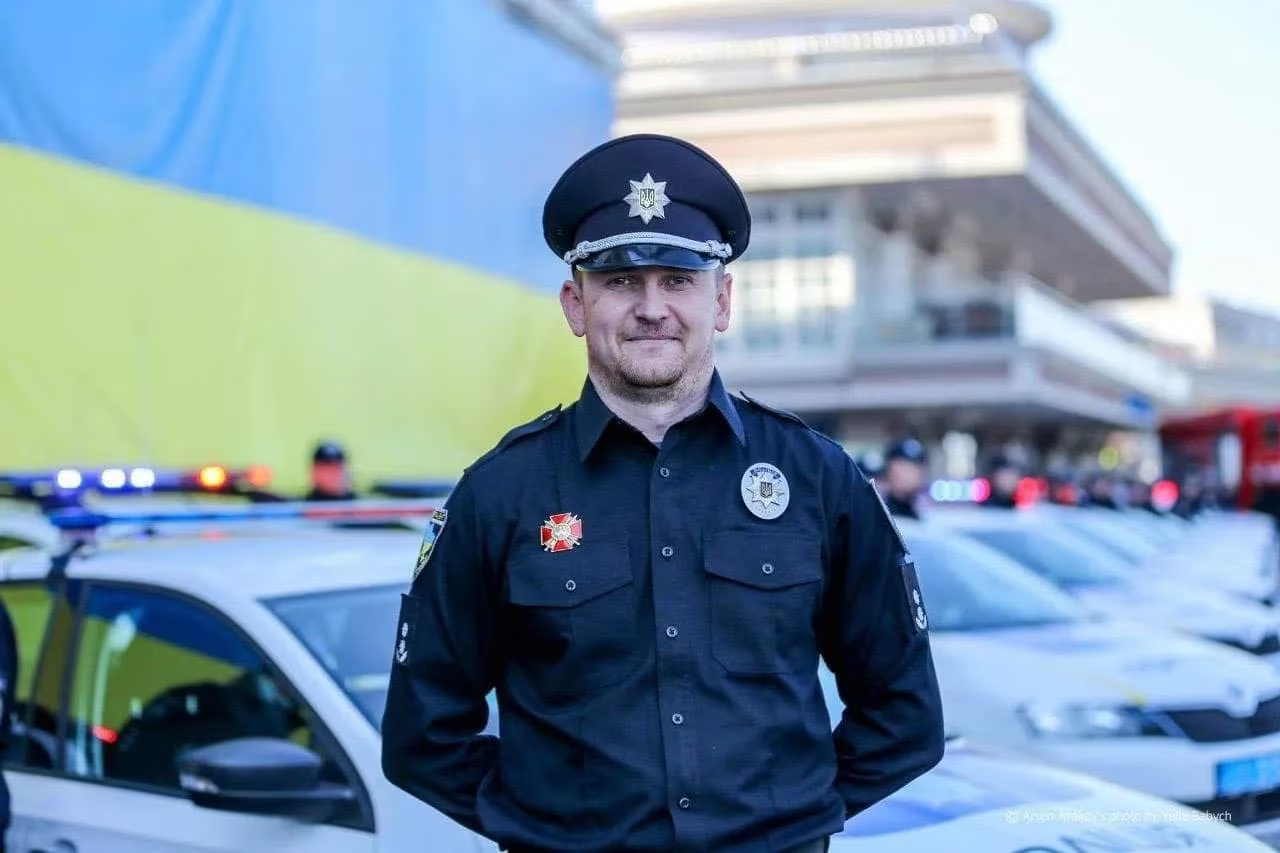
On April 19, 2026, Yevhen Zhukov officially stepped down as head of Ukraine’s Patrol Police. His resignation was a direct response to the shooting in Kyiv’s Holosiivskyi district—in that incident, patrol officers fled the scene, leaving a civilian without protection. A video of the episode, widely shared on social media, triggered a sharp public backlash: many Ukrainians saw the officers’ conduct as a betrayal.
Yet the consequences of Zhukov’s departure may prove far more significant than an ordinary personnel reshuffle inside the Interior Ministry.
To begin with, it is worth recalling who Zhukov is.
In 2014, he was one of the commanders involved in the defense of Donetsk airport, under the call sign “Marshall.” He took over as head of the Patrol Police Department in November 2015—more than ten years ago. In the history of independent Ukraine, it is hard to recall another official who led an Interior Ministry unit of comparable importance for so long.
The department itself had been created shortly before his appointment and was presented as the start of an ambitious reform—an attempt to replace post-Soviet “cops” with a European-style police force and push corruption out of the system. Young men and women in new uniforms, styled after American ones, did indeed stand in stark visual contrast to the old Ukrainian militia.
In truth, corruption reached them fairly quickly as well. Even so, the patrol police remained the “shop window” of reform—largely because there was little else in the Interior Ministry that could be presented to Western partners as convincing change. That helps explain Zhukov’s tenure, extraordinary by Ukrainian bureaucratic standards: he outlasted a change of president, several ministers, and multiple chiefs of the National Police. By now, he had become a figure who had definitively slipped out of the system of relationships that had taken shape inside the ministry.
In that sense, many saw his departure as only a matter of time—the only thing missing was a sufficiently weighty trigger. That trigger arrived this weekend.
The “Corruption-and-Economic” Weight of the Patrol Police Has Grown Markedly in Recent Years
Before the full-scale war, the main source of off-the-books income for patrol officers remained road violations—a legacy inherited from the “old” traffic police. Ukrainian media repeatedly described schemes in which those involved in traffic accidents were offered the chance to “settle” the matter with a bribe. The money was collected at the level of regional department chiefs, after which part of it was passed further “upward.”
But in recent years, a genuine corruption bonanza has opened up for patrol officers—as they were drawn into so-called “busification” as part of draft-office teams. Bribes taken from so-called draft dodgers are divided equally among the members of these “notification” groups.
The mechanics are simple: at a checkpoint, a patrol officer checks a potential conscript on a tablet through the Oberig database. If the person appears on the so-called wanted list, he is offered a choice—detention and transfer to the draft office, or a way to resolve the matter “on the spot.” Both draft-office officials and patrol officers in such groups are required to hand over part of their daily “takings” to their superiors. Accordingly, a share of the proceeds from these “busification” collections flows from regional department leadership further upward through the chain of command.
That is precisely why, after Zhukov’s resignation, there will be no shortage of people eager to rebuild this vertical chain under their own control.