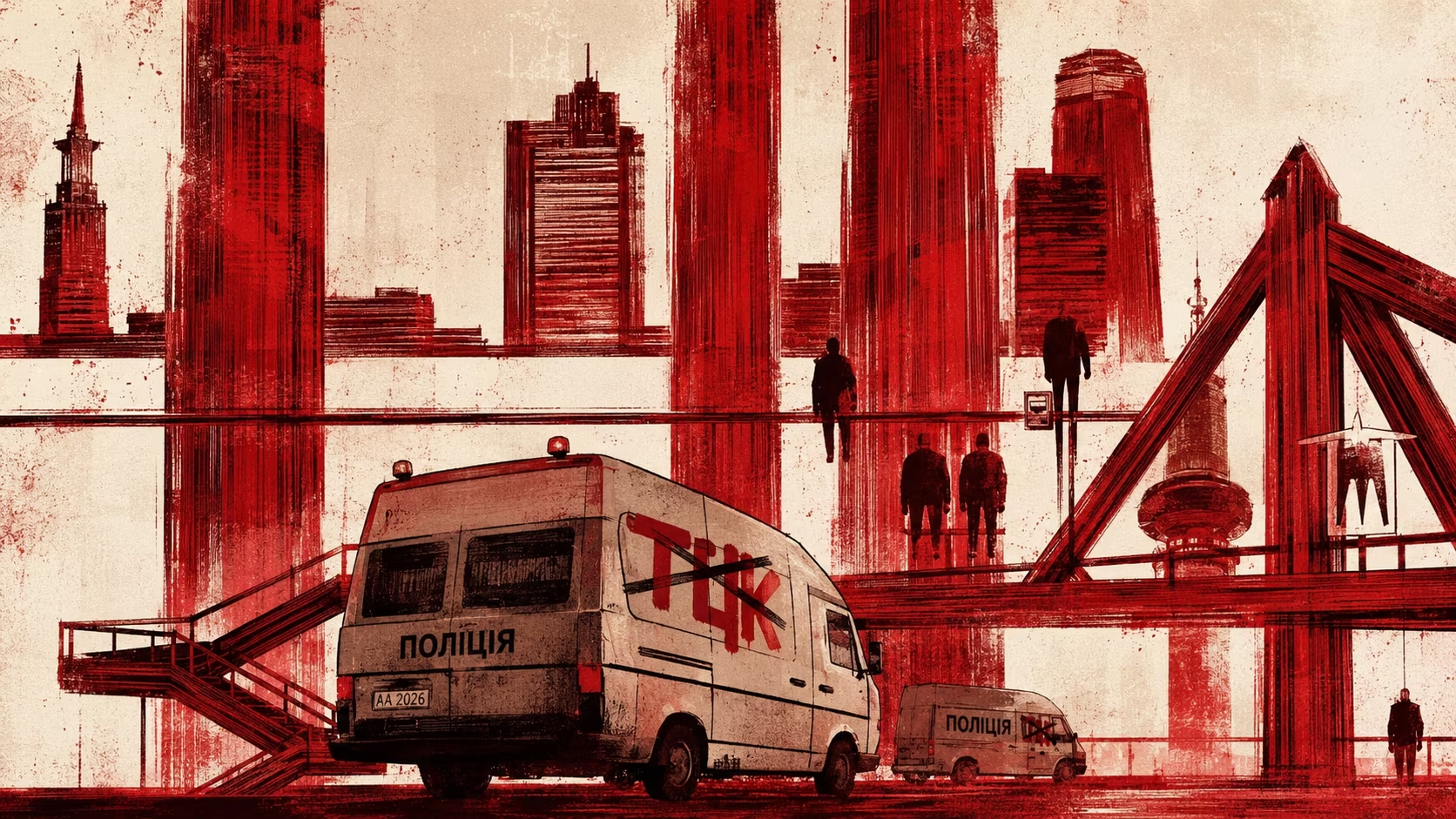
Ukraine is preparing a new mobilization reform—and the public debate surrounding it already suggests that the issue may be less about revising the underlying principles than about recalibrating the machinery of coercion.
Officials acknowledge the need for changes, while media reports describe competing versions of what the future system could look like: from tougher rules, criminal prosecution of so-called draft evaders, and a possible expansion of enforcement powers for territorial recruitment centers—to softer scenarios involving the removal of some individuals from wanted lists and attempts to bring them back into the legal system.
On the surface, this resembles a debate between “the stick” and “the carrot.” In practice, however, the discussion may simply create the illusion of choice where the core decision has already been made.
The key question is not what the reform will ultimately be called or which elements it will include, but whether the state intends to abandon the practice of street-level coercion—or merely shift it into a more sustainable legal framework. If the central innovation becomes transferring the search and forced delivery of men to recruitment centers over to the police, the reform may amount not to dismantling “busification,” but to institutionalizing it.
In January 2026, Volodymyr Zelensky ordered Defense Minister Mykhailo Fedorov to “deal with busification”. The very appearance of such language at the highest political level amounted to an acknowledgment that mobilization had long ceased to be merely a question of military registration and had become one of the country’s most painful internal conflicts.
Formally, procedures remain codified in laws and regulations. In practice, they often look very different. Men are detained on streets, on public transport, outside apartment buildings, and at checkpoints. Recruitment center staff frequently operate without police involvement or with only passive police participation. Incidents are not always recorded on body cameras. Alongside TCC representatives, individuals with unclear status appear during violent detentions, beating men and forcing them into minibuses. In some cases, such episodes have ended in death.
It is precisely this practice that turned the word “busification” into a political symbol. The term describes not merely the forced transportation of men to recruitment centers, but a broader sense of legal arbitrariness: an individual encounters state force while often not understanding who exactly stands before him, on what grounds he is being detained, or how he can defend his rights in the moment of detention.
That is why promises to “deal with” busification do not necessarily imply abandoning it. The state may recognize the problem not in order to end street-level coercion, but to remove its most toxic forms—or to give them a more controlled and legally protected appearance.
The most likely component of the reform is already becoming visible: the search for and delivery to recruitment centers of men whom the state considers to be in violation of mobilization requirements may be transferred to the police. Formally, this will be presented as restoring order. Instead of chaotic TCC groups operating in the streets, there would be a recognizable law-enforcement institution, with a defined hierarchy, uniforms, authority, and responsibility.
But this may also be where the central substitution occurs. If the people who today effectively conduct street roundups are absorbed into the police system or begin operating through it, the state will not need to radically alter the practice itself. There would be no need to separately arm recruitment centers (as some public figures have openly proposed), create a new institution, or rewrite the entire mobilization system. It would simply shift the coercive component into an institution that already possesses the legal right to detain people, use force, and under certain circumstances open fire.
For the authorities, this solves several problems at once. The TCC brand has become toxic, associated with fear, anger, and resistance. The police, however, belong to a different legal category. A confrontation with a TCC officer and a confrontation with a police officer are fundamentally different situations for an ordinary citizen. In the first case, society may still view resistance as a reaction to an unlawful or questionable detention. In the second, it far more quickly becomes a criminal matter.
In recent weeks, Ukraine’s Security Service has begun detaining TCC officials in cases involving bribery, illicit enrichment, and mobilization-related schemes. After several years during which the system was largely defended, justified, or shielded from public scrutiny regarding internal corruption, the state is suddenly demonstrating a willingness to pursue offenders—in Odesa, Dnipro, Kyiv, Ternopil…
The political meaning of these arrests may extend far beyond the criminal cases themselves. Society is being shown that the problem was not the mobilization model itself, but individual corrupt officials. They were identified, punished, and order was restored. Then, if TCC officers are removed from direct street-level contact, it can be presented as a cleansing of the system: no longer will “TCC men” seize people in the streets—the police will handle it instead, meaning a formally lawful and supposedly more controlled institution.
The state may effectively sell society two illusions at once: that corruption inside the TCC has been purged, and that “busification” has ended. In reality, millions of men could remain on wanted lists under the threat of criminal prosecution, now facing direct interaction not with discredited recruitment centers but with the police. Yet such logic leaves the core question unanswered. If the objective itself remains unchanged—to locate, detain, and funnel men into the mobilization system—why should corruption disappear simply because the label changes?
The reform debate also includes discussions about criminal prosecution for those labeled “draft evaders.” But here the issue is not only political will—it is scale. If the number involves hundreds of thousands or even millions of men unwilling to fight, any attempt to transform this into a mass criminal campaign would quickly collide with the limits of the system itself.
Investigators, prosecutors, courts, and prisons are not built to process such volumes. The state can selectively open cases, create high-profile examples, and intensify pressure through summonses, fines, wanted notices, and the threat of prison terms. But imprisoning everyone is impossible. Nor is such a goal likely necessary. In systems like these, the threat often works more effectively than mass punishment.
That is why the criminal component of the reform will likely function not as a sweeping imprisonment campaign, but as a mechanism of intimidation and coercion designed to force compliance. The state does not need to open cases against hundreds of thousands of people: it may lack the investigators, courts, and prison capacity required. It is enough to create the risk that a case could be opened at any moment—selectively, demonstratively, and against anyone who ignored a summons, failed to update personal data, or already appears on a “wanted” list. In such a system, criminal prosecution becomes a threat intended to compel a person to report to a recruitment center before the state comes for him directly.
The central intrigue of the reform is not whether TCC officers disappear from the streets. They may disappear externally—as a label, as a uniform, as the most irritating symbol. But the function for which they became part of everyday life may remain almost entirely unchanged.
If the personnel responsible for forcibly transporting men are transferred into the police system or begin operating in close coordination with it, the state would effectively preserve the same mobilization practice but with a stronger legal framework. Yesterday, it looked like the controversial and often chaotic activities of recruitment centers. Tomorrow, it may look like the lawful execution of police powers.
For society, such a shift would carry enormous significance. Mass distrust toward the TCC has already formed: many people no longer see it as a neutral administrative institution, but as a structure associated with violent detentions, arbitrariness, corruption, and disappearances. The police, despite all the complaints directed at them, possess a different status. They are embedded within the accepted order of the state, and resistance against them automatically exists within a harsher legal framework.
This is precisely where the reform may cease to be a way of protecting citizens from arbitrariness and instead become a way of protecting the mobilization apparatus from citizens. The more official coercive street encounters become, the harder they are to challenge in real time. The clearer the legal status of the person in uniform, the more dangerous resistance becomes. The less ambiguity surrounds the enforcer, the greater the risks for the person being detained.
In this way, the state may solve the problem of “busification” not by abandoning it, but by legalizing it in another form. Not a minibus operating without rules, but a minibus backed by a police protocol. Not men with unclear status, but men with formal authority. Not the end of street coercion, but its transformation into a format in which citizens have even less room to resist.
Kyrylo Budanov indirectly pointed to this. Commenting on possible reforms, he warned: “I wouldn’t want you to expect a miracle—that the TCC no longer exists. Just because the name changes does not mean the essence changes.”
Society will judge the reform not by whether the TCC acronym disappears from public irritation, but by whether the practice that made the acronym toxic disappears with it. If only the identity of the enforcer changes, Budanov’s warning may prove to be the most accurate description of what is happening: externally the system will appear different, but in substance almost nothing will change for the citizen.
Another expected direction of the reform is a revision of exemption policies. The state may reduce both the number of enterprises allowed to shield employees from mobilization and the proportion of exempt workers even within companies that retain “critical importance” status.
The logic here is simple: exempt workers are the most convenient mobilization resource. They are officially employed, registered in state databases, have updated personal information, remain tied to employers, and have not disappeared from the system. There is no need to search for them through street raids. It is enough to revise exemption criteria—and a person protected by the state yesterday becomes available for mobilization tomorrow.
Combined with the transfer of enforcement powers to the police, this creates a more rigid structure. First, an enterprise loses part of its exemptions; then employees re-enter the mobilization system; after that, contact is no longer handled by the toxic and controversial TCC, but by the police—with different powers and different consequences for resistance.
The economic impact of such a decision is obvious. The narrower the exemptions become, the greater the risks for manufacturing, logistics, energy, agriculture, defense contractors, and small businesses already operating at their limits. But such economic losses may be deemed secondary if the core political logic remains unchanged: people must be mobilized, while funding for the budget, reconstruction, procurement, and systemic stability will still come from so-called European partners.
The form of the reform may vary, but its political meaning is already visible in the rhetoric of some lawmakers, officials, and pro-government propagandists. Increasingly, there is little room left for the question of whether a person actually wants to serve. Choice is replaced by obligation, disagreement by suspicion, fear by “evasion,” and coercion by “state interest.”
One response to this is that in a war waged by Russia against Ukraine, citizens cannot possess complete freedom of choice: there is duty, mobilization, and the necessity of defending the country. But such logic requires trust in the state asking people to risk their lives. It requires confidence that sacrifice truly serves a collective victory rather than merely covering for the failures of a system in which some are sent to the front while others continue profiting from war, political office, procurement contracts, and proximity to power.
For Ukraine today, the war is not only about Russia’s external aggression, but also about internal exhaustion that is steadily weakening the country. Corruption penetrates too many levels—from the police and recruitment centers to officials, security agencies, defense procurement systems, and individuals close to the presidential circle. Against this backdrop, the state demands the ultimate sacrifice from citizens while failing to demonstrate the same severity toward its own system.
That is why the question of mobilization cannot be reduced to discipline and punishment. It runs much deeper: why should a person give his life for a country where schemes, kickbacks, and influence networks remain intact, using war as a source of power and enrichment? Why should someone dragged by force into a recruitment center believe his death will contribute to victory rather than serve as the price for preserving a system in which some fight while others distribute money, positions, and Ukraine’s future?