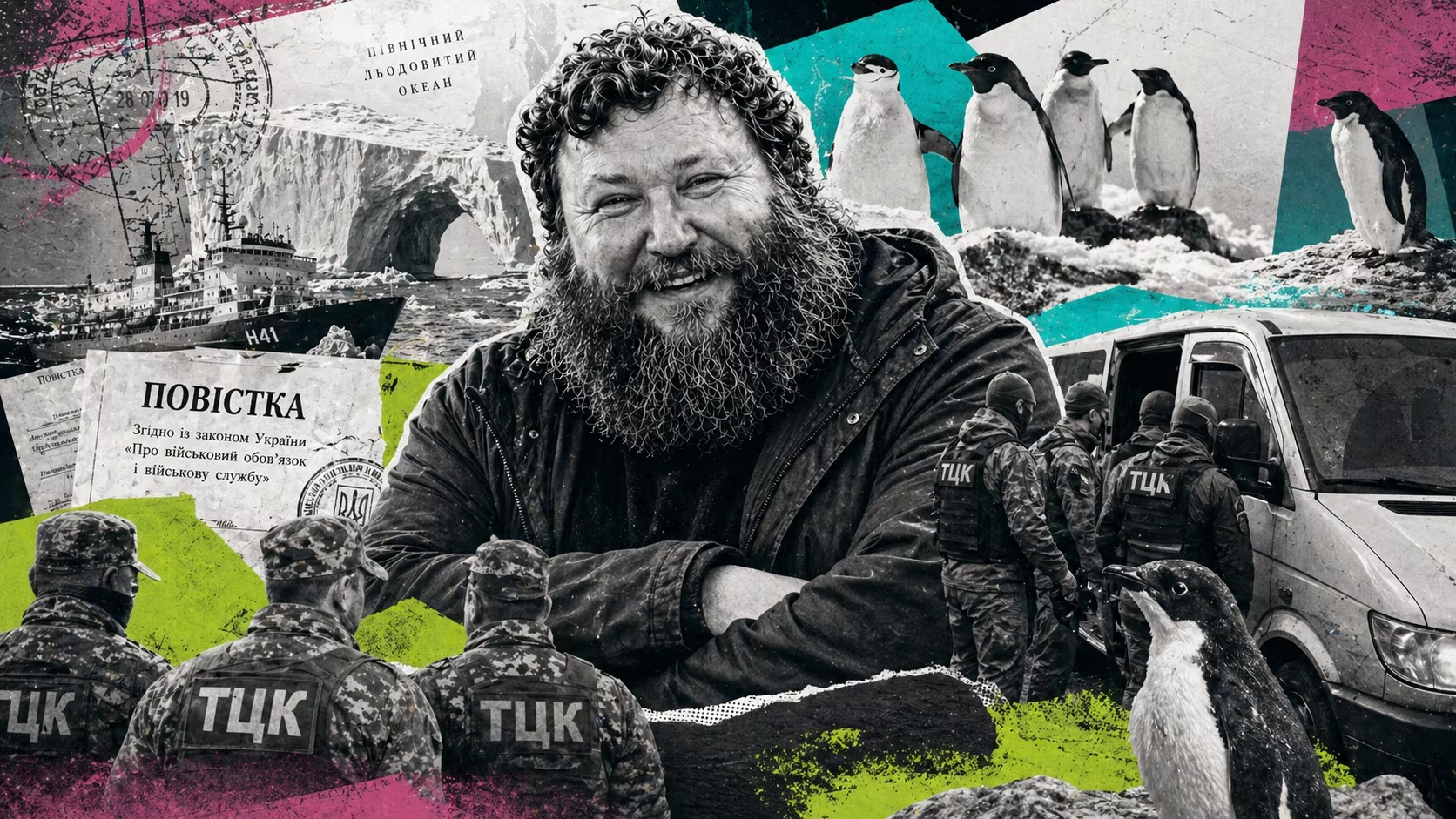
Yevhen Dykyi has proposed giving weapons to staff of territorial recruitment centres, issuing them direct orders to use lethal force in the event of attacks, and providing draft officers in advance with a legal guarantee that afterwards they “will not have to spend years in prison proving they had no other way out”.
In Dykyi’s view, such a policy change alone would be enough to stop attacks on recruitment centre staff: “there will be one or two incidents where the attackers are shot dead, and believe me—it will vanish overnight,” he said in an interview with the YouTube channel Novynarnia. To illustrate the scale of the problem, he cited figures from Ukraine’s interior ministry—602 attacks on recruitment centre staff since the start of the full-scale invasion, fewer than ten of them fatal.
Dykyi is one of the most media-visible voices in Ukraine’s public discussion on mobilisation, a regular guest on television broadcasts and YouTube channels. By training, he is a biologist and hydrobiologist, with a PhD in biological sciences. From February 2018 he served as acting director, and since August 2019—as the elected director of Ukraine’s National Antarctic Scientific Center (NASC), a state institution under the Ministry of Education and Science. Dykyi spent several months at the front: he volunteered for the 24th Aidar Territorial Defence Battalion in May 2014, served as acting deputy platoon commander and later company commander, and took part in the battles for Shchastia, Luhansk, Novosvitlivka, and Khriashchuvate. He was demobilised in the summer of the same year, 2014, because of a combat injury.
Since 2015, Dykyi has had no connection to the unit—this was stated publicly by serving Aidar brigade soldier Stanislav “Osman” Buniatov, who appealed to journalists to stop identifying Dykyi on screen as the “former commander of the Aidar battalion”. “We ask that this interviewee not be presented as the former commander of the Aidar battalion; call things by their proper names, so as not to mislead readers,” Buniatov wrote. According to him, Dykyi commanded a company for several months and has played no role in the life of the unit since 2015, which means his comments on strategic decisions by the Ukrainian armed forces command reflect the position of an outside commentator, not that of an active serviceman.
The remark about using lethal force is not a one-off episode, but part of a consistent rhetorical line Dykyi has been developing since the start of 2024. In January 2024, in an interview with Novynarnia, he said that if draft evaders began gathering in groups, veterans would “clean them out so thoroughly there would be nothing left”, adding: “We have enough hands, enough metal, and enough resolve for that.” In February 2024, after residents of the village of Kosmach in Ivano-Frankivsk region protested against the actions of recruitment centres, Dykyi called for the village to be “cleansed” and for its residents to be tried for treason. In the summer of 2024, commenting on protests in Vorokhta against the installation of a recruitment-centre checkpoint, he said on Kyiv 24: “I would use lethal force. Straight away—lethal force, straight away.” In May 2025, he proposed lowering the mobilisation age to 18. In April 2026, he called for Ukrainian passports to be taken away from those evading service abroad.
Alongside these statements, the centre headed by Dykyi received 463 million hryvnias from the state budget in 2024—about $11 million—for the work of the 29th Antarctic expedition, in the third year of the full-scale war. Procurement included, among other things, 168 bottles of red wine, 112 bottles of white wine, 28 bottles of sparkling wine, red caviar, and five professional dart sets. The same Buniatov reacted to the scandal: “Yevhen Dykyi, [why do] you need half a billion to study penguins? Although, judging by how you are driving everyone to the front, soon penguins will be fighting there.” Dykyi himself explained that the funds had been provided by western partners and could not be redirected to army needs—an argument that is technically correct, but does not erase the contrast between the two simultaneous agendas of the NASC chief: total mobilisation of Ukrainian citizens on the one hand, and funding for an Antarctic programme costing one of the most expensive cycles in its history on the other.
Dykyi, 51, who constantly calls for tougher mobilisation, falls within the relevant mobilisation category by both age and previous military experience. He is not serving—he holds a civilian state post.