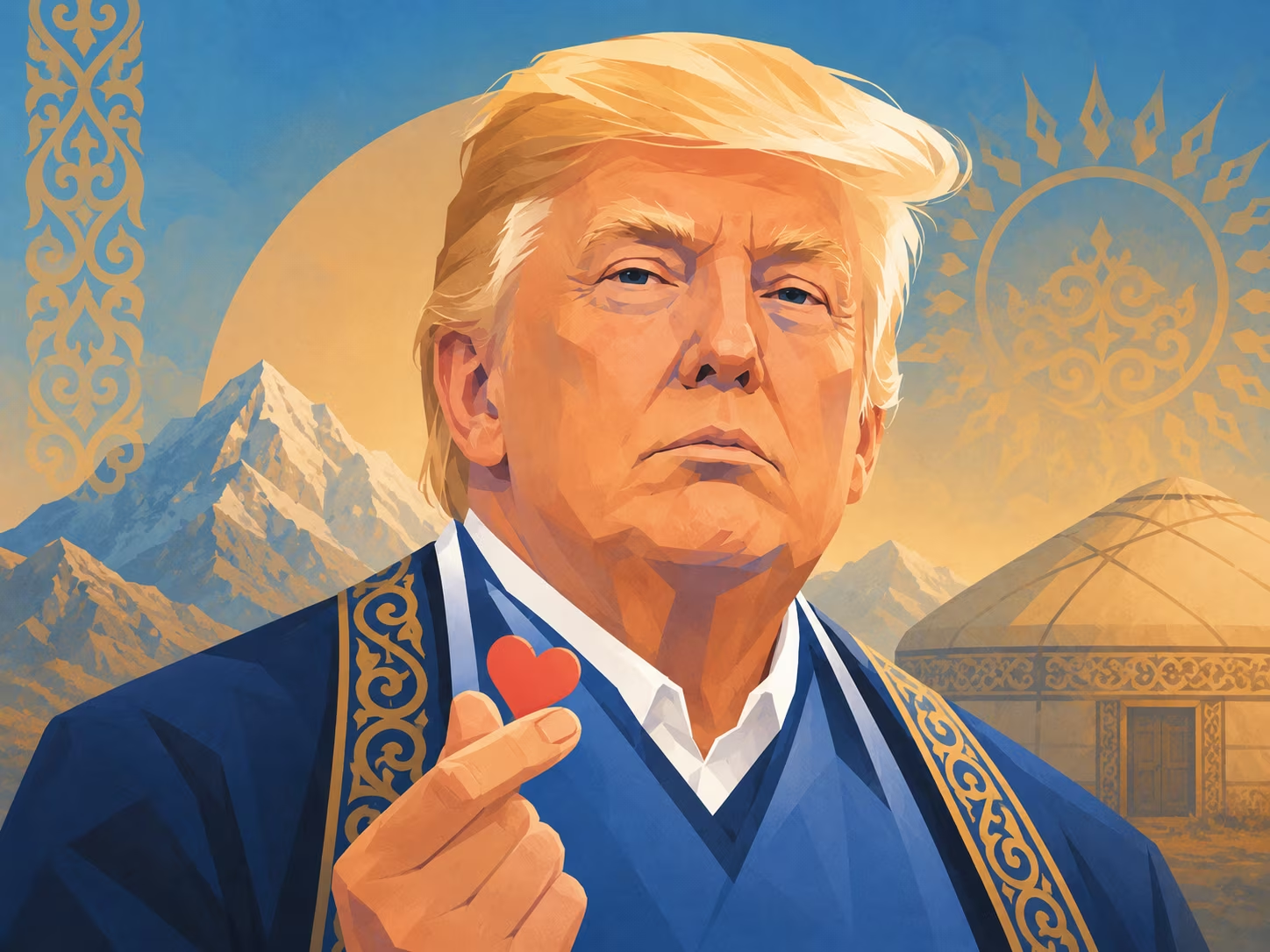
Donald Trump struck a multibillion-dollar resources deal with Kazakhstan from which his sons may profit, The New York Times writes.
The case concerns federal financing for the American company Kaz Resources, which plans to develop one of the world’s largest tungsten deposits.
According to the outlet, soon afterward the sons of Trump and U.S. Commerce Secretary Howard Lutnick became involved in the deal. They acquired a 20% stake in the Kazakh project.
“This arrangement is hardly an exception. According to federal records reviewed by the newspaper, one or both families have financial ties to at least 14 companies that are actively working with the federal government on important deals in the mining industry, including the project in Kazakhstan,” the NYT writes.
Against this backdrop, Kazakh President Kassym-Jomart Tokayev, the outlet notes, called Trump “sent by heaven.”
The New York Times also writes that under Trump, the international-development agency that dealt, among other things, with human-rights issues in Kazakhstan was disbanded. After that, the outlet notes, democracy and human rights effectively ceased to be a significant element of Washington’s policy toward Astana.
At the same time, Kazakhstan itself is actively strengthening relations with the United States, trying to balance the influence of its two powerful neighbors—Russia and China.
The NYT describes Astana as a visible reflection of Kazakhstan’s “multi-vector” foreign policy. In the capital, a Kazakh-Russian business center with a “Moscow” sign, a luxury pagoda-shaped hotel owned by a Chinese state oil company, a hotel tower and shopping center under the Ritz-Carlton brand, and Abu Dhabi Plaza—the city’s tallest skyscraper, built by a developer from the UAE—coexist side by side.
This approach, the outlet writes, reflects Tokayev’s desire for greater autonomy and security. Kazakhstan, a landlocked country bordering Russia and China, is trying to balance between neighboring superpowers by attracting investment from more distant countries—the United States, European states including the Netherlands and Switzerland, South Korea, Turkey and countries of the Middle East.
After the War With Iran, the U.S. Faced a Tungsten Shortage—A Key Metal for Weapons Whose Market Is Controlled by China
A Bill to Create a $2.5bn Critical Minerals Reserve to Be Introduced in the US Congress
Trump’s Sons Invested in a Military Drone Company Working With the Pentagon
Kazakhstan Adopted a New Constitution—It Strengthens Presidential Power and Puts National Law Above International Law