Nord Stream has lost a €580 million lawsuit in London against insurers over the explosions that destroyed the Russian gas pipelines in the Baltic Sea, the Financial Times reports.
London’s High Court ruled that insurers led by Lloyd’s of London are not required to cover the damage. The court found that a war-related exclusion applied, allowing the companies to avoid one of the largest infrastructure-damage payouts in the industry’s history.
During the proceedings, Russia, Ukraine, and the US were named among the possible perpetrators of the explosions. Judge Clare Moulder, however, did not determine who was responsible for the sabotage.
The ruling means Western insurers will not have to pay a large sum to a company ultimately controlled by Gazprom. Moscow used gas supplies to Europe as a tool of pressure during the energy crisis less than five years ago.
In a 96-page judgment following a six-week trial, Moulder said that determining the insurers’ liability did not require identifying the specific perpetrator of the explosions.
The court concluded that, in all plausible scenarios considered, the war between Russia and Ukraine would have been a “significant” cause of what happened. The war-related exclusion from insurance coverage therefore had to apply.
The decision was a victory for a group of insurers including Lloyd’s and Arch. They argued that the explosions were connected to the war or must have been authorized by a state, and therefore were not covered by the insurance policies.
Nord Stream’s lawyers argued that the war exclusion should not apply because the war was the backdrop, not the cause, of the explosions. They also said the sabotage could have been carried out by nonstate actors.
The judge, however, said that even in that case the perpetrators’ motives would have been shaped by the war.
Lloyd’s, Arch, and Nord Stream’s lawyers declined to comment after the court ruling.
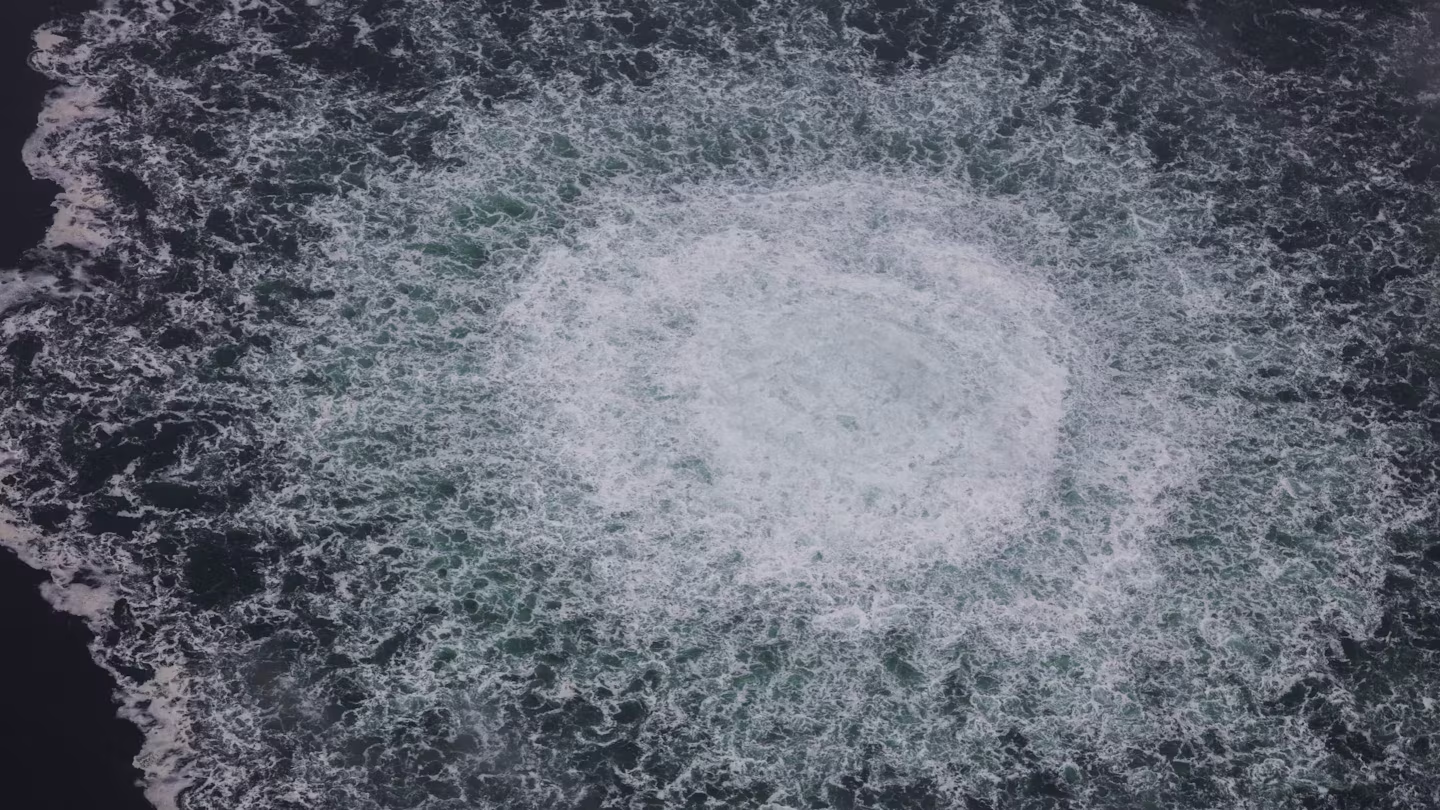
Three of the four lines of the Nord Stream 1 and Nord Stream 2 pipelines were destroyed off the coast of Denmark by explosions deep in the Baltic Sea in September 2022.
By the time of the explosions, Gazprom had already halted gas supplies to Western Europe through Nord Stream 1 in an attempt to provoke an energy crisis on the continent. Its consequences are estimated to have ultimately cost European countries more than €1 trillion.
Nord Stream 2, which the US had long opposed on the grounds that it would increase Russia’s influence over Western Europe, was due to begin operating in early 2022. Germany blocked the project’s launch as Moscow prepared to invade Ukraine.
The Nord Stream 1 pipelines were 51% owned by Gazprom, with the remaining stake divided among several German energy companies. Western energy companies also helped finance Nord Stream 2, but it was wholly owned by Gazprom.
No state has claimed responsibility for the explosions. Two Ukrainian suspects were detained in Italy and Poland after investigators found traces of explosives on a yacht that German prosecutors allege was used as a base for planting the charges.
The suspect detained in Italy was extradited to Germany. Polish authorities refused to hand over the second man.
Last week, Germany’s federal prosecutors brought charges against the first suspect, a Ukrainian citizen. He is accused of organizing an explosion, destroying structures, aiding and abetting a war crime, and disrupting public facilities.
Among the scenarios considered by experts in court was the possibility that Ukraine destroyed the pipelines to cut Moscow’s revenues, or that Russia wanted to deprive Europe of gas.
A possible US motive cited was that the pipelines “gave Russia geopolitical leverage,” insurers’ representative Simon Salzedo said in written submissions.
However, the court did not need to establish who exactly was behind the explosions in order to rule in favor of the insurers.
“If any of the possible perpetrators committed the sabotage, the war would have been a ‘significant’ cause of their actions, and therefore the damage was ‘directly or indirectly caused by, happened through, or was a consequence of war’ within the meaning of this exclusion,” Moulder said.
Lloyd’s and Arch Estimate Nord Stream Repairs Would Take Three Years
German Prosecutors Said the Nord Stream Sabotage Group Acted on Behalf of Ukrainian Authorities
German Federal Prosecutors Bring First Charges Against Ukrainian in Nord Stream Case
Germany’s Federal Supreme Court Said Ukraine Was Involved in the Nord Stream Blasts