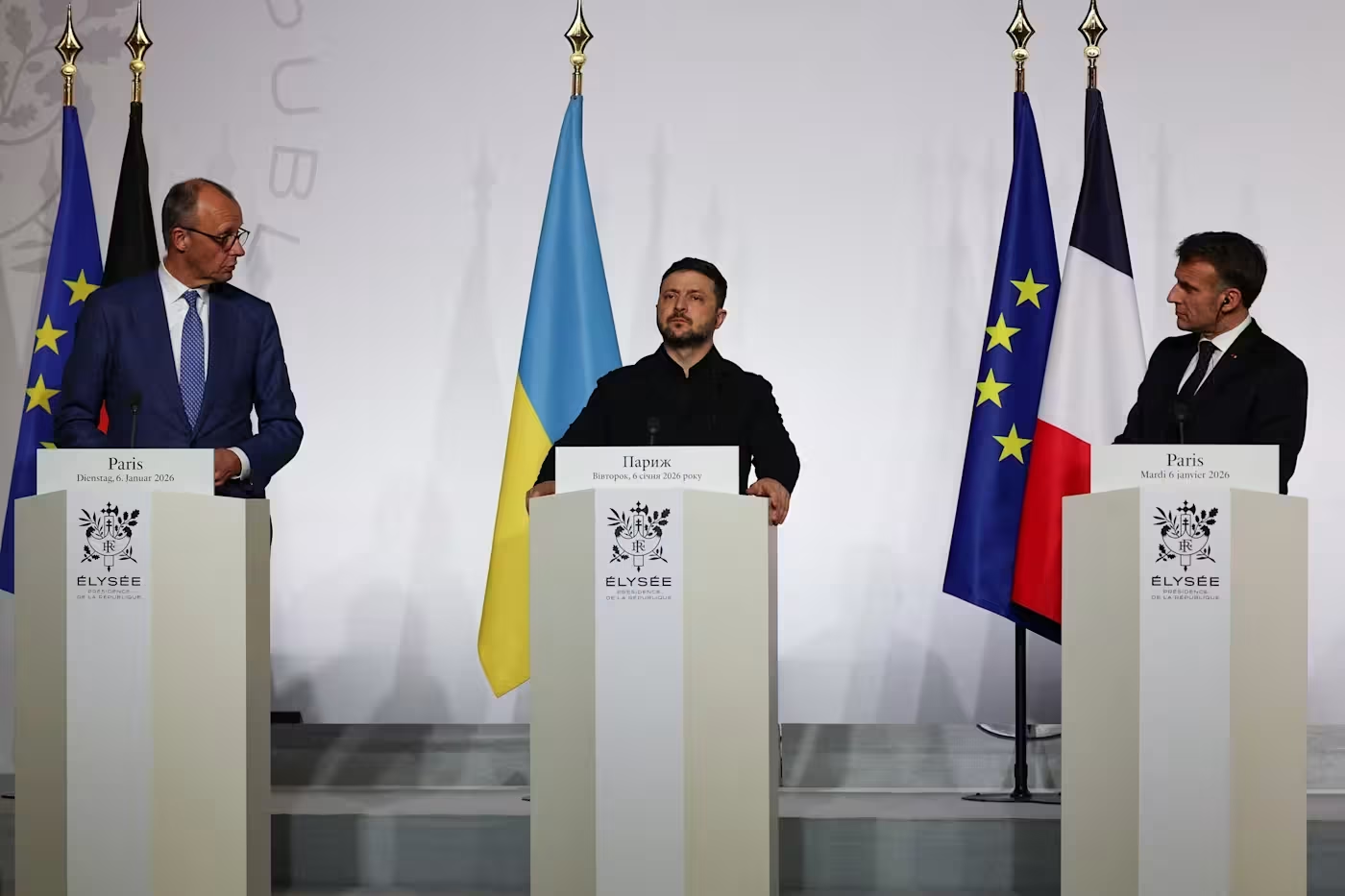
Germany and France have proposed giving Ukraine “symbolic” advantages during a transitional stage before it joins the European Union, while farm subsidies and voting rights remain outside the scope of the arrangement. The approach diverges from Kyiv’s plans for accelerated membership in the event of a possible peace deal with Russia.
Volodymyr Zelensky sees EU accession as one of the central gains to be secured from any peace settlement and is counting on the country entering the bloc as early as 2027. But the union’s largest states have refused to back proposals from the European Commission, which had argued for setting aside the slow and bureaucratic process in favor of quickly giving Kyiv the first benefits of membership.
Berlin’s and Paris’s positions are set out in separate documents. In effect, they cut across Kyiv’s hopes for a special status tailored to a country at war. Germany favors a model of “associate membership,” under which Ukraine would receive a seat at meetings of EU ministers and leaders, but without voting rights and “without automatic application” of the union’s common budget. In the French version, this interim format is described as the “status of an integrated state,” while access to the “Common Agricultural Policy (CAP) and European funding, including cohesion policy… should be deferred until the post-accession stage.”
The recent election defeat of Viktor Orban in Hungary, who had blocked the opening of talks on Ukraine’s membership, at one point raised cautious hopes of movement. But most EU countries remain seriously concerned that a fast-tracked accession for Kyiv and other candidates would upset the bloc’s political mechanics and diminish the value of membership itself.
The overall logic of the Franco-German papers will “probably” form the basis of the EU’s final proposal to Ukraine, according to two senior European Commission officials.
Ukraine’s deputy prime minister for European integration, Taras Kachka, said: “We are in contact with [Paris and Berlin], as we are with other capitals—everything is in motion. There are other documents as well.”
Another Ukrainian official acknowledged that Kyiv views the idea of curtailed membership warily—amid public fatigue from the war, it could be seen as an inadequate substitute for real accession—but allowed that some elements might prove useful. “We call it ‘shadow membership,’” he said. One of his colleagues put it more bluntly: “These guys… need to understand that Ukraine is something they need too. If they want real security, they will have to make an honest offer.”
The proposals from Paris and Berlin emerged after the European Commission’s idea of “reverse enlargement”—granting Ukraine full membership without requiring it to meet all EU criteria, followed by the phased delivery of financial and other benefits as benchmarks in various sectors were met—was rejected almost across the board. The core difference between Brussels’ concept and the approaches of the two capitals comes down to a single question: at what point Ukraine would be able to call itself a member of the union and vote in its governing bodies.
The German document stresses that the new status should carry “symbolic force through its very name,” and that it could be granted by a political decision of EU leaders, bypassing “lengthy procedures.” The French text follows similar logic: “Beyond its symbolic value, this new level of phased integration would make it possible to deliver progress that is tangible to citizens of candidate countries.”
For France, there is also a domestic political variable in play: by law, the admission of every new EU member requires a referendum. Some European leaders fear that a full-scale debate on the issue could flare up on the eve of France’s presidential election next year and be exploited by the ultraright favorites in the race, who are prepared to play on the fears of French farmers. That is why substantial CAP farm subsidies and regional funds—together accounting for about two-thirds of the union’s current budget—are, in the Paris document, proposed to be “deferred until the post-accession stage.”
The lighter form of membership would, however, extend to Ukraine the EU’s mutual defense clause—one of the key benefits for Kyiv at a time when NATO membership is effectively off the table for the foreseeable future. That clause, the German document says, “can be made effectively applicable by a simple political declaration.” But “there will be no automatic application of the budget”: countries such as Ukraine would be gradually brought into EU funding programs “in line with progress in negotiations and under transitional rules.”
As candidates move forward on the accession track—a lengthy process of reforms and implementation of the so-called acquis, the body of law that forms the EU’s legal framework—they will receive “expanded access to EU funding programs,” the French side notes, pointing in particular to the Erasmus+ student exchange scheme and public-private partnerships in digital investment.
The central caveat from both capitals is that the lighter format is not an alternative to full membership but, in Berlin’s wording, “a substantial shortcut that is simple to implement” on the way to it—which, Paris adds, should serve as an “accelerator.”