Hungary’s energy dependence on Russia long predates Viktor Orban. Even during the Cold War, Hungary—which took care not to provoke Moscow after the 1956 intervention—stood out within the socialist bloc for the unusually large role Soviet gas and oil played in its economy. Diversification efforts in the 1990s produced only partial results, and the surge in energy prices in the 2000s pushed the Hungarians back toward Russian offers.
Budapest was one of the enthusiasts behind South Stream, and the then-prime minister Ferenc Gyurcsany met Putin repeatedly despite criticism from Brussels and Washington. Their ties grew so close that Gyurcsany traveled to Moscow for dinner with Putin even after losing the premiership—together with his wife, Klara Dobrev, who to this day remains a leader of the liberal opposition and now condemns Orban for the very same flirtation with the Kremlin.
Yet, as Maxim Samorukov, a fellow at the Carnegie Berlin Center, notes in his analysis, the Socialists under Gyurcsany in 2010 and Fidesz in 2026 did not lose elections because Hungarian society was outraged by cooperation with Moscow. Hungarians feel no particular affection for Russia, but neither do they trust many other countries. For Hungarian voters, dealings with the Kremlin contained nothing new. What did sound new were accusations of pervasive corruption—especially once they coincided with several years of economic stagnation.
Orban could keep winning re-election throughout the 2010s while the Hungarian economy was growing with confidence. But by the mid-2020s external conditions had sharply deteriorated, and he himself had lost interest in the routines of governance, calcifying after so many years in power. Having spent a total of 20 years at the head of the country, Orban preferred meetings with Trump, Putin, and Xi—and the fight for a rightward turn across Europe as a whole—to yet another attempt to fix the economy at home. The price of that neglect was the rapid rise of Tisza.
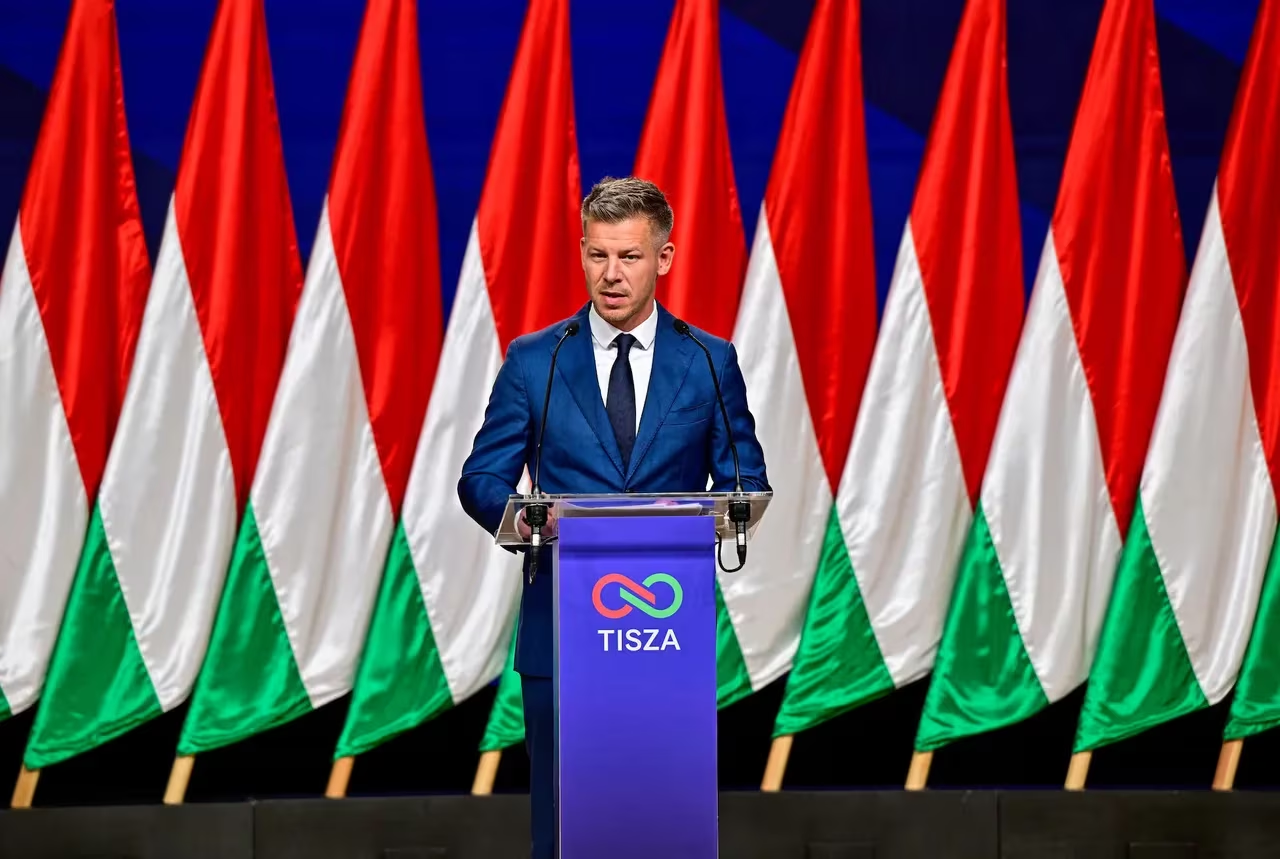
The victorious party, however, represents not a values-based opposition to Fidesz, but a generational one. Magyar himself is the son of a secretary-general of the Supreme Court, the grandson of a judge, and the great-nephew of former Hungarian President Ferenc Madl. Until 2024, he built his career through various posts in the ruling party, the state apparatus, and state-owned corporations. The potential foreign minister, Anita Orban, served as a special envoy for energy security in Orban’s office from 2010 to 2015. The possible defense minister, Ruszin-Szendi, headed the general staff under Orban. Tisza’s chief economist, Kapitany, received the Order of Merit of Hungary from the Fidesz government.
In essence, Tisza is the bolder wing of the ruling elite, one that decided to turn a broader elite fatigue into politics: fatigue with the fact that Orban and his narrow inner circle have sat in place for too long and behaved with too much greed. What angers them is not so much the substance of Orban’s policies as their cost: for several years now Hungary has been unable to access billions in frozen European subsidies because of Fidesz’s ideological confrontation with Brussels.
Magyar speaks often about fighting corruption, but even his campaign platform offers few promises of radical change in other areas. Tisza is a small party without enough personnel to overhaul an entire state apparatus that has fused with Fidesz over many years. Tisza’s victory became possible largely because it threatens no one except the very top.
Even after defeat at the polls, an enormous number of key posts remain in the hands of appointees from the former ruling party—from the president and prosecutor-general to Supreme Court judges and the heads of state media. As Samorukov notes, Magyar and his small circle of allies are left with either merging into the existing system and limiting themselves to cosmetic changes, or entering into a long bureaucratic struggle with little chance of quick success. Hungary is not the first country where the opposition has come to power after a long period of corrupt rule: something similar happened in Slovakia, Poland, and Bulgaria. And everywhere, the methods of predecessors proved either too convenient to abandon or too deeply entrenched to revise without years of struggle.
The same logic applies to the new Hungarian government’s relations with Moscow. The circle of Hungarian beneficiaries of energy dependence is not limited to Orban and his relatives. Multibillion-dollar Russian loans for the construction of the Paks nuclear plant, the resale of Russian gas from TurkStream, discounted oil supplies through Druzhba—all this forms a substantial part of the Hungarian economy. No leader will want to cut it off simply for the sake of praise from Brussels.
Magyar, despite EU support, never promised anything of the sort before the election. His statements on the matter were rare and evasive: to examine existing agreements for corruption and to gradually reduce dependence on Russian supplies by the mid-2030s. That sits uneasily with Brussels’s demand to abandon Russian raw materials as early as 2027.
Much will depend on how firmly the EU links the abandonment of Russian energy to the unfreezing of subsidies. But in Samorukov’s assessment, a significant share of the money will probably be unfrozen even without specific concessions from Budapest—simply because the opposition won. EU leaders are so weary of Orban that they can hardly avoid rewarding Hungarian society for removing him. After that, constructive negotiations over the gradual reduction of Russian supplies can continue for years.
After Orban’s loud disputes with Kyiv, Magyar is expected to take steps toward Ukraine. But here too reality may prove more modest than expectations. Magyar himself promised nothing of the kind: he demands protection for the rights of the Hungarian minority in Transcarpathia, is prepared to let Ukraine into the EU only after a referendum, and in the European Parliament voted against granting Ukraine a €90 billion loan. Polls show that Tisza voters view Ukraine somewhat more favorably than Fidesz supporters do, but even among them the share of those who see Ukraine as a threat is larger than the share of those who do not.
The reason lies not in Magyar’s personal preferences, but in the fact that the issue of Ukraine’s European integration is becoming increasingly unpopular in the eastern part of the EU. Countries from Poland to Bulgaria see Ukraine as a direct competitor for subsidies, jobs, and agricultural markets.
Through his defiance, Orban fashioned for himself the image of almost the sole opponent of aid to Ukraine in the entire EU. But in reality he was more likely just the fall guy—the one willing to absorb all the backlash with his veto, allowing the other opponents to remain in the shadows. Without him, someone else will have to step forward—from Slovakia, the Czech Republic, Germany, or Poland.
The EU’s mounting internal problems, deepening tensions with the United States, war in the Persian Gulf, and record energy prices are making the conditions for pressuring Russia and supporting Ukraine steadily less favorable, regardless of who serves as Hungary’s prime minister. It would be naive to expect that replacing one leader of a small European country with another—similar, but younger—could fundamentally alter the situation.