In France, about 1,000 excess deaths were recorded over four days amid abnormal heat, the national public-health agency Santé Publique France said.
According to the agency, the period in question ran from Wednesday to Saturday, when temperatures in the country reached record levels. The agency compared average daily mortality with figures from the previous two months.
The most noticeable rise in mortality was recorded in western and central France. About 85% of those who died were over 65, although mortality rose across all age groups.
Full data can be calculated only in several months. For now, the death toll remains significantly lower than during the 2003 heat wave, when an estimated 15,000 people died in France.
According to Santé Publique France, mortality rose last week in hospitals and nursing homes. A particularly sharp increase in deaths at home was recorded in the Paris region.
“This observation is a reminder of the need for support measures for isolated people and those facing deep social isolation, including in highly urbanized areas,” the agency said.
Élisabeth Charrier, head of the national federation of funeral services, told Le Figaro that morgues in France are under heavy strain. According to her, the main pressure is on Paris: for the past two days, two facilities within the city have been completely full.
The heat in France and Europe last week was among the most severe in recent years. Temperatures exceeded 40 degrees Celsius for several days. In some parts of France, the highest temperatures ever recorded in the country were registered on Wednesday and Thursday.
The heat disrupted railway services, led to school closures or reduced school hours, caused a sharp rise in air-conditioner sales and forced some residents to cover windows with emergency blankets or chalk.
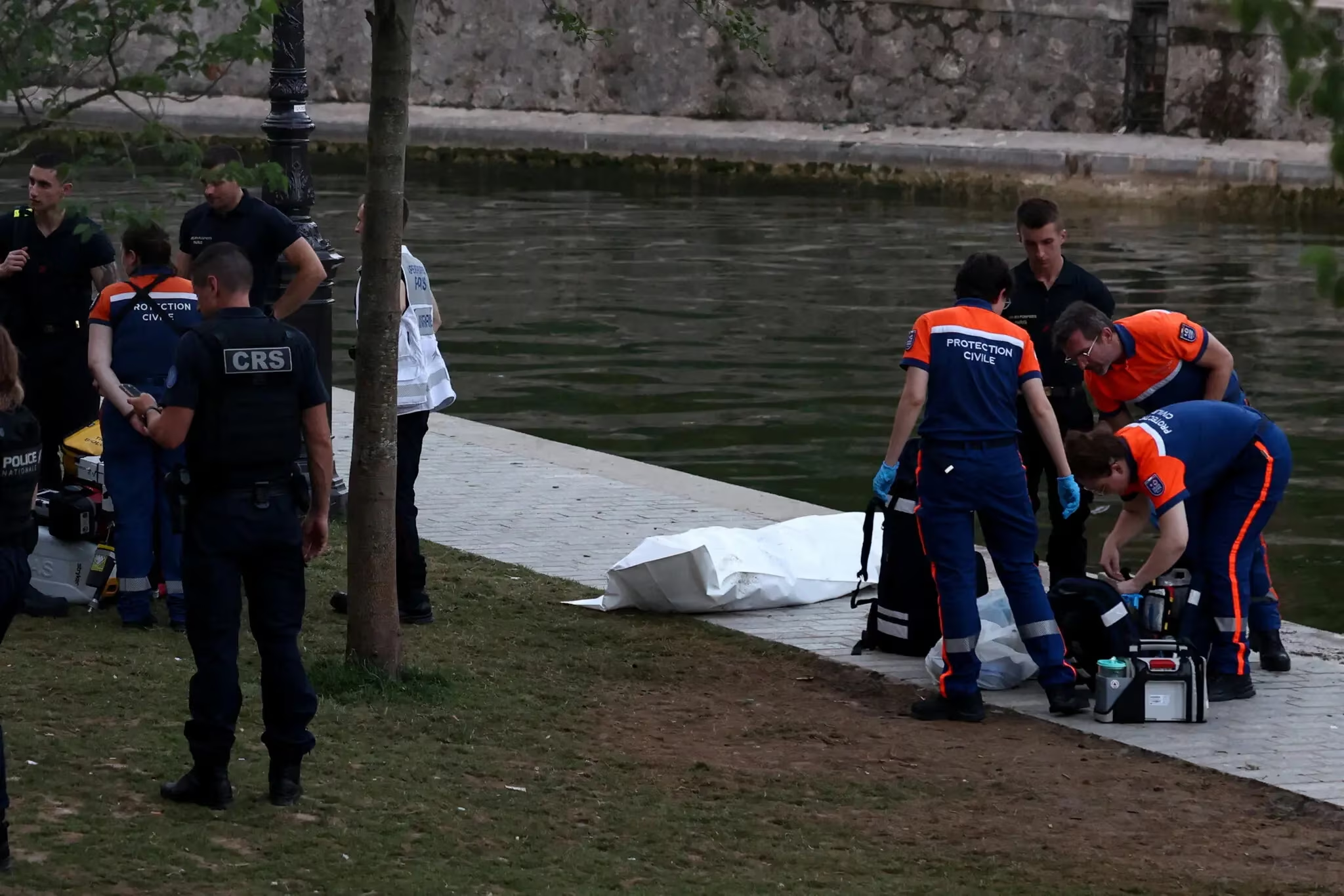
Additional deaths were also linked to swimming in rivers and other bodies of water. On Saturday, French Interior Minister Laurent Nuñez said that 74 people had drowned in the country since June 18.
Although temperatures fell over the weekend, doctors expect patients suffering the effects of the heat to continue arriving at hospitals in the coming days.
Dr. Agnès Ricard-Hibon, a representative of France’s emergency services, said on the radio that in the first days of the heat wave, emergency departments were not overwhelmed because the human body is able to adapt. “But after a certain time, that capacity is exhausted, and when temperatures rise in this way, it leads to organ failure,” she said.
Conservative lawmaker Philippe Juvin, who heads the emergency department of a Paris hospital, said that after the weekend, relatives, caregivers and social workers may find elderly people at home in extremely serious condition.
“We will open the doors and probably find people who are at home in very, very bad condition, who have not drunk anything for three days, who are in the heat or have already died,” he said.
Final data on excess mortality linked to the heat will not be known before December, since the cause of death must be established in each case, French Health Minister Stéphanie Rist said.
On Sunday, WHO Director-General Tedros Adhanom Ghebreyesus said that more than 1,300 excess deaths linked to high temperatures had been recorded in Europe since June 21.
“Heat stress is often called a ‘silent killer,’ and European homes, workplaces and schools were not designed for such temperatures,” he said.
Ghebreyesus added that the WHO is urging European countries to introduce health action plans for heat as part of a broader policy to protect health from the effects of climate change.