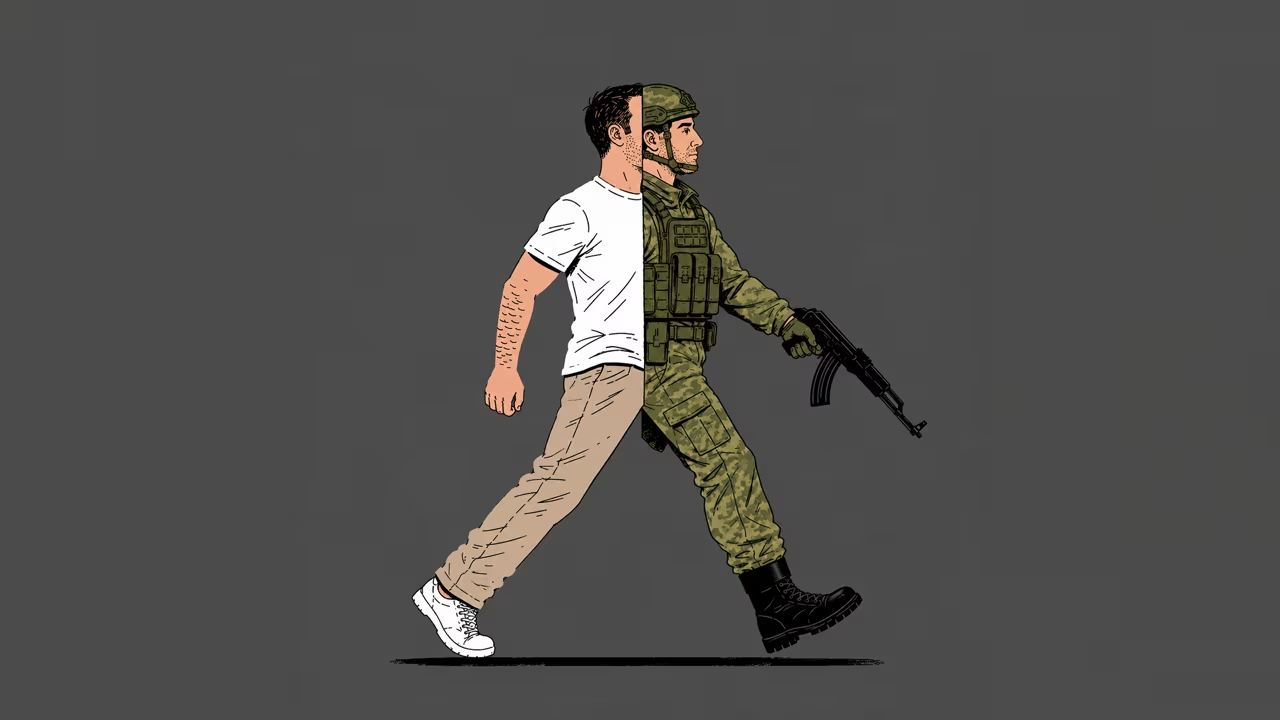
The European Commission has formally proposed extending the temporary protection program for Ukrainians in the EU by another year—until March 2028. At the same time, Ukrainian men subject to conscription are proposed to be excluded from the program.
The restriction, as previously reported, should apply only to newly arrived men, not to those who have already received temporary protection in the European Union. It concerns men aged 23 to 60. Germany, Sweden and Poland supported the idea of restrictions, while Estonia and Luxembourg opposed it. The decision must be approved by a qualified majority in July or September 2026. In the Cypriot proposal that formed the basis of the discussion, the exclusion of conscripts is justified by the need to “avoid depleting Ukraine’s military strength and encourage return.”
Ukraine’s own mobilization, the protection of whose participants the EU sees as justification for the restrictions, is taking place against a backdrop of systemic violations whose scale is captured only partly by official statistics.
The number of complaints about the actions of individual representatives of territorial recruitment centers rose from 18 in 2022 to 6,127 in 2025. In the first five months of 2026 alone, the ombudsman’s office recorded more than 3,000 new complaints about unlawful actions by recruitment centers. The ombudsman himself stresses that these are only officially filed complaints, not the full picture. As early as March 2025, Dmytro Lubinets said that human-rights violations by recruitment-center employees had taken on systemic features.
Deaths of mobilized men are recorded regularly, but there is no unified accounting. According to calculations based on data from law-enforcement agencies and Ukrainian media, since the beginning of 2026 alone at least six people have died during forced mobilization on the streets, in recruitment-center buildings and immediately after arriving at training units, while two others fell into comas. Deaths in recruitment-center buildings were reported in Dnipropetrovsk and Kryvyi Rih; in March, lawmaker Yurii Kamelchuk said that recruitment-center employees had beaten a father of six to death at a military enlistment office. In Kyiv, a man mobilized in January was hospitalized with fractures and died several days later. On June 23, the ombudsman reported systemic violations in Mykolaiv region, where an inspection of an assembly point led to the release of six men who had been held without legal grounds.
Accountability is distributed asymmetrically. A Rozholos study covering 4,352 cases from 2022 to 2026 recorded 3,490 convictions of civilians and only one actual conviction of a recruitment-center employee or law-enforcement officer, with none for forcible delivery.
On June 26, Denmark said that Ukrainians aged 23 to 60 who are not exempt from military service will no longer be able to obtain residence permits under a simplified scheme. This was announced on the website of the Ministry of Immigration and Integration.
After the start of Russia’s full-scale invasion, Denmark adopted a special law allowing those forced to leave Ukraine to obtain temporary residence permits through a simplified procedure. The government now plans to tighten it so that Ukrainian men cannot use the law to evade mobilization.
“Denmark firmly supports Ukraine in its fight for freedom. That is why we are changing the special law, because our rules are not intended to be used to evade mobilization into Ukraine’s defense forces. This undermines Ukraine’s war effort and weakens its ability to defend itself against Russian attacks,” said Immigration Minister Morten Bødskov.
The ministry stressed that the changes will not affect residence permits that have already been issued. As of May 2026, 47,600 Ukrainians who had received residence permits under the special law were living in Denmark.
European Commission Chief Proposes Limiting Simplified Entry for Ukrainians to the EU
Ukraine Asks the EU to Stop Granting Temporary Protection to Men of Mobilization Age, the Migration Commissioner Says
Exemption From Mobilization Is Being Sold for Several Annual Salaries
Lubinets Reported 6,000 Complaints Against Military Recruitment Offices and Killings Inside Draft Centers