In late May, the Council of the European Union began discussing whether temporary protection for Ukrainian men of conscription age should be preserved. According to an internal Council document seen by Euractiv, one option under consideration is to extend protection while narrowing its scope: new male applicants of military age, as well as those who left Ukraine outside legal procedures, would be excluded from the scheme. Norway, which is not an EU member, has already taken such a decision: since late March, men aged 18 to 60 have been stripped of collective protection and must apply for status individually.
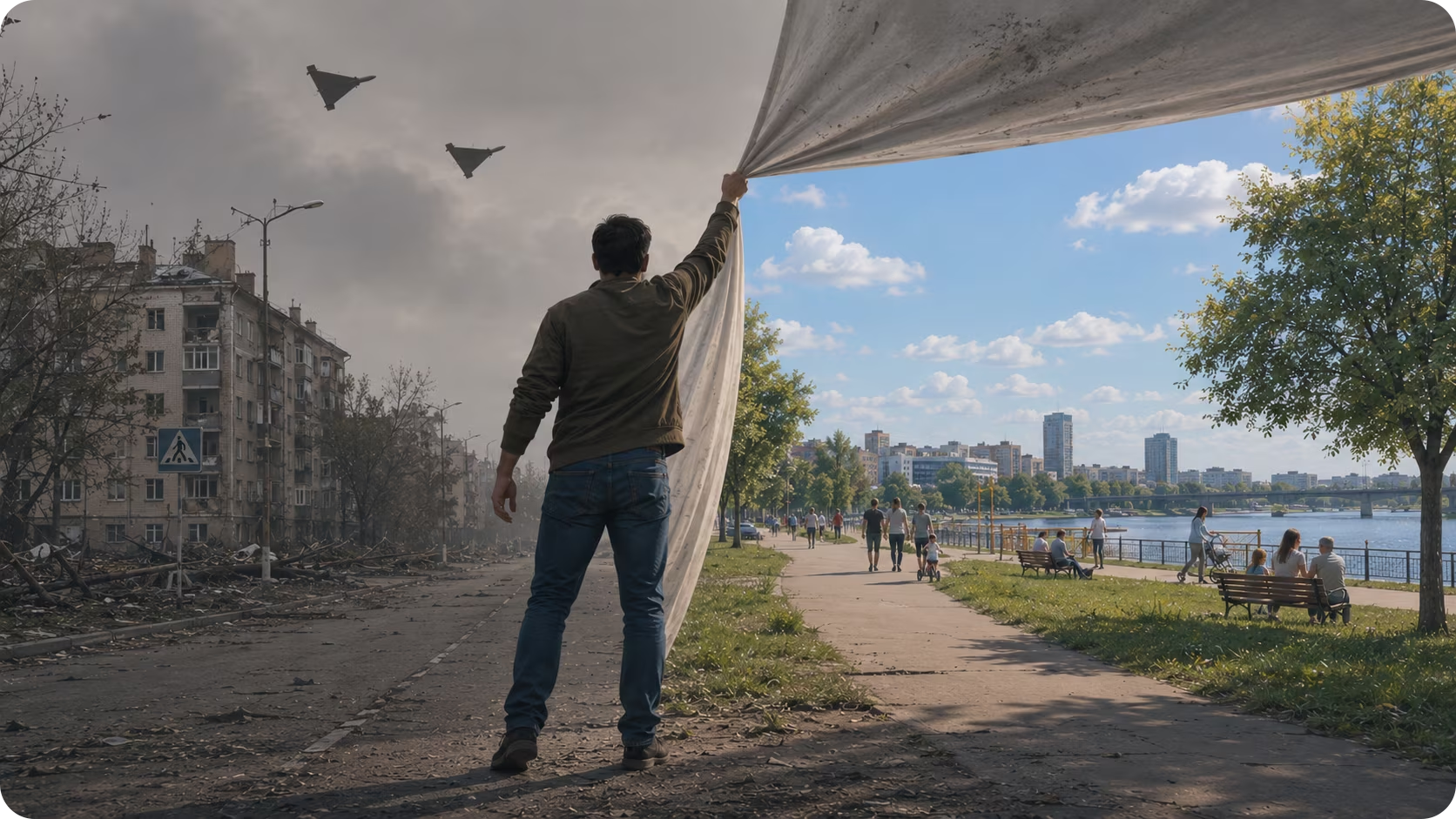
On its face, this is a technical adjustment to a migration regime. But if one looks at the position in which it places a specific person, what emerges is a structure that is hard to describe as anything other than closed. A Ukrainian man aged 18 to 60 has fewer and fewer exits left—and each of them is being shut by someone.
The first point is that leaving the country is already closed to him by law. Since February 2022, men in this age group have been banned from leaving Ukraine. Those who try to cross the border illegally are caught like contraband: on the western border, a criminal business has emerged in which guides charge up to $15,000 per person for passage into Romania and, according to border-guard accounts, often use local children as escorts. According to Ukrainian lawmakers, in figures published in May, 45,000 men have illegally left the country since the ban came into force—and those are only the cases known to the authorities.
Inside the country, too, the exit has narrowed to physical coercion. In 2024, a new word entered the Ukrainian lexicon: “busification”—the detention of men on the streets, outside apartment buildings, on public transport, at markets and near concert halls, followed by delivery to territorial recruitment centers. Formally, recruitment-center staff do not have the power to detain people, but they act together with the police or with their passive involvement, and in practice that distinction disappears. The scale is reflected in the complaints: according to Ukraine’s ombudsman, the number of appeals against recruitment-center staff rose from 18 in 2022 to more than 6,000 in 2025. The social reaction has become physical: since the start of the war, more than 600 attacks on recruitment-office staff have been recorded, including at least 117 in the first four months of 2026—more than 20 times the figure for the entire first year of the war.
What is telling is that the problem has been acknowledged at the highest level. In January 2026, Volodymyr Zelensky instructed the new defense minister, Mykhailo Fedorov, to “deal with busification”, placing the task alongside strengthening air defense. The appearance of such language from the president was an indirect admission: forced mobilization had become one of the country’s most painful internal conflicts. Yet acknowledging the problem is not the same as abandoning the practice—the reform under discussion appears likely to transfer the function of searching for and delivering draft evaders to the police, giving street coercion a more orderly and legally protected form rather than eliminating it.
A third exit remains: to pay. And here the locked door comes with a price tag. Court cases and prosecutors’ materials describe an established shadow market: a fake “unfitness” certificate together with the organization of a border crossing costs $6,000 to $10,000; a medical certificate of unfitness costs $18,000 to $25,000. These are not isolated excesses. Under Operation Guard, launched in May 2025, there were 325 suspects and 115 indictments by the end of March 2026. The sums found with some organizers of the schemes are striking when set against their official incomes: a recruitment-center employee in Bucha, who had declared annual income of 366,000 hryvnias, was found with gold, $43,500 and cash in euros. To understand what those figures mean for an ordinary person, one comparison is enough: with the average salary in Ukraine at about $500 a month, the price of a seemingly legal exemption from mortal risk equals several years of earnings. In other words, the right not to go to the front is effectively for sale—and available to those who have money. The commander of the National Guard reportedly urged those with “money problems” to go serve. Analysis of casualty data shows that the dead disproportionately come from small towns with higher levels of poverty.
All this is happening against the backdrop of a changing public attitude toward continuing the war. According to Gallup, the share of Ukrainians who support ending the war through negotiations rose from 27% in 2023 to 69% in 2025. Over the same period, support for the idea of “fighting until victory” fell from 63% to 24%. These figures need no commentary—they describe a person who understands less and less why he is being caught on the street.
And at this moment, the European Union knocks on the door—from the side that a person fleeing mobilization considered the last one still open. The EU Temporary Protection Directive allows Ukrainians to live and work across the Union without going through national asylum procedures and is in force until March 2027. As of March 2026, 4.33 million Ukrainians held that status, with the largest numbers in Germany (1.27 million), Poland (961,405) and the Czech Republic (379,820). Women accounted for 43.3% of recipients, children for 30.1%, and adult men for 26.6%. It is this last category—and specifically future applicants—that is now being proposed for exclusion from the scheme. The logic was formulated by the EU special envoy for Ukrainians, Ylva Johansson: she finds it not entirely consistent that men who are forbidden to leave Ukraine receive protection immediately after crossing the border, sometimes illegally.
The argument is coherent in its own way. But placed alongside other actions by the same Union, it produces a picture that needs no comment.
The same European Union that is discussing whether to close the last legal exit for a Ukrainian liable for military service paid Russia more than €15 billion for gas in 2025. About €7.2 billion of that was for liquefied gas from the Arctic Yamal project alone—even though the agreement on a full ban on Russian LNG will not take effect until January 2027, and European buyers, analysts estimate, are rushing to take the maximum volumes before that deadline. The EU accounts for more than three-quarters of exports from Russia’s largest LNG terminal. In the first nine months of 2025, Belgium spent €1.4 billion on Russian gas—more than the amount of its military aid to Ukraine over the same period.
At the same time, according to figures from a German business delegation cited by Bild, about 1,600 German companies continue to operate in Russia, with a combined turnover of roughly €20 billion a year. These are mainly subsidiaries and businesses with German capital. They explain their presence as “social responsibility” toward employees: the cheese producer Hochland cites obligations to 1,800 workers, Beiersdorf continues to supply Nivea, and the Metro chain keeps 91 stores and 8,000 employees. Formally, sanctions are not being violated. Foreign companies that remain in Russia are estimated to have paid more than $20 billion in taxes into the Russian budget over the year, with Germany in second place after the United States.
Taken together, these facts form a situation with no single simple culprit, which is precisely why it works the way it does. Ukraine needs soldiers, and the state closes the exits—that is the logic of a country at war. The European Union does not want to receive fighting-age men from a country it is itself helping to fight, and prefers that they remain at home—that is the logic of an ally that believes human resources are needed more at the front than in its own economy. European business continues to earn money in Russia and pay taxes into its budget—that is the logic of profit. Each actor behaves rationally from its own vantage point. The problem is that at the intersection of these rational logics stands a specific person—the one who wanted to work, run a business, raise children—and no one bears responsibility for his life.
The declarations that human life comes above all else remain in force. The only question is whose life, exactly, is meant—and how much an exit costs for someone whose life is not on that list.