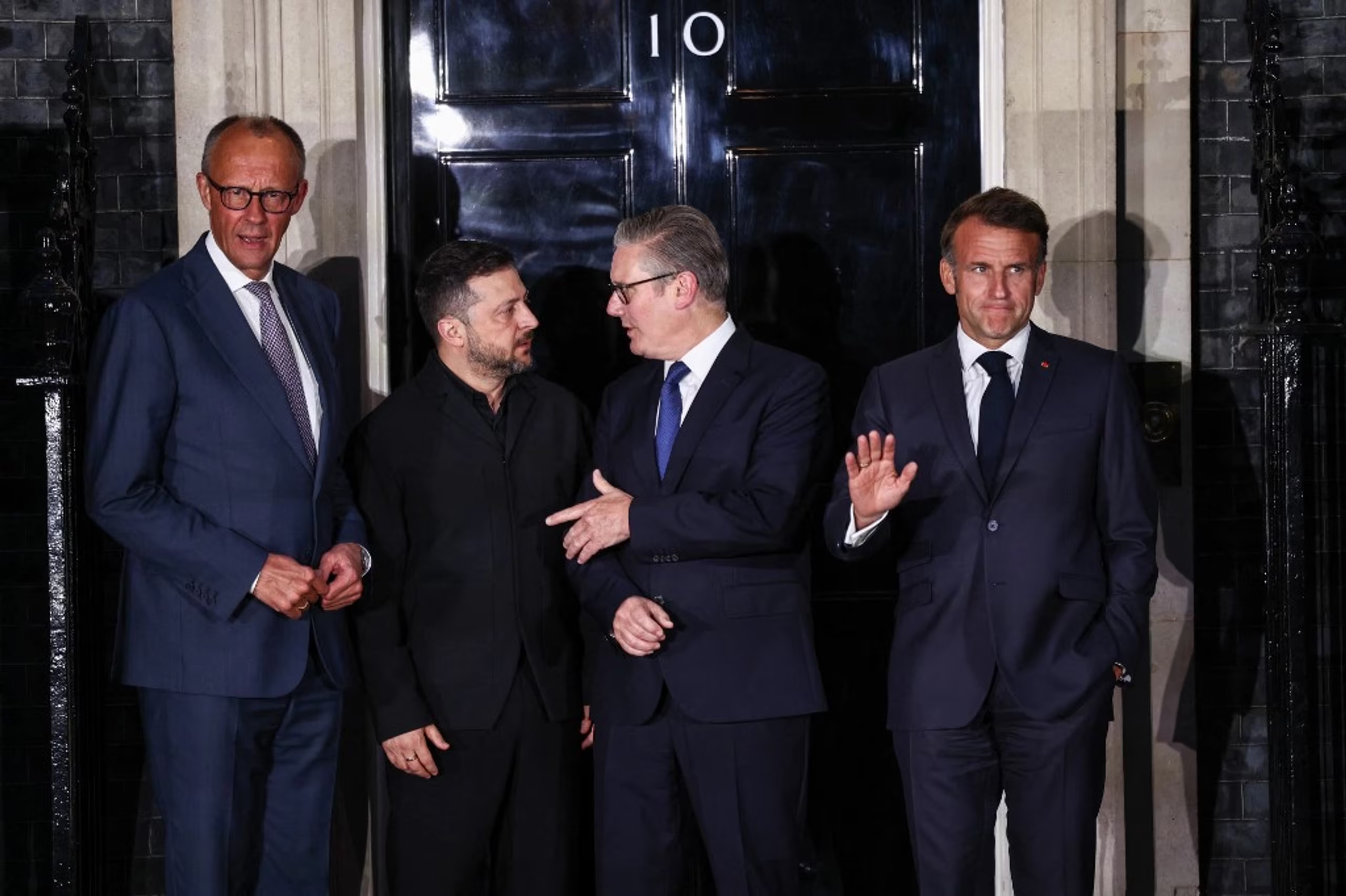
The terms for ending the war in Ukraine, agreed in London at a meeting between Volodymyr Zelensky, Friedrich Merz, Emmanuel Macron and Keir Starmer, are structured in such a way as to look like a step toward peace while ensuring that they do not lead to it.
On the surface, the “London” statement continues the line already visible in Zelensky’s letter to Putin—to offer Russia a cessation of hostilities along the front line. But it is offered in a form in which Moscow is almost certain to refuse. The document will probably be presented as a possible basis for talks between European countries and Russia—a subject being discussed more actively in Europe—and that is why the structure of the proposal itself matters.
The statement’s architecture is internally contradictory, and that contradiction is not accidental. On one hand, it speaks of stopping the war along the current front line as the starting point for negotiations—that is, of a step that could theoretically mark the beginning of de-escalation. On the other, it embeds in the same framework a provision for the subsequent deployment of foreign troops on Ukrainian territory, something Moscow has previously opposed categorically. In other words, a condition known in advance to be unacceptable to the other side is attached to a proposal presented as peaceful.
The context makes this calculation even clearer. The Kremlin, as Putin himself recently reiterated, rejects not only the presence of a foreign contingent but also the very idea of a ceasefire along the current line of contact, insisting instead on the withdrawal of Ukrainian troops from Donbas. Against this backdrop, European capitals are effectively taking a position already far removed from Russia’s and adding to it a point Moscow has repeatedly called inadmissible. The result is predictable—and, judging by the structure, it is precisely the result being built in.
The logic becomes easier to understand if one assumes that Kyiv and European capitals are not fully confident that Moscow, under certain circumstances, would not change its position and agree to end the war along the front line. Such a scenario would be inconvenient for the authors of the statement: if Russia suddenly accepted a ceasefire, it would be politically extremely difficult for the Ukrainian authorities to reject it. That is why additional conditions are inserted into the public framework—conditions that all but nullify the likelihood of Russia’s consent. The display of readiness for peace is preserved, while the risk that peace might actually arrive on inconvenient terms is removed.
A separate question is the reality of deploying foreign troops at all, and here the same duality is even more visible. Without a UN Security Council resolution, which Russia would block, and without a stable peace settlement, which is impossible without Moscow’s consent as one of the parties to the war, the likelihood of a European contingent being deployed in Ukraine even after a freeze along the front line is close to zero. At any moment the conflict could be “unfrozen”—and European troops would then be drawn directly into a war with nuclear-armed Russia, precisely the scenario Europe and the United States have consistently and deliberately avoided in recent years. That is why statements about sending troops or deploying “peacekeepers” before these conditions are met remain mostly political rhetoric—rhetoric that does not bring a settlement closer, but only complicates an already difficult negotiating process.
There is also a more subtle indicator of intent. Even if one assumes that someone really is prepared to take the risk of sending troops into Ukraine after a ceasefire without Russia’s consent, then given Moscow’s position it would be more logical not to make such plans public before a truce takes effect—provided the goal is indeed to secure Russia’s agreement to stop the fighting along the front line. Openly and repeatedly voicing these plans works in exactly the opposite direction, giving Moscow a ready-made reason to refuse. That means that, if one reasons from observed behavior, the goal appears to be the reverse—and in that case constant statements about the possible deployment of troops look entirely logical, even if in reality no one intends to send them to Ukraine.
The picture that emerges is one in which European diplomacy carefully separates image from outcome. At the level of image, it maintains the impression of active movement toward peace—meetings, statements, draft “bases for negotiations.” At the level of concrete conditions, however, every step is structured so that the other side’s agreement remains virtually impossible. A desire to end the war is being demonstrated, but the substance of the proposals is arranged so that such an end cannot, under any circumstances, take place on terms Kyiv and European capitals consider disadvantageous.