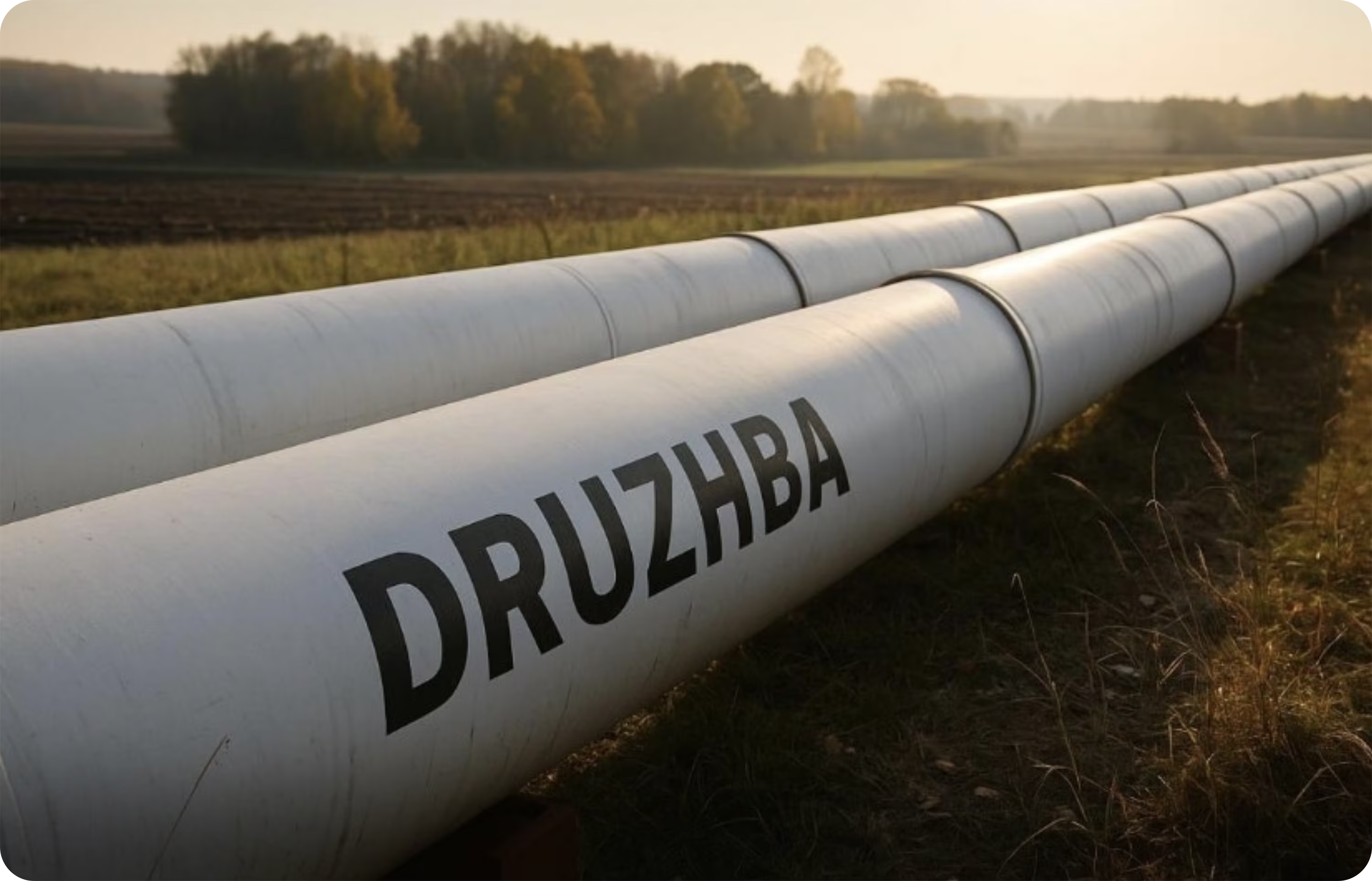
Ukraine has completed repair work on the Druzhba oil pipeline (“Druzhba” means “friendship” in Russian)—Zelensky announced this on April 21. The pipeline, which carries Russian oil in transit through Ukrainian territory to Hungary and Slovakia, may resume operations. At the same time, Hungary’s future prime minister, Peter Magyar, urged Zelensky “not to engage in blackmail” and to restore the flows.
This brief news item captures a paradox that deserves attention in its own right. In late January, a Russian drone strike on Druzhba infrastructure in western Ukraine destroyed part of the storage facilities—and pumping stopped. The country under attack had to restore infrastructure destroyed by the aggressor state so that the aggressor state could continue supplying oil to the EU. In this arrangement, the instrument of war and the instrument of commerce are one and the same pipeline.
Pressure on Kyiv was direct. Hungary blocked a 90-billion-euro EU loan to Ukraine, froze adoption of the 20th sanctions package against Russia, and refused to open negotiating clusters on Ukraine’s accession to the EU—in exchange for demanding the restoration of transit. In March, Zelensky put the situation with unusual bluntness: he was being forced to restart Druzhba, and that differed little from lifting sanctions on Russia. Brussels, for its part, offered Ukraine technical and financial assistance for the repairs and required the work to be completed within six weeks. The fact that Russia carried out the strike on this infrastructure is usually left at the margins of diplomatic communiques—the priority is that the flow be restored.
The change of power in Budapest has not altered the picture. On April 12, Peter Magyar’s Tisza party won 53% of the vote and a constitutional majority in the parliamentary elections, bringing Viktor Orban’s 16-year rule to an end. The “pro-European” turn proved largely rhetorical. Immediately after the victory, Magyar said Hungary was under no obligation to support the EU loan to Ukraine, expected to preserve purchases of Russian oil and economic cooperation with Moscow, and favored lifting EU sanctions on Russia once the war ends. And the date Tisza has promised for ending reliance on Russian oil is 2035—eight years later than the European deadline. Hungary’s future economy and energy minister, Istvan Kapitany, a former global Shell executive, has already stated publicly that he assumes the war will end by late 2027 and that the country will not fully renounce Russian energy.
But even if Hungary is removed from the frame, the contradiction does not disappear—it is merely redistributed. Since the start of the full-scale invasion, EU countries have paid Russia roughly 231 billion euros for fossil fuels, according to data from the Centre for Research on Energy and Clean Air. Total European aid to Ukraine over the same period has amounted to about 200 billion. In other words, Brussels, Berlin, Paris, and Rome together have transferred more money to Moscow than to Kyiv. That money has gone into the Russian budget, from which missiles, drones, and contracts for mobilized troops are financed—including those used to destroy Ukrainian energy infrastructure that then has to be rebuilt. Since the war began, Russia has earned about 644 billion euros from energy exports—one-third of that sum came from European buyers.
And what matters here is not only the arithmetic, but the politics of silence surrounding it. Not a single European leader, in three years of war, has gone before the cameras and said the simple thing: we are paying Russia money with which it wages war against the country we are simultaneously defending. That sentence appears nowhere in the speeches of Ursula von der Leyen, the statements of Macron, or the communiques of the European Council. What exists instead are sanctions packages with carve-outs. Deadlines with exemptions. A ban on seaborne supplies of Russian oil—while pipeline deliveries remain intact. A ban on LNG pushed back to 2027, by which point, according to Magyar’s experts, the war may already have ended on its own. There is rhetoric about “full support for Ukraine” alongside continued purchases of the very raw materials whose revenues finance Russia’s war. In 2024, 18% of the gas consumed by the EU was still Russian. In December 2025, the EU adopted a binding decision to phase out Russian oil and gas by the end of 2027—yet Putin has already hinted that he may halt supplies himself sooner if he judges it advantageous. In other words, the question of when the EU stops financing Russia may ultimately be decided not by the EU, but by Russia.
The essence of what is happening is simple, once the diplomatic layer is stripped away. Ukraine is fighting a war in which its cities are regularly shattered by Russian missiles and drones, while its army—at the cost of human lives—grinds down Russian military power that might otherwise be directed farther west. In European capitals, this is acknowledged in private and avoided in public: every Russian column destroyed near Pokrovsk is a column that did not reach NATO’s borders. In this configuration, Ukraine is performing for Europe the function of a buffer—disarming Russia in real time and at its own expense. Europe pays for that function through aid, weapons, and loans—but at the same time it also pays for the war itself by buying Russian oil and gas, the revenues from which go into the same budget that pays for shells.
In this triangle, Ukraine ends up not as a subject but as an object of bargaining. Moscow and Brussels, formally locked in a sanctions war, converge on one point: the flow of Russian oil to European refineries must continue. They differ only on the details—through whom, at what price, and with what exemptions. When the Ukrainian president tries to use his own territory as leverage, he is publicly told that this is not how one behaves. The bargaining chip in this arrangement is the country that is itself fighting the war—and from which others simultaneously demand that it not interrupt the very exports financing that war.