Chinese company Moonshot has unveiled Kimi K3, an artificial-intelligence model that the developer says approaches the capabilities of leading products from OpenAI and Anthropic PBC. Its release is the latest indication that the technological gap between Chinese and American laboratories is narrowing.
Moonshot released Kimi K3 on Friday, July 17. The company says the open-weight model ranks behind only Anthropic’s Claude Fable 5 and OpenAI’s GPT-5.6 in overall capabilities.
Kimi K3 has 2.8 trillion parameters and supports a context window of 1 million tokens. Independent benchmarking service Artificial Analysis ranked it above Anthropic’s Opus 4.8 in several frontier-level tests. Kimi K3 is the first Chinese open-weight model to achieve such a result.
“K3 is a brilliant model,” said Leonid Mironov, a portfolio manager at Gavekal Capital Ltd. “In my experience, it is clearly the best Chinese model ever created.”
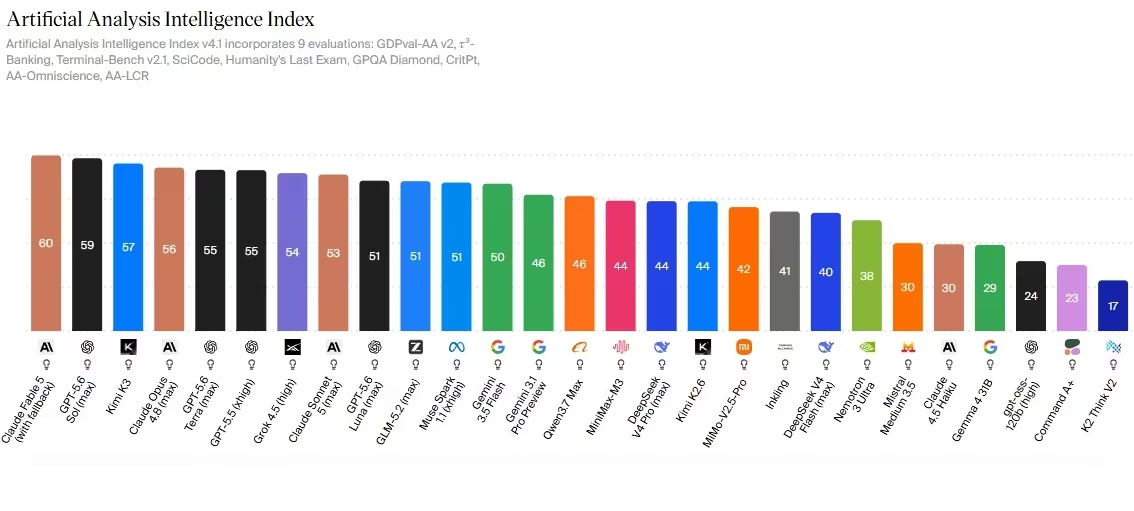
Artificial Analysis Intelligence Index.
Kimi K3’s performance surprised the market and intensified doubts about Z.AI’s competitive position. Moonshot also says its new system outperforms Z.AI’s most advanced model on programming tasks.
Z.AI shares fell 30%—their steepest decline since the company went public. MiniMax Group Inc. lost 16%. The declines came amid a broader selloff in Asian technology stocks as investors worried that the multiyear rally driven by advances in AI had gone too far.
“Whenever a new artificial-intelligence model emerges, shares of established market participants come under pressure as competition intensifies,” said Stephen Leung, executive director at UOB Kay Hian.
The release of Kimi K3 shows that Chinese developers are competing increasingly on technical capabilities as well as price. Moonshot has priced use of the model at roughly the same level as Anthropic’s Sonnet, allowing the company to charge more than other Chinese platforms.
Competition is intensifying as leading Chinese developers expand into international markets. Z.AI’s annual recurring revenue is approaching $1 billion, according to people familiar with the matter.
Beijing, meanwhile, is expanding support for the country’s artificial-intelligence industry. Chinese President Xi Jinping praised the country’s success in developing inexpensive AI systems and called for a more open global technological order.
The White House Accused China of Industrial-Scale Theft of U.S. AI Companies’ Research
Chinese AI Models Enter the European Market
China Imposed Overseas Travel Restrictions on Leading AI Specialists From Private Companies Such as Alibaba and DeepSeek