
Volodymyr Zelensky presented a 20-point framework for a peace agreement currently under discussion in talks in the United States. According to him, there is still no consensus on a number of key provisions, including the most sensitive issue—territory.
The proposals rest on reaffirming Ukraine’s sovereignty and concluding a non-aggression agreement between Ukraine and Russia, with international monitoring along the line of contact. A separate section addresses security guarantees, including maintaining the size of Ukraine’s armed forces at 800,000 personnel in peacetime. Under the plan, the United States, NATO, and European countries would provide Ukraine with guarantees modeled on Article 5, implying a military response and the reimposition of sanctions in the event of a new Russian invasion. Moscow, for its part, would be required to legally codify a policy of non-aggression toward Ukraine and Europe across all relevant legislation.
The plan also envisions Ukraine’s integration into the European Union within a fixed timeframe, alongside the launch of a global development package to be formalized through a separate investment agreement. Several funds would be established to support reconstruction, with the overall goal of mobilizing up to $800 billion. In parallel, Ukraine intends to accelerate the conclusion of a free trade agreement with the United States and to retain its non-nuclear status.
One of the most contentious issues remains the fate of the Zaporizhzhia nuclear power plant. There is no compromise here: the United States is proposing a tripartite management model with a central role for the American side, while Ukraine’s proposal envisages joint US-Ukrainian governance on a 50–50 basis. The territorial question is no less complex. One option under discussion would involve the withdrawal of Russian forces from the Dnipropetrovsk, Mykolaiv, Sumy, and Kharkiv regions, while maintaining the current line of contact in the Donetsk, Luhansk, Zaporizhzhia, and Kherson regions under the formula “we stay where we stand.” Russia, for its part, is insisting on Ukraine’s withdrawal from the Donetsk region. As a compromise, the United States is proposing the creation of a free economic zone. If agreement on the “we stay where we stand” formula proves impossible, the free economic zone option could be implemented only through a referendum, in which the entire text of the agreement would have to be put to a vote.
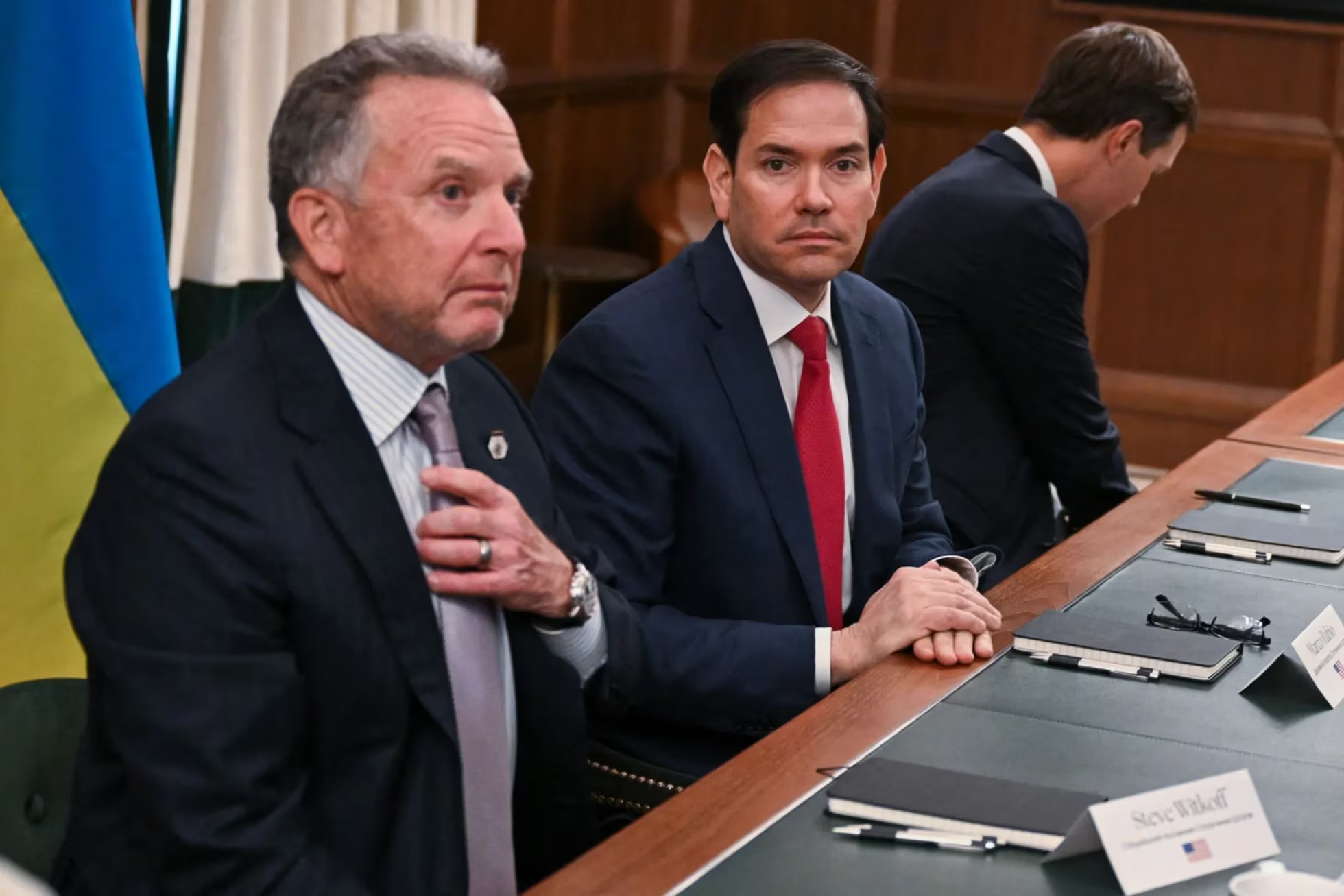
Why Approaches to Ukraine Peace Talks Have Diverged Inside the Trump Administration
Rivalry Between Special Envissary Steve Witkoff and Secretary of State Marco Rubio Is Undermining Washington’s Unified Diplomatic Line
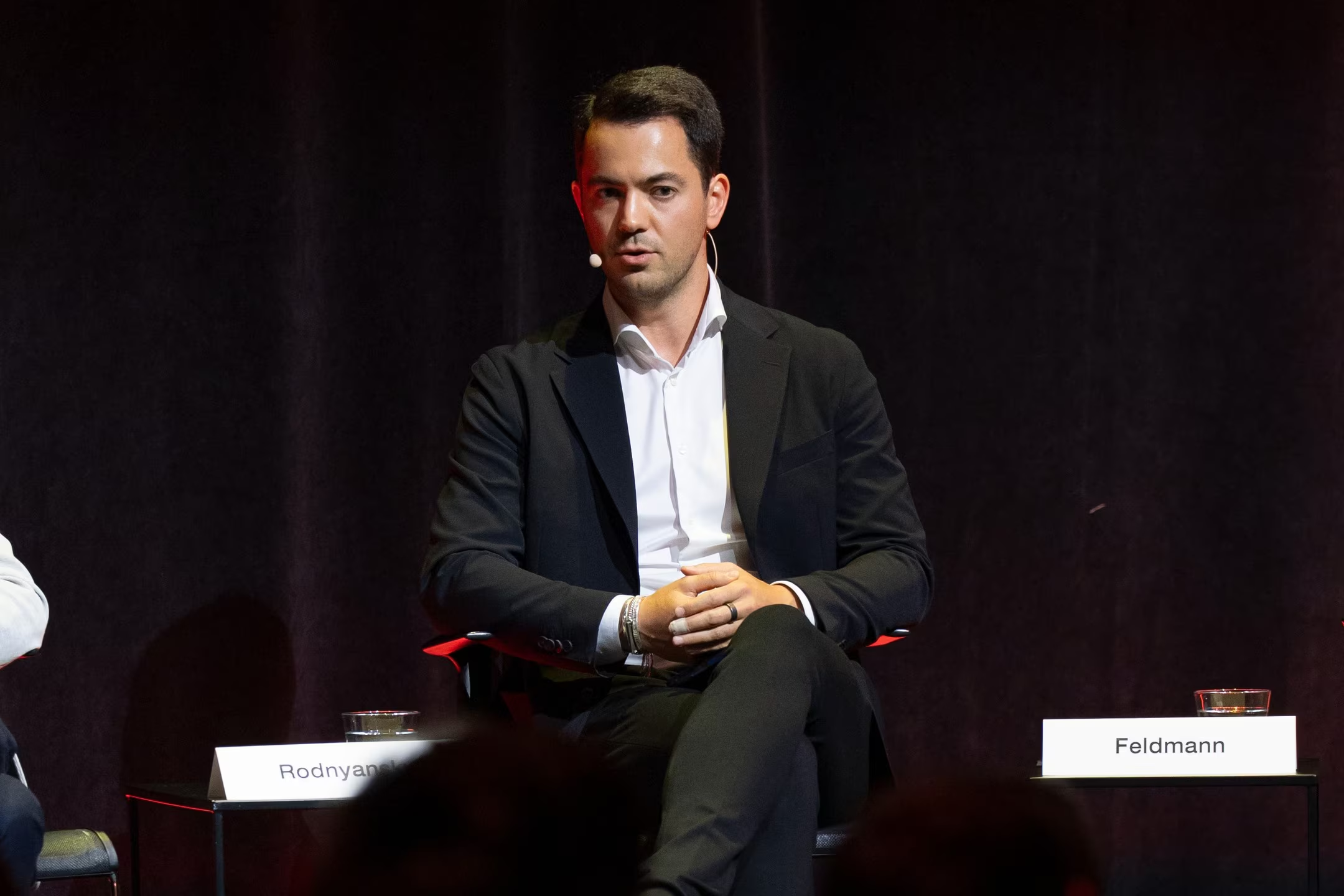
“Loyalty Proved More Important Than Competence, and Institutions Were Devalued.”
Alexander Rodnyansky on How the Personalization of Power Led Ukraine Into a Systemic Governance Crisis
The document also предусматривает a mutual commitment by the parties not to alter the agreements reached by force. Russia would be required to guarantee Ukraine unhindered use of the Dnipro River and the Black Sea for commercial activity, while the Kinburn Spit would be subject to demilitarization. A separate provision enshrines a “all for all” prisoner exchange, alongside the return of civilians, children, and political prisoners.
After the agreement is signed, Ukraine would be required to hold elections as quickly as possible. The agreement itself would be legally binding, with oversight of its implementation entrusted to a Peace Council chaired by Trump. Once all parties have formally endorsed the document, a comprehensive ceasefire would enter into force immediately.