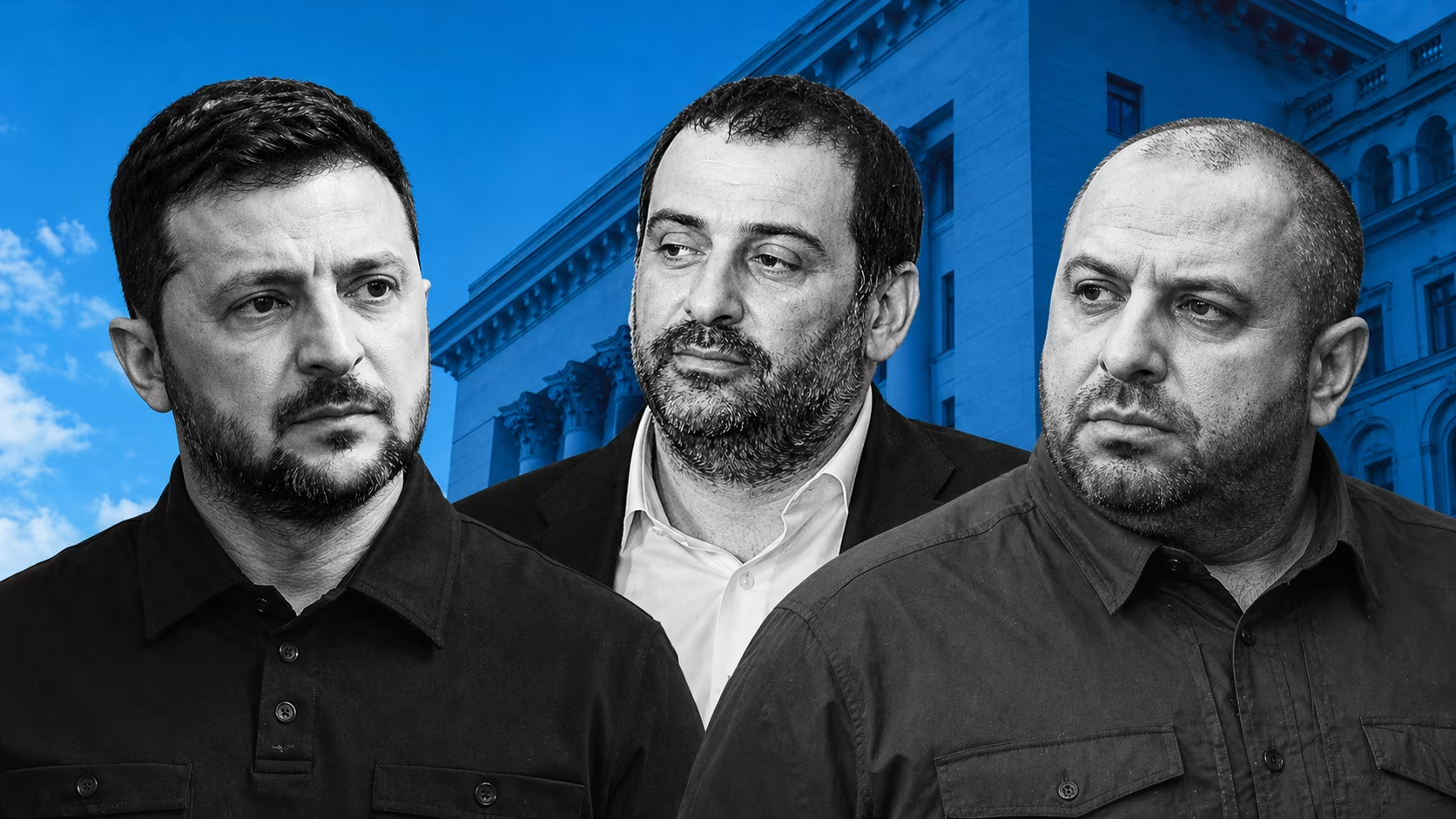
Late last night, Ukrainska Pravda journalist Andrii Tkach published the contents of wiretaps conducted by NABU and SAPO in the apartment of Tymur Mindich—a close friend of Volodymyr Zelenskyy—on Hrushevskoho Street in Kyiv. It had been reported as far back as the summer of 2025 that the apartment was being bugged and that the recordings might contain conversations involving the president himself. Ukrainska Pravda is close to NABU and SAPO, and the source of the recordings passed to Tkach is obvious.
Tkach did not release the audio files themselves. He read out the contents of three fragments, first “apologising” to the audience for the Russian language spoken by people from Zelenskyy’s inner circle.
The first fragment is a conversation between Mindich and the president’s friend Serhii Shefir on June 30, 2025, about the criminal case against then deputy prime minister Chernyshov. The recording indicates the following:
Chernyshov is close to Mindich and Shefir, and both discuss how to help him with bail and other support. — Both are outraged that NABU is targeting the president’s closest associates. — According to Mindich, Zelenskyy himself shares this anger and has spoken to him about it. — Mindich already knows that NABU is also working on a case against him and says he is being advised to leave the country. — Both suspect Chernyshov of “skimming” in the apartment scheme under NABU investigation. Shefir adds that when he catches his own people doing that, he demands 50%. Among those he considers “his own” is MP Kysel, whom NABU served with a bribery notice at the end of 2025.
The second fragment is a June 1, 2025, conversation between Mindich and a certain Natalia about the construction of houses in the Dynasty cottage settlement. According to media reports, mansions for Zelenskyy, Yermak, Mindich, and Chernyshov were being built there with money of unclear origin, and NABU is conducting a separate investigation into the matter. The recording indicates:
— Mindich is concerned about media attention to the construction and discusses the need to slow it down, while transferring the houses themselves to other people on paper. — The context confirms that Zelenskyy, Yermak, and Mindich himself are building houses in the settlement.
The third fragment is a conversation between Mindich and then defence minister Umerov on July 8, 2025. The recording indicates:
— Mindich and Umerov speak closely and in confidence. — Mindich has direct ties to the company Fire Point, which receives the largest state contracts for the production of missiles and drones. — Mindich asks Umerov to speed up the allocation of funds for Fire Point’s missile production and also to pay for body armour already manufactured by another company. On both counts, Umerov promises to try. — The sale of a stake in Fire Point to investors, presumably from the Middle East, is discussed. At Mindich’s request, Umerov is conducting the negotiations. — “Masha”, who receives $20,000, is mentioned several times. Tkach suggests this may refer either to volunteer Maria Berlinska or to Umerov associate Mariia Dotsenko. — Mindich is unhappy that Umerov is to be replaced as defence minister by Shmyhal. The latter’s appointment is linked to the influence of a certain “David”—most likely Servant of the People faction leader Davyd Arakhamia.
Tkach announced that more recordings would be published. Persistent rumours suggest that Zelenskyy’s own voice is also on the tapes.
The leak began at a moment when Kyiv is being pressed to accelerate so-called anti-corruption reforms. Last week, the European Union approved a 90 billion euro loan for Ukraine for the next two years and explicitly linked the funds to reforms from the so-called “Kachka-Kos list” (Taras Kachka is deputy prime minister for European integration, Marta Kos is the European commissioner for enlargement).
The bulk of these reforms comes down to two directions. The first is an expansion of NABU and SAPO’s powers: in effect, the abolition of statutes of limitation in corruption cases and the right of SAPO to issue notices of suspicion to MPs independently, without the prosecutor-general. The second is the effective transfer of the Prosecutor General’s Office, the State Bureau of Investigation, the Interior Ministry, the High Qualification Commission of Judges, and the Constitutional Court under external control through кадровые competitions in which “international experts” hold the decisive vote. Where this leads can already be seen in the recent competition for the head of customs: the “international experts” selected two candidates, and both turned out to come from NABU.
In essence, this is about handing control of these bodies to an environment previously linked to the US Democratic Party and now patronised by the European Union. It is precisely this milieu, which exerts decisive influence over NABU and SAPO, that is driving “Mindichgate” and forms the core of the situational “anti-Zelenskyy coalition” that took shape last year.
Implementation of the package would deprive Zelenskyy of control over the law-enforcement and judicial systems and turn him into a figure without real authority. That is why the president, his entourage, and most Servant of the People MPs are in no hurry to carry out the reforms and intend to sabotage them, рассчитывая that during the war Europe will not dare cut off funding.
The “anti-Zelenskyy coalition” is enraged by this—and now, it seems, is deploying the “Mindich tapes” to force through the laws it wants.
How will Zelenskyy respond—given that his own voice may yet emerge on the tapes, and that Yermak, Shefir, and Umerov could see notices of suspicion accelerated against them? Will he yield by ordering the laws to be passed? Will he ignore the signals on the assumption that, in the current military and political situation, Europe will not move against his inner circle? Will he strike back at NABU and SAPO? And how will parliament behave, where MPs—even on instructions from Bankova—may refuse to vote for a package whose first victims they themselves risk becoming?
The answers to these questions will go a long way towards determining Ukraine’s political dynamic in the near future. One thing, however, is already obvious: while the war continues at the front, and society suffers daily losses while accumulating fatigue, Ukraine’s political class is preoccupied above all with internal struggle—for control over law-enforcement and judicial institutions, shares in defence contracts, and its own political survival.