In Kyiv and the Kyiv region, a de facto blackout continues. Residents of the capital and its suburbs are without electricity for 14–17 hours a day; heating is unavailable in many neighborhoods. Indoor temperatures in apartments are falling to 6 degrees Celsius. Public transport, communications, and social infrastructure have been disrupted, forcing people to adapt their daily lives to prolonged outages.
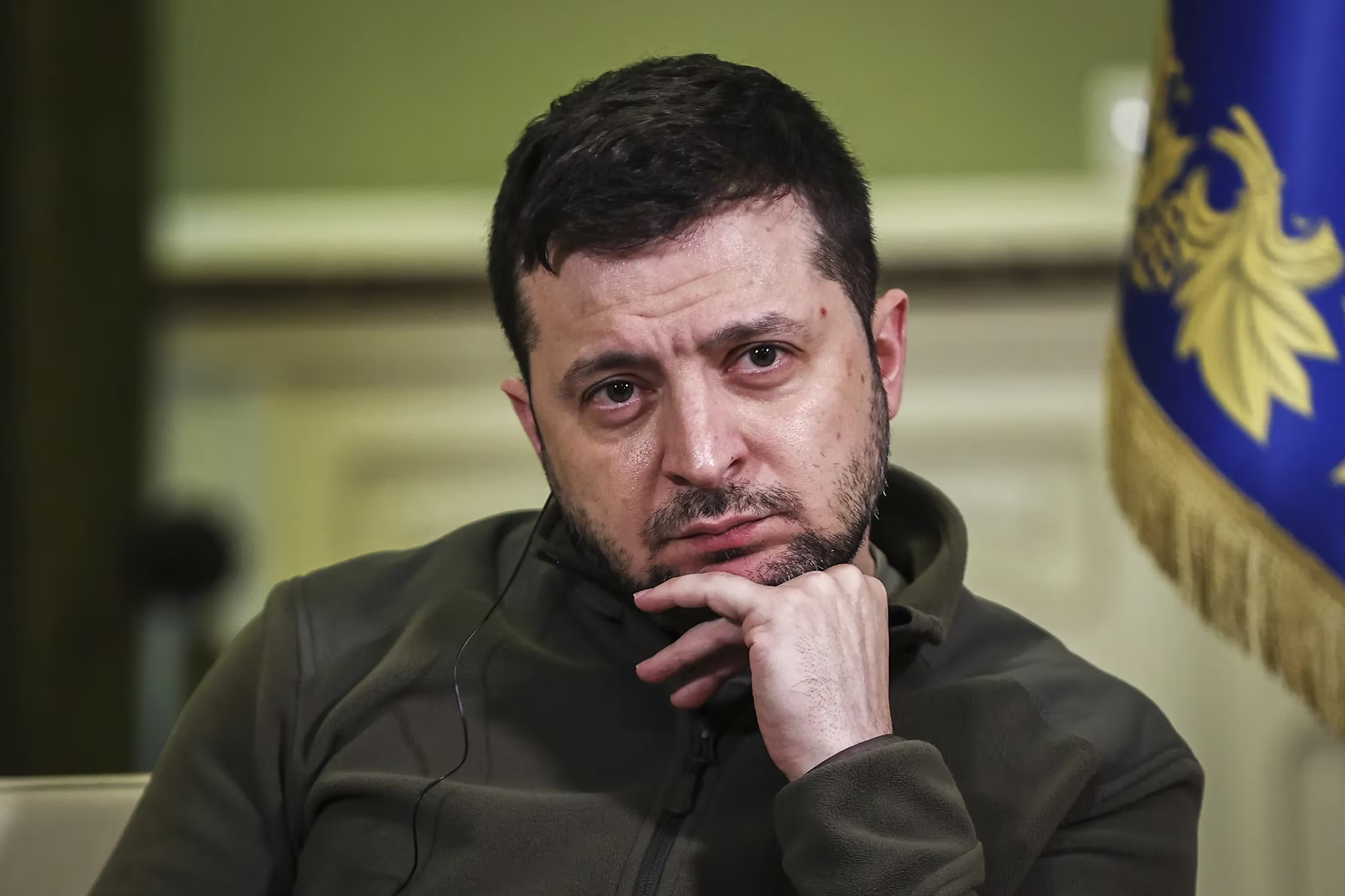
Against this backdrop, President Volodymyr Zelensky publicly accused Kyiv Mayor Vitali Klitschko of inadequate preparation to protect the city’s energy infrastructure. Zelensky said he does not see the necessary intensity in the actions of the city authorities and emphasized that Kyiv, as the country’s most financially secure city, had the capacity to better prepare for strikes on the energy system.
Klitschko rejected the accusations, saying municipal services are operating under emergency strain, addressing the aftermath of attacks and ensuring that critical facilities are connected to backup power sources. According to him, responsibility does not rest solely at the municipal level, and the capital’s energy system is suffering primarily because of the scale of the strikes.
Separately, Zelensky announced the introduction of a state of emergency in the energy sector. Observers note that such a regime could potentially restrict the publication of full information about the real condition of the energy system and the circumstances facing millions of residents of Kyiv and the surrounding region.
The public criticism of Kyiv’s preparedness to protect its energy infrastructure voiced by Volodymyr Zelensky has become a notable episode in relations between the central government and the capital’s leadership. The president directly pointed to the responsibility of the city authorities and Mayor Vitali Klitschko, saying that Kyiv’s level of readiness for attacks on its energy system proved insufficient.
Zelensky stressed that he does not see the necessary intensity in the actions of the city administration, singling out the capital’s financial capacity. According to him, Kyiv had resources that would have allowed it to better prepare in advance for strikes on critical infrastructure. Klitschko responded by saying that municipal services are operating under emergency strain, restoring damaged facilities and deploying autonomous power sources for social institutions.
Formally, the discussion concerned specific management decisions and the consequences of the attacks. However, the form this criticism took—personal and public—gave the situation a different character. The claims were directed exclusively at the mayor, while the head of the Kyiv City Military Administration—who, under martial law, holds broad powers in the areas of security and infrastructure coordination—was not mentioned in these statements. This imbalance immediately raised questions about the logic behind the allocation of responsibility.
Additional context lends the situation a sharper political tone. Shortly before this, anti-corruption authorities brought charges as part of a large-scale investigation in the energy sector, implicating figures linked to the president’s closest circle. The probe focuses on schemes within state energy companies and alleged abuses in contracting and procurement. For the current administration, the case has become one of the most sensitive in recent years.
Against this backdrop, the sharp criticism of Klitschko appears not merely as a technical review of failures, but as an attempt to exert pressure on an independent political actor. Kyiv’s mayor has long been seen as a potential rival to Bankova, and the public accusation of failing to prepare the capital reinforces an already established line of conflict between the central authorities and the city’s leadership.
As a result, the issue of protecting energy infrastructure—on which the daily lives of millions of residents of Kyiv and the surrounding region directly depend, including home heating, hospital operations, transport, and communications—is drawn into a political confrontation. The choice of target and the timing of the public accusations make this episode illustrative: a governance crisis and corruption scandals in the energy sector form the backdrop against which any statements by the authorities are inevitably read more broadly than mere commentary on the performance of municipal services.