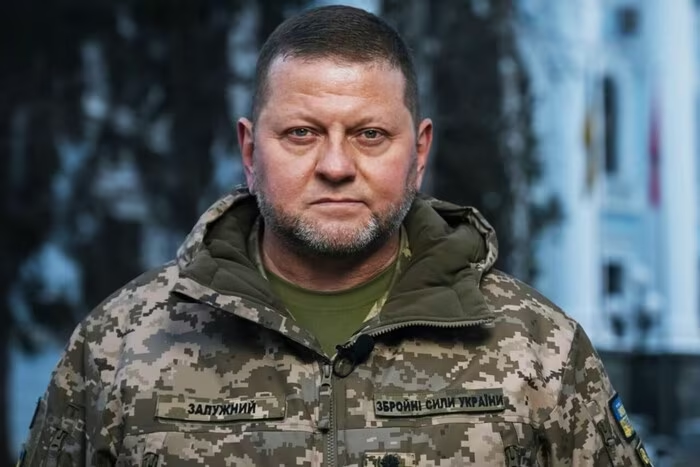
Former Commander-in-Chief of Ukraine’s Armed Forces Valerii Zaluzhnyi, in a conversation with The Guardian, placed responsibility on the president for refusing to impose martial law in advance—a decision that, he said, deprived the country of time for systematic preparation for Russia’s invasion.
“Martial law should have been introduced in January or, at the very latest, in February. You are about to fight Mike Tyson, and the only fight you have ever had before that was a pillow fight with your younger brother. This is a one-in-a-million chance, and you have to be ready,” Zaluzhnyi said.
According to him, he raised the issue repeatedly but found support only from Defence Minister Oleksii Reznikov. Volodymyr Zelenskyy, he said, continued to reject the idea, fearing it would provoke public panic. As a result, the National Security and Defence Council agreed only to a state of emergency.
Zaluzhnyi stressed that the lack of full-scale preparation ultimately exacted a heavy price for Ukraine in the first days of the invasion.
A number of defensive measures were taken by the military on their own initiative, at the risk of criminal prosecution. At the very last moment, mines were laid on the seabed of the Black Sea to disrupt a possible amphibious landing near Odesa, while certain units were ordered to urgently change positions and move to areas more advantageous from a defensive standpoint.
At the same time, according to the general, Zelensky went to bed with his family on the night of February 24, convinced that there would be no war. The very next day, his wife was hastily packing their belongings as she heard explosions somewhere in the distance.
In the same piece, The Guardian also describes as catastrophic advice given by Volodymyr Zelensky on the eve of the war—urging people not to give in to anxiety, to plan “barbecues in May,” and not to believe talk of an imminent Russian invasion.
The paper writes that in January 2022 the then director of the CIA, William Burns, flew to Kyiv to personally warn the Ukrainian president that war was inevitable, “yet the reaction was not what he may have expected.”
Just a week later, Zelensky delivered a video address to the public, calling on citizens to ignore warnings of an impending invasion. In January he said: “In May, as usual—sunshine, days off, barbecues, and of course Victory Day. Take a deep breath, calm down, and don’t rush to stock up on food and matches.”
“That advice proved catastrophic, given that many thousands of people soon found themselves in active combat zones or under Russian occupation,” The Guardian concludes.