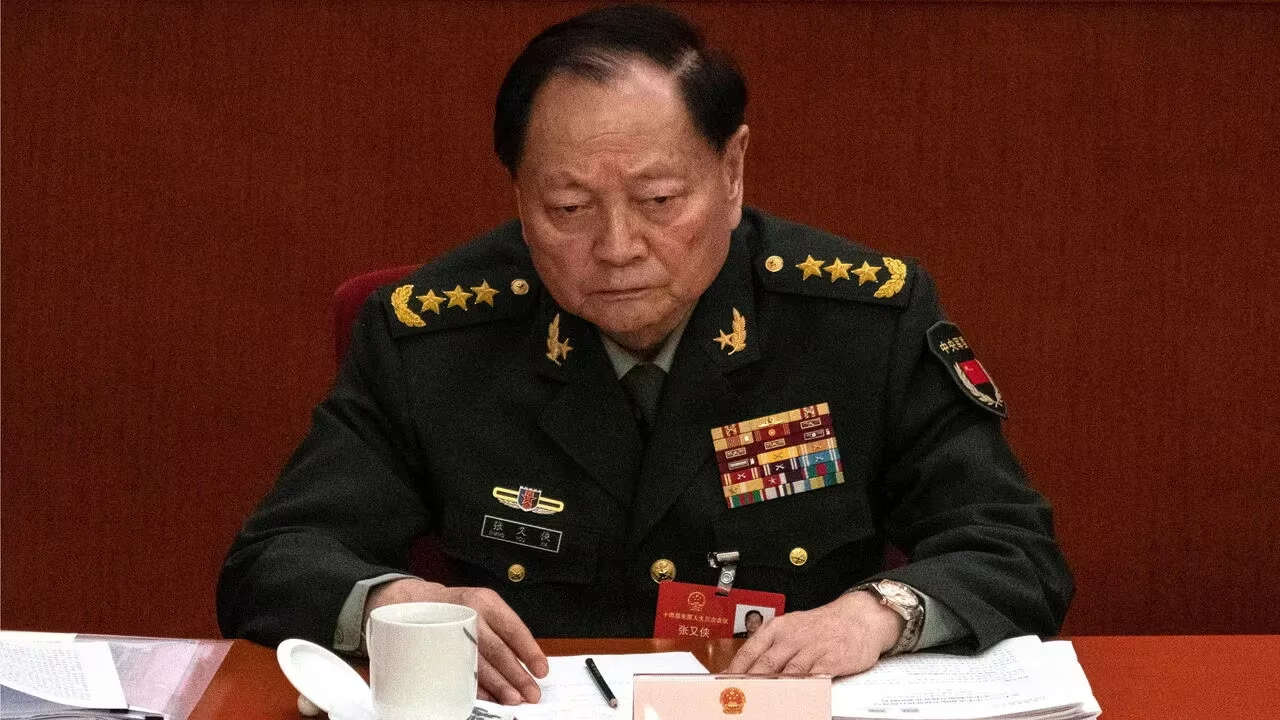
For a long time, it was widely believed among Chinese generals that one of their number lay beyond the reach of the sweeping purges that have rolled through the top military leadership over the past two years. That figure was Zhang Youxia—the highest-ranking active officer in the armed forces. He was not only a personal acquaintance of Xi Jinping but also one of the few commanders with genuine combat experience: in 1979, he fought in the war with Vietnam and distinguished himself in battle. This bolstered his standing as the senior of the two vice chairmen of the Central Military Commission—the body that oversees the armed forces and is chaired by Xi himself. Some analysts even viewed Zhang as a key figure behind the recent repression within the military. Now, however, he too has come under fire—in the most high-profile episode of these purges.
On January 24, the Ministry of Defense announced that Zhang Youxia, 75, and another member of the Central Military Commission, General Liu Zhenli, are under investigation on suspicion of “serious violations of discipline and the law.” No further details were provided. Liu, 61, heads the Joint Staff Department, which is responsible for operations, intelligence, and troop training. He is also believed to have been personally close to Zhang—the two were linked by their shared experience in the border war with Vietnam.
These investigations mean that Xi Jinping has effectively drained the country’s entire top military leadership of authority—on a scale without precedent since Mao Zedong’s death in 1976. Formally, Zhang and Liu have not yet been removed from the Central Military Commission, but such probes typically entail detention and almost always end in formal dismissal. Four other military members of the commission have already been stripped of their party and army posts. As a result, the body that controls China’s roughly two-million-strong People’s Liberation Army has effectively been reduced to two active figures—Xi himself as chairman and Zhang Shengmin, head of the army’s disciplinary system, who became vice chairman in October.
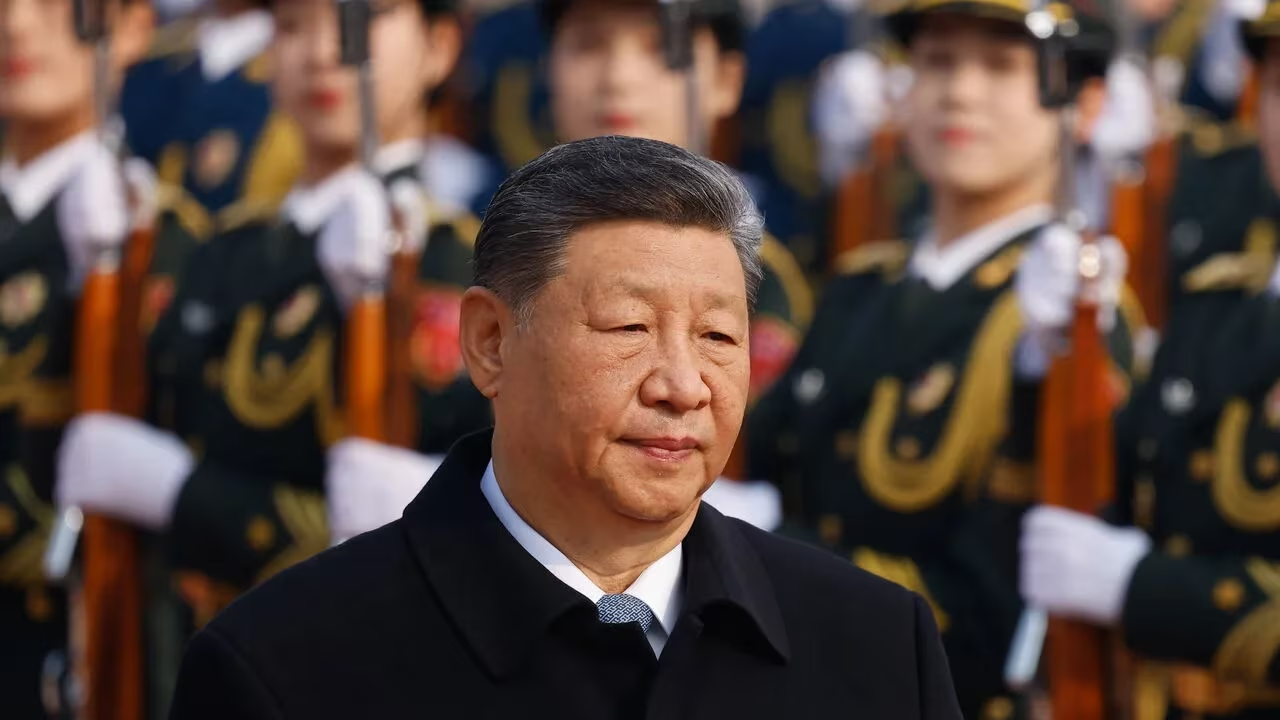
The latest inspections most clearly illustrate the scale of the problems Xi still faces in his effort to turn the military into a fully modern fighting force. Soon after taking power, he launched a campaign against endemic corruption and against the military’s fixation on formal metrics rather than real combat readiness, forcing dozens of generals into retirement and initiating a sweeping structural overhaul. A new wave of purges began around 2023 with the Rocket Force, which is responsible for China’s nuclear arsenal, before spreading to other branches of the armed forces as well as to bodies overseeing weapons development and political work. Yet corruption has not been eradicated, and the reforms have remained incomplete. It is possible that Xi is signaling dissatisfaction with Zhang’s failure to deliver tangible results by a deadline he had set—by next year, under Xi’s plan, the military is supposed to be ready for an operation against Taiwan.
There is another explanation as well. Zhang or members of his family may have been implicated in corruption in the past—for example, during the period from 2012 to 2017, when he headed one of the units most vulnerable to abuse, responsible for weapons development and procurement. Old allegations may have resurfaced, or new ones may have emerged as investigators widened their inquiries or received information from Zhang’s rivals. Some of the officers targeted earlier were widely seen as his protégés.
Yet the new purges may have been driven not only by suspicions of corruption but also by Xi Jinping’s concerns about the growing influence of General Zhang Youxia. “This is the most shocking development in Chinese politics since the early years of Xi’s rise to power,” says Dennis Wilder of Georgetown University in Washington, a former CIA China analyst. In his view, many of the recent crackdowns were tied to rivalry between a faction led by Zhang and another group whose members built their careers in the country’s eastern regions, including during the period when Xi himself worked there. In that struggle, Zhang’s camp—which included several sons of prominent revolutionaries—prevailed. That gave him power without precedent. But it also made him a potential threat to Xi. “He’s a tough, rough old type, and while he was an ally of Xi’s, he was never subordinate to him,” Wilder says of Zhang.
Zhang’s family ties to Xi date back to the civil war, when their fathers fought side by side. Zhang’s father later became a three-star general; Xi’s father rose as a civilian leader. In 2017, Xi signaled his trust in Zhang by overseeing his appointment to the Politburo—the roughly twenty-member body of the Communist Party’s top leadership—and to the post of junior vice chairman of the Central Military Commission, making him the country’s second-ranking general. In 2022, when Xi secured a third term at the helm of the party, Zhang, despite being 72—an age that under previous norms would have meant retirement—was elevated to senior vice chairman of the commission.
If Zhang is formally retired, he will become the highest-ranking serving military officer ever removed by Xi. And if he also loses his seat on the Politburo, it would mark the first time since 1989 that two of its members have been purged within a single five-year term—since the People’s Liberation Army crushed protests in Tiananmen Square. Such a move would send a stark signal to both the military and the civilian elite, especially to scions of famous revolutionary families: personal closeness to Xi offers no guarantee of protection. At the same time, it creates a new problem for him—who to appoint to replace an entire cohort of generals cleared from the system.
Since coming to power in 2012, Xi has sought to promote generals who would be both politically loyal and capable of transforming the military into a more agile force—one able to integrate operations in the air, on land, at sea, as well as in cyberspace and outer space. He first moved to remove commanders appointed by his predecessors. Then many of his own appointees came under fire. As a result, a large share of the remaining generals are either too inexperienced or tainted by ties to disgraced figures. According to a number of Western analysts, these upheavals are beginning to weigh on the military’s combat effectiveness.
In its latest annual report on China’s armed forces, published in December, the Pentagon says that the removal of senior PLA officers has “led to uncertainty over organizational priorities” and “reverberated throughout the force.” The document notes that corruption in defense procurement has caused “documented” capability failures—as serious as faulty covers on missile silos. “These investigations are highly likely to create a risk of short-term disruptions to PLA operational effectiveness,” the report says. “At the same time, the military could emerge from this campaign as a more professional fighting force if it succeeds in using it to eliminate the systemic conditions that fuel corruption.” At the very least, on this point, Xi can hope that the Pentagon is right.