The hard line adopted by China’s leader Xi Jinping in response to the trade war launched this year by U.S. President Donald Trump has delivered tangible results. Tariffs were sharply reduced, new export controls and port fees were suspended, and China once again gained access to more advanced Nvidia chips—critical to advancing its ambitions in artificial intelligence.
By leveraging Beijing’s economic instruments—including control over rare-earth supply chains, where China holds a dominant position—Xi managed to inflict enough pain to force Trump to retreat from his most aggressive measures.
Yet as 2026 approaches—with two meetings with Trump on the calendar—the Chinese leader’s negotiating position may weaken amid mounting imbalances in the world’s second-largest economy. Despite resilient export strength, China’s domestic slowdown has only deepened in recent months.
Even so, analysts say Xi is likely to harden his tactics in dealings with the Trump administration.
“The United States has quite literally done everything it could to exert economic pressure on China—and failed,” says Victor Shih, a specialist in China’s political economy at the University of California, San Diego. “That will only reinforce Xi Jinping’s thinking: everything we have done so far has worked brilliantly, and the U.S. now has no effective levers left against us.”
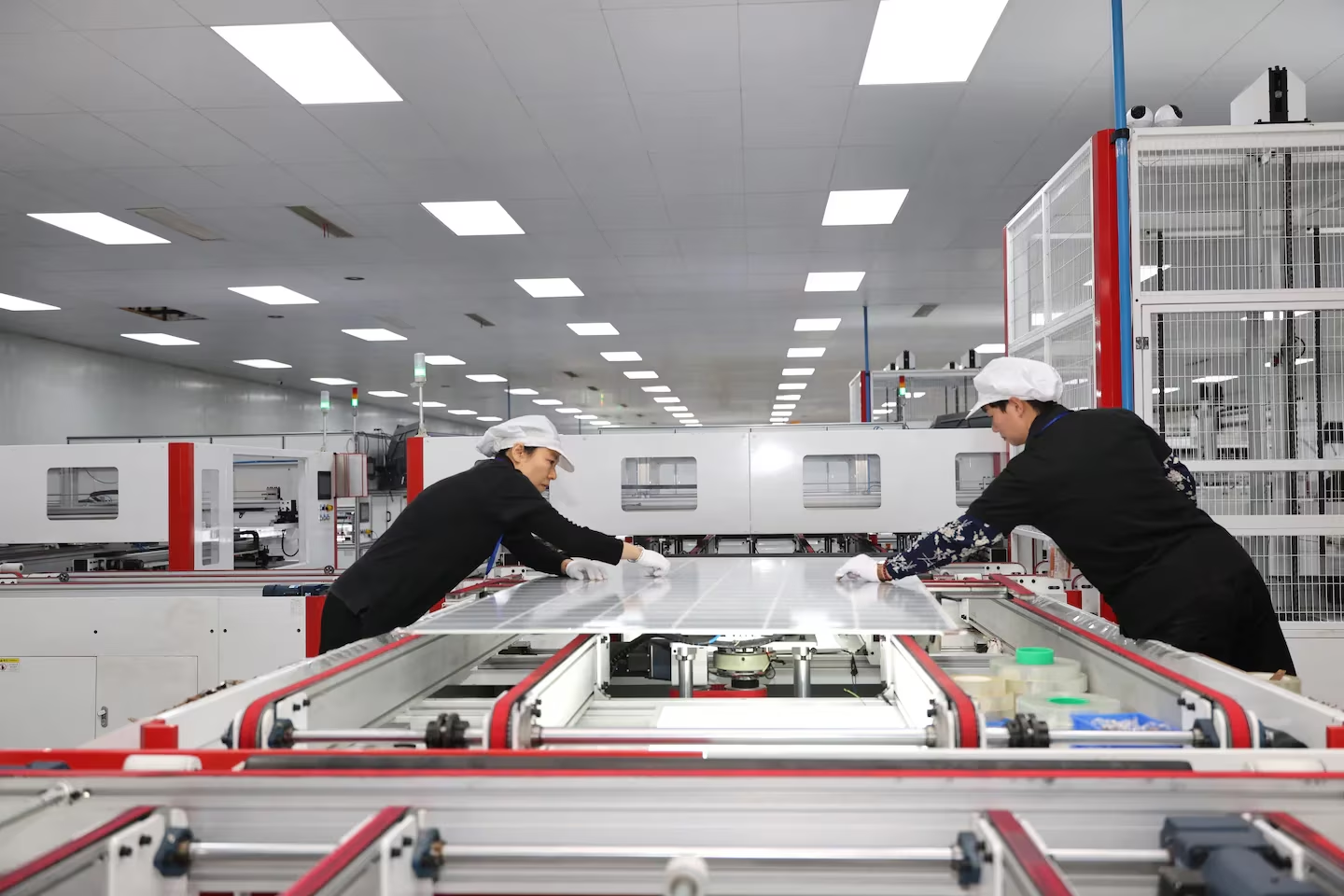
Workers assemble a solar module at a technology company in Huaian.
For the United States, such rigidity raises the risk of another escalation in the trade conflict at precisely the moment when Washington and Beijing are preparing for high-stakes negotiations.
For many years, China’s economy has been operating in two distinct modes. The export sector continues to expand amid global demand for China-made furniture and toys, solar panels, and electric vehicles, while domestic demand remains subdued.
Over the first 11 months of the current year, China’s cumulative trade surplus exceeded $1 trillion, already surpassing the total for all of 2024. A sharp drop in sales to the United States was more than offset by rising shipments to other markets, most notably Southeast Asia.
Other macroeconomic indicators, however, suggest that China’s domestic economy is losing momentum on several fronts at once. Imports remain sluggish, industrial output slowed last month to a 15-month low, and retail sales recorded their weakest performance since the abandonment of the “zero-Covid” policy in 2022.
Investment activity is falling sharply, while the prolonged downturn in the property market continues to erode household wealth and undermine consumer confidence. Adding to the pressure is growing instability in the labor market.
According to World Bank forecasts, China’s economy is expected to grow by just 4.4 percent next year. That would mark the weakest performance in a non-pandemic year in five decades and fall well short of the Communist Party’s stated target of “around 5 percent.”
“China is already in a state of depression,” says Zhu Tian, a professor of economics at the China Europe International Business School in Shanghai. “The downward pressure and the economic challenges the country faces are immense.”
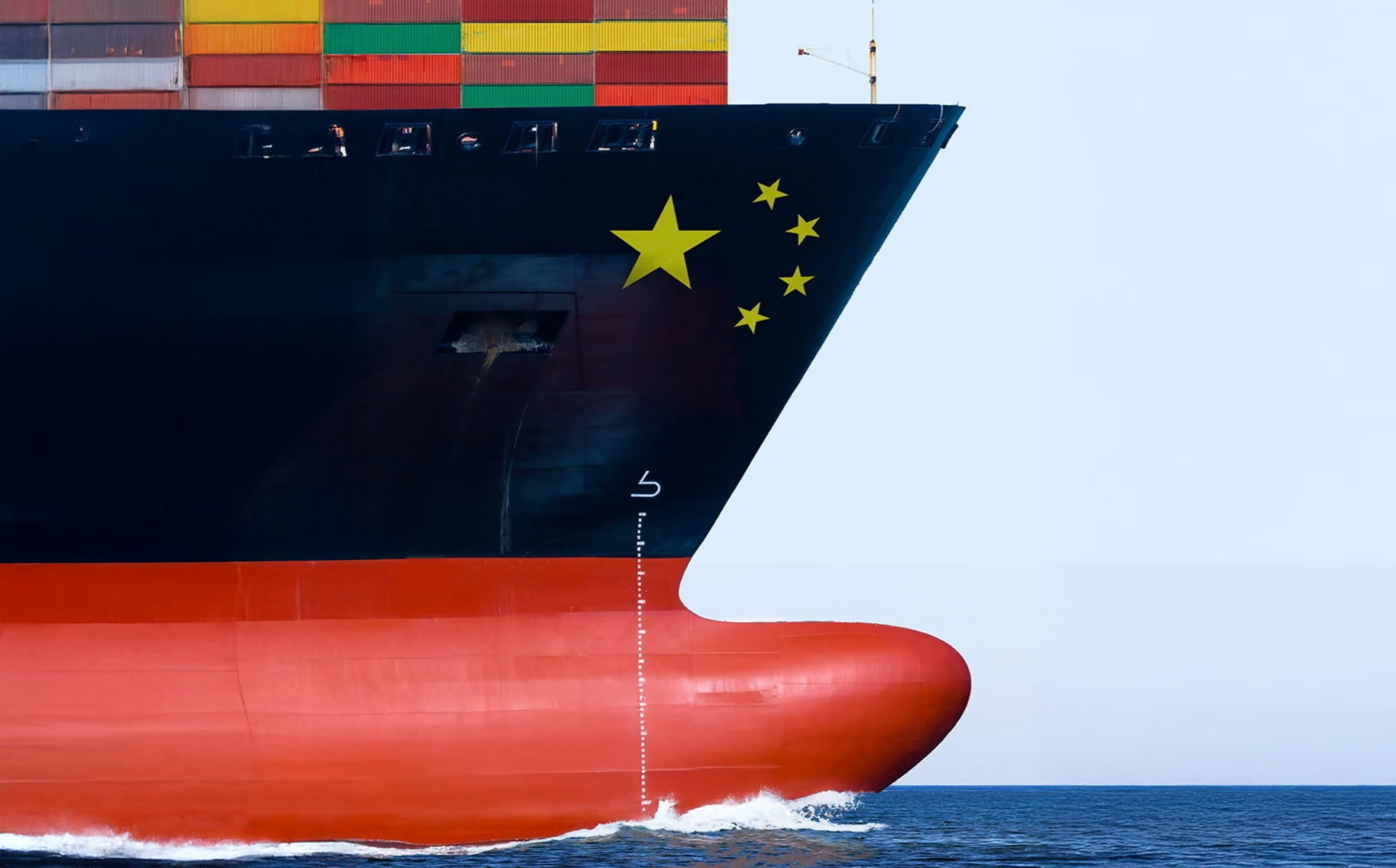
China Ends the Year With a Trade Surplus Exceeding $1 Trillion for the First Time
Rising Exports to Europe and Southeast Asia Offset the Decline in Shipments to the U.S. and Sustain the Record Surplus
The Global Economy Is Slowing, Though the U.S.-China Tariff Standoff Proved Softer Than Expected
The IMF Sees Risks From an Overvalued AI Market and Weakening Global Demand
Beijing, as it has for decades, continues to insist that it will prioritize boosting domestic demand and reducing reliance on exports. Following the conclusion last week of a key annual economic policy meeting, the semi-official Global Times said that among the main objectives for 2026 is, “above all, maintaining a demand-oriented approach and building a strong domestic market.”
The pledge was met with skepticism. “China has been talking about this forever,” says Andy Xie, an independent economist and financial adviser based in Shanghai, adding that he does not believe the promises will be carried out. “China is sacrificing consumption in favor of technological development,” he says, stressing that this model is likely to persist for years.
Yet Beijing has taken no serious steps to revive consumer demand. After the 2008 global financial crisis, authorities deployed massive stimulus to revive the economy, but have since steered clear of similar measures, viewing them as both politically risky and excessively costly.

Shoppers walk past retail outlets inside a shopping mall in Beijing.
Economists warn that the growing imbalances are creating vulnerabilities not only for China, but for the global economy as a whole.
“As the world’s second-largest economy, China is simply too big to generate meaningful growth through exports alone,” said Kristalina Georgieva, managing director of the International Monetary Fund, during a visit to Beijing earlier this month.
She urged China to “accelerate” the implementation of its plan to rebalance the structure of the economy, emphasizing that this “would be good for China and beneficial for the global economy.”
Georgieva’s remarks echo what foreign leaders—most recently French President Emmanuel Macron—and economists have been telling Beijing for years.
The reluctance to pursue redistribution, according to Alicia Garcia Herrero, chief Asia economist at the French investment bank Natixis, “creates serious fragilities in the Chinese economy.” With domestic demand already under strain, a sharp external shock could have severe consequences.
“If export demand were to suddenly disappear—because of a pandemic or for any other reason—the scale of the disruption would be enormous,” she said, not ruling out a catastrophic scenario.
At the same time, the obstacles preventing Beijing from making a decisive shift toward boosting consumption remain substantial, notes Arthur Kroeber, founder of the China-focused consultancy Gavekal Dragonomics.
“To seriously move toward a consumption-led growth model, they would have to dismantle parts of the complex manufacturing machine built over four decades and begin constructing the infrastructure of a consumer society,” Kroeber said, adding that this process in China is still at a very early stage.
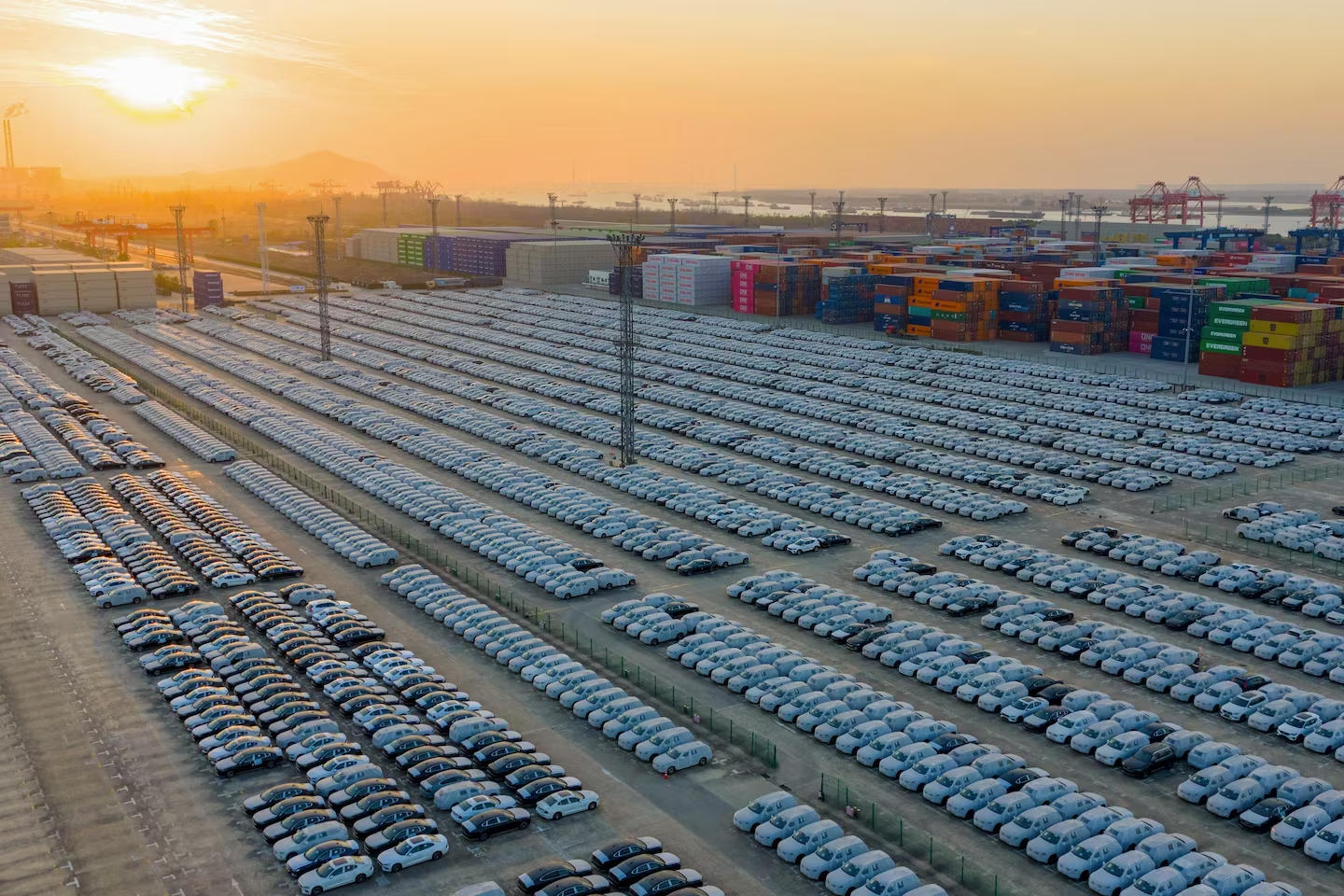
Vehicles await export at Nanjing.
Another step long urged by foreign economists—allowing the yuan to appreciate—also appears politically out of reach. A stronger currency would make Chinese exports more expensive abroad, helping to narrow the trade surplus, while lowering the cost of imports and potentially supporting domestic consumption.
“A proactive and significant appreciation of the yuan is almost impossible and entirely at odds with the current economic situation,” said Zhu of the China Europe International Business School. “The downward pressure and economic challenges China faces are immense,” he added.
As China maintains—and in some cases expands—its massive surpluses, its trading partners are growing increasingly uneasy. The European Union has already imposed tariffs aimed at curbing the influx of cheap Chinese electric vehicles, citing the threat to its domestic industry.
Measures to block low-cost Chinese imports, however, are not confined to advanced economies. Earlier this month, Mexico announced tariffs of up to 50 percent on more than a thousand categories of goods, many of which are produced in China.
Economists warn that such steps are likely to proliferate if Beijing continues to offset domestic weakness with an export-led growth model.
“There is a broad consensus among economists that if countries pursue beggar-thy-neighbor surplus policies,” says Michael Pettis, a Beijing-based economist and fellow at the Carnegie Endowment for International Peace, “deficit countries will ultimately have no choice but to respond.”
Even so, according to Arthur Kroeber of Gavekal Dragonomics, Xi is unlikely to shift his current stance on China’s industrial dominance when he meets Trump next year. The reason is that beyond familiar political and economic considerations, China’s leadership shares a deeply rooted conviction: China’s future—and its destiny as a superpower—depends on what its factories produce and the technologies that underpin that production.
“They essentially believe that economic power comes from the material production of technology,” Kroeber says. “The more physical goods you produce, the more technology is embodied in them. That, in their view, is how power and growth are achieved.”