Despite the fact that over the past year Donald Trump has launched a trade war, attacked core US institutions—including the Federal Reserve—and threatened allies over Greenland, the global economy has so far shown resilience. Inflation has continued to ease, while equity markets in Europe and elsewhere have pushed to new highs, unfazed by a succession of shocks.
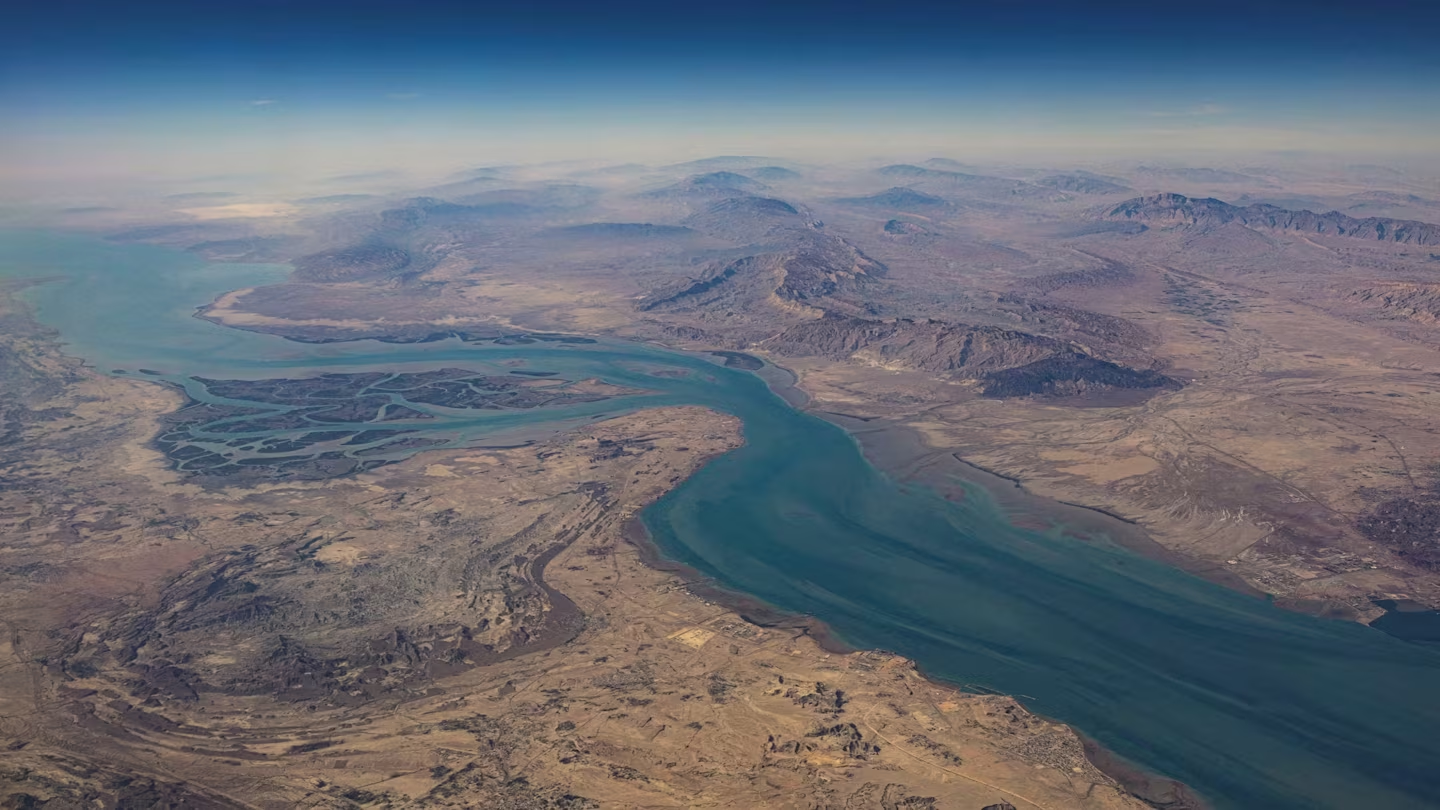
Now, as US and Israeli strikes on Iran risk spilling into a broader regional conflict, the oil market becomes the decisive transmission channel—through which it will be determined whether this relatively benign trajectory can be sustained, given the danger of supply disruptions. The central question is whether the United States and its partners can avert a prolonged shutdown of energy shipments through the Strait of Hormuz, which runs along Iran’s southern coast. If shipping continues and price increases are contained by Sunday’s decision by oil-producing countries to raise output, the hit to economic growth may prove limited.
If not, a sharp surge in energy prices could ignite a new bout of inflation in major economies, derail central banks’ plans to cut interest rates, and undermine business confidence. “Oil is a critically important channel,” said Neil Shearing, chief economist at Capital Economics.
One in every five barrels flows through the Strait of Hormuz—if it is shut, prices could surge above $100
Edward Fishman, a senior fellow at the Council on Foreign Relations and the author of Chokepoints, a book on US economic statecraft, outlines two baseline scenarios for energy markets.
The first envisages a “significant and prolonged halt to all traffic through the Strait of Hormuz—the most critical maritime chokepoint in global trade,” he says. Roughly one in every five barrels of the world’s oil passes through this route, and if it were closed, “it would amount to a colossal shock to global oil prices.” Analysts estimate that under such a scenario, oil prices could rise above $100 a barrel. Brent crude is already near a seven-month high—around $73 a barrel—having gained nearly 12 percent over the past month amid rising expectations of a confrontation between the United States and Iran.
The shock would also hit the natural-gas market, intensifying inflationary pressure in key economies, including Europe.
Fishman sees a more likely—and less destructive—scenario in which the Strait of Hormuz is not fully closed, but shipments of Iranian oil are halted. In that case, he says, price increases would more likely push crude to at least $80 a barrel.
OPEC+ steps up production—but it may not be enough to contain prices
If other oil producers raise output, the impact could be more muted. On Sunday, the OPEC+ alliance announced plans to increase production in April by 206,000 barrels a day—a move by the Saudi-led group aimed at calming the market. Even so, the increase fell short of what some analysts and OPEC+ watchers had expected.
A $10-a-barrel rise in oil prices would “have no meaningful impact” on either inflation or economic growth, argues Neil Shearing, chief economist at Capital Economics.
Although Iran remains an important supplier for several economies, including China, its role in global oil consumption is not critical. According to the International Energy Agency, the country produced 3.45m barrels of oil a day in January—less than 3 percent of global supply.
The US Is Largely Independent of Oil Imports—but a Sharp Price Spike Would Still Hit Americans
The United States today is largely self-sufficient in energy. According to the US Energy Information Administration, in 2024 just 17 percent of the energy consumed by Americans came from imports—the lowest share in 40 years. That does not mean, however, that potential disruptions to oil supplies from the Persian Gulf would be irrelevant for the US economy, given their impact on global oil benchmarks.
“A sharp rise in global oil prices could deal a painful blow to American consumers and the corporate sector,” says James Knightley, ING’s chief US economist. That would feed directly into higher gasoline prices, intensifying pressure on households—many of which already speak of a cost-of-living crisis—ahead of the key midterm elections in November.
By Knightley’s estimates, oil at $100 a barrel could push consumer inflation from an annual rate of 2.4 percent in January to above 4 percent. The Federal Reserve, however, targets 2 percent inflation, measured by the year-on-year change in the personal consumption expenditures index.
In the short term, that would reduce the likelihood of the Fed cutting interest rates later this year.
Last year’s 12-day war between Iran and Israel had only a fleeting impact on commodity markets, but a longer and more intense conflict could weaken both the US economy and others. “Every sustained $10-a-barrel increase in oil prices can shave 10–20 basis points off economic growth over the following 12 months,” says Ajay Rajadhyaksha, head of rates and securitized products research at Barclays. “If oil were to rise, say, to $120 a barrel and remain there, the US economy—and the global economy more broadly—would take a significant hit.”
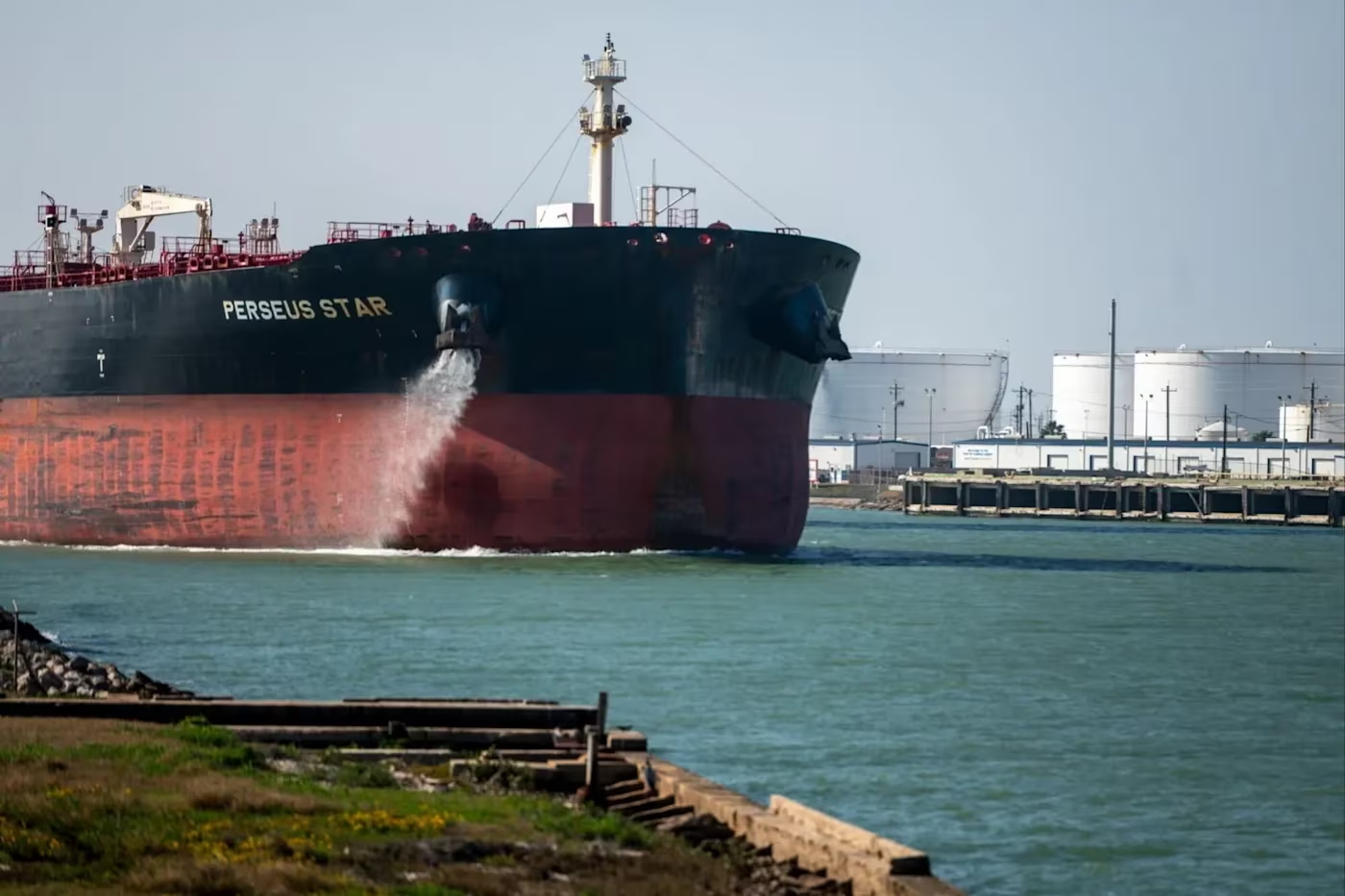
An oil tanker leaves the port of Corpus Christi, Texas.
Another potential side effect, Barclays economists warn, could be a stronger dollar.
“Developments in the Middle East point to elevated risks of a protracted conflict and higher oil prices. Historically, such shocks tend to support the US dollar,” said Themistoklis Fiotakis, an economist at the British bank.
Barclays expects the dollar to appreciate against a basket of global currencies by “roughly 0.5–1 percent for every 10 percent increase in oil prices.”
China, Europe, Asia—Supply Disruptions Through Hormuz Would Hit Several Major Economies at Once
China is among the largest buyers of oil from the Persian Gulf, leaving its economy particularly exposed in the event of severe shipping disruptions. According to the US Energy Information Administration, in 2024 some 84 percent of crude oil and condensate, as well as 83 percent of liquefied natural gas, transiting the Strait of Hormuz was destined for Asian markets. The main destinations were China, India, Japan, and South Korea.
A rise in Brent crude to $100 a barrel could add between 0.6 and 0.7 percent to global inflation, according to Capital Economics. Europe would also be among the regions hardest hit by higher prices—not only for oil, but for LNG as well.
The immediate implications for European Central Bank policy may be relatively limited, as inflation in the euro area remains well below target—at 1.7 percent—allowing the central bank to maintain its current wait-and-see stance.
For the Bank of England, the impact could be more pronounced, says Hetal Mehta, chief economist at asset manager St James’s Place. The traditional central-bank response to a sharp rise in oil prices is to look through the spike, on the grounds that over time it can have a disinflationary effect by eroding households’ purchasing power. In this case, however, adhering to that principle may prove more difficult: the Bank of England’s Monetary Policy Committee is split over whether to cut rates by a quarter of a percentage point as soon as its next meeting.
“Given how finely balanced the vote remains, I think this could make it somewhat harder to move toward a rate cut until there is greater clarity about the scale of the initial oil-price response and how long the effect is likely to last,” Mehta said.
Markets Were Already on Edge Over Trump and AI—the Iran Conflict Has Added a New Jolt of Anxiety
The conflict has erupted at a moment of heightened nervousness in global financial markets. On Friday, shares of US banks suffered their steepest drop since the tariff shock triggered by Trump in April, amid fears of a downturn in private credit and the destabilizing impact of AI on large companies. The US technology sector extended its decline, driven by a reassessment of expectations surrounding artificial intelligence, leaving the Nasdaq Composite down more than 3 percent for February.

A prolonged conflict could further undermine confidence in equity markets.
A drawn-out conflict in the Persian Gulf, with the potential to destabilize global energy markets, would deal an additional blow to investor confidence—particularly if it reinforces fears that the Federal Reserve will be less inclined to ease monetary policy. It could also sap business sentiment and restrain investment, says Tomasz Wieladek, chief European economist at T Rowe Price. “It feels like too many shocks are happening at once,” he noted. “Venezuela, Greenland, tariffs, and now Iran—all within the space of two months.”
At the same time, some analysts strike a calmer note, pointing to the resilience of the global economy amid a succession of shocks over the past year. “Despite the long list of geopolitical events in recent months, global economic and trade growth has proved surprisingly resilient,” said Innes McFee, chief economist at Oxford Economics.