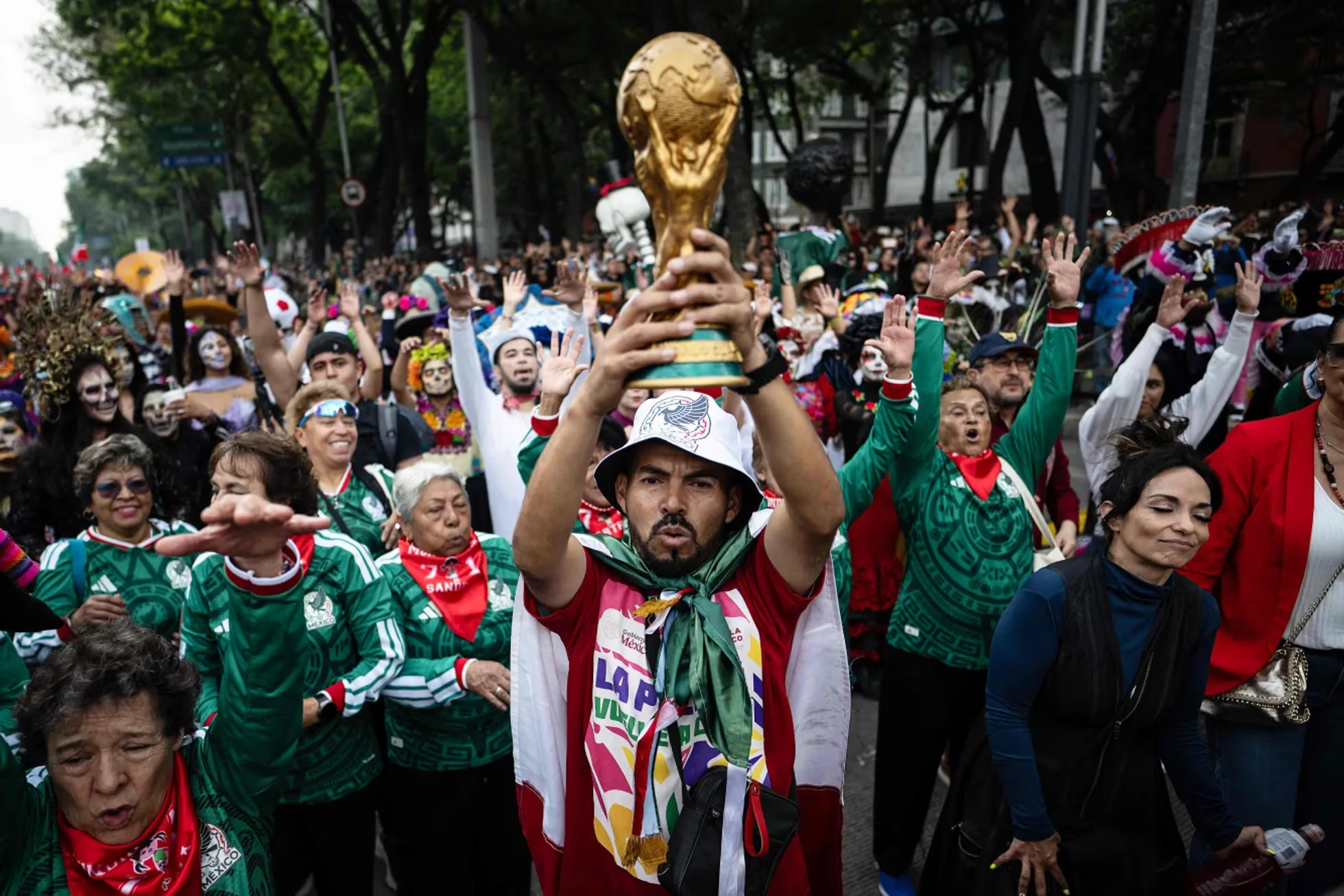
The World Cup began today—the largest tournament in the history of the sport. It will run from June 11 to July 19 and, for the first time, will be hosted by three countries at once: the United States, Canada and Mexico.
The scale of the tournament has grown markedly compared with previous World Cups. Matches will be held in 16 North American cities, divided into three regional clusters—Western, Central and Eastern. Teams will play within a single cluster, a format intended to reduce travel for national squads and fans. The opening match will take place at Estadio Azteca in Mexico City, while the final will be held at MetLife Stadium in New York.
The main change at the 2026 World Cup is the expansion of the field. Instead of 32 national teams, 48 will play in the final tournament. Asia, Africa and North America received additional places, while Oceania was given a guaranteed direct berth for the first time. Four teams will be making their debuts: Uzbekistan, Jordan, Cape Verde and Curaçao.
The new format has also changed the structure of the competition. The 48 teams are divided into 12 groups of four. The teams finishing first and second will advance to the knockout stage, along with the eight best third-placed teams.
2026 World Cup group lineups
Group A
🇲🇽 Mexico
🇿🇦 South Africa
🇰🇷 South Korea
🇨🇿 Czech Republic
🇲🇽 Mexico
🇿🇦 South Africa
🇰🇷 South Korea
🇨🇿 Czech Republic
Group B
🇨🇦 Canada
🇨🇭 Switzerland
🇶🇦 Qatar
🇧🇦 Bosnia and Herzegovina
🇨🇦 Canada
🇨🇭 Switzerland
🇶🇦 Qatar
🇧🇦 Bosnia and Herzegovina
Group C
🇧🇷 Brazil
🇲🇦 Morocco
🇭🇹 Haiti
🏴 Scotland
🇧🇷 Brazil
🇲🇦 Morocco
🇭🇹 Haiti
🏴 Scotland
Group D
🇺🇸 United States
🇵🇾 Paraguay
🇦🇺 Australia
🇹🇷 Turkey
🇺🇸 United States
🇵🇾 Paraguay
🇦🇺 Australia
🇹🇷 Turkey
Group E
🇩🇪 Germany
🇨🇼 Curaçao
🇨🇮 Côte d’Ivoire
🇪🇨 Ecuador
🇩🇪 Germany
🇨🇼 Curaçao
🇨🇮 Côte d’Ivoire
🇪🇨 Ecuador
Group F
🇳🇱 Netherlands
🇯🇵 Japan
🇹🇳 Tunisia
🇸🇪 Sweden
🇳🇱 Netherlands
🇯🇵 Japan
🇹🇳 Tunisia
🇸🇪 Sweden
Group G
🇧🇪 Belgium
🇪🇬 Egypt
🇮🇷 Iran
🇳🇿 New Zealand
🇧🇪 Belgium
🇪🇬 Egypt
🇮🇷 Iran
🇳🇿 New Zealand
Group H
🇪🇸 Spain
🇨🇻 Cape Verde
🇸🇦 Saudi Arabia
🇺🇾 Uruguay
🇪🇸 Spain
🇨🇻 Cape Verde
🇸🇦 Saudi Arabia
🇺🇾 Uruguay
Group I
🇫🇷 France
🇸🇳 Senegal
🇳🇴 Norway
🇮🇶 Iraq
🇫🇷 France
🇸🇳 Senegal
🇳🇴 Norway
🇮🇶 Iraq
Group J
🇦🇷 Argentina
🇩🇿 Algeria
🇦🇹 Austria
🇯🇴 Jordan
🇦🇷 Argentina
🇩🇿 Algeria
🇦🇹 Austria
🇯🇴 Jordan
Group K
🇵🇹 Portugal
🇨🇴 Colombia
🇺🇿 Uzbekistan
🇨🇩 DR Congo
🇵🇹 Portugal
🇨🇴 Colombia
🇺🇿 Uzbekistan
🇨🇩 DR Congo
Group L
🏴 England
🇭🇷 Croatia
🇬🇭 Ghana
🇵🇦 Panama
🏴 England
🇭🇷 Croatia
🇬🇭 Ghana
🇵🇦 Panama
Because of the expanded bracket, the tournament will include an additional round—the round of 32. In all, the World Cup will feature 104 matches instead of the previous 64, and the tournament itself will last 39 days—longer than previous editions, which usually took 29–30 days.
Who should you root for at the World Cup?
Several prominent national teams failed to qualify for the final tournament, including Poland, Denmark, Wales, Serbia, Cameroon and Nigeria. One of the defining results of qualification was Italy’s latest absence: the national team will miss the World Cup for the third time in a row. Ukraine’s qualifying campaign ended in the playoffs with a 1–3 defeat to Sweden. Russia, as before, did not take part in qualifying because of its suspension from FIFA and UEFA competitions after the full-scale invasion of Ukraine.
According to the sports-data aggregator Opta, Spain is considered the tournament’s leading favorite, with its chances of winning estimated at more than 16%. France follows at 13%, England at 11.2%, the reigning world champion Argentina at 10.4%, Portugal at 7%, Brazil at 6.6%, Germany at 5.1% and the Netherlands at 3.6%.
For those who want to follow the teams with the strongest chances of going deep and contending for the title, the favorites remain the obvious place to start.
Spain
After exits in the round of 16 at the 2018 and 2022 World Cups, Spain has gone through a generational shift and returned to the ranks of the leading contenders. The first confirmation of that status came with victory at Euro 2024.
The new Spanish side is built around young players including Lamine Yamal, Pedri, Gavi, Nico Williams and Ferran Torres. After the disappointing 2022 World Cup, Luis de la Fuente took charge, and under him Spain has significantly changed its style of play.
Where the old Spain was often criticized for dominating possession without enough cutting edge up front, the current team plays in a more vertical and aggressive way. Spain moves attacks to the flanks more quickly and uses the pace, technique and dribbling of Yamal and Williams to open up opposing defenses.
In qualifying for the 2026 World Cup, the team won its group convincingly, beating Turkey 6–0, Bulgaria 4–0 and Georgia 4–0. Before the tournament, Spain also beat Serbia 3–0 and Peru 3–1 in friendlies.
This is a team for those who want to support a side built on modern attacking football, high tempo and plenty of goals.
France
France arrives at the tournament as one of the deepest and most balanced national teams in the world. Didier Deschamps has several top-level players for almost every position, and the team has repeatedly shown that it can come back even in matches that turn against it. The 2022 World Cup final remains the clearest example of that resilience.
Kylian Mbappé remains the central figure in this team. His most recent season at Real Madrid was unsuccessful for the club, which failed to win a trophy. Yet even in such a year, Mbappé finished as the top scorer in La Liga, with 25 goals. After winning the World Cup in 2018 and finishing runner-up in 2022, he enters the new tournament with an obvious goal: to return the title to France and continue his pursuit of Miroslav Klose’s record for World Cup goals.
Another focal point in the team is Ousmane Dembélé, the 2025 Ballon d’Or winner. In late May he helped PSG win the Champions League for the second year in a row. A successful World Cup could make him one of the leading contenders for a second Ballon d’Or as well.
For France, another storyline is Deschamps himself. After the World Cup, he will leave the national team he has led for 14 years. During that time, he brought the side out of crisis, won the 2018 World Cup and the 2024/25 Nations League. The players have already said they want to end his era with another trophy.
France is the team for those who want a powerful squad, experience in major matches and a real chance of winning the tournament.
England
England remains one of world football’s most enduring storylines: a national team with one of the most expensive squads regularly arrives at major tournaments among the favorites, yet has not won one for 60 years. In that time it has stopped seven times in World Cup quarterfinals and lost two consecutive European Championship finals, in 2020 and 2024.
England comes to the 2026 World Cup with a new coach. Thomas Tuchel has taken over and noticeably changed the team’s style: in place of cautious, academic football, England now plays more aggressively, with counter-pressing and quick transitions into attack. In qualifying, that produced a near-perfect result—eight wins in eight matches, 22 goals scored and none conceded.
To fit the new model, Tuchel left several star players out of the squad and placed his trust in younger footballers. The decision drew criticism in the English media, but for now the results are on his side.
The team’s main figure is its captain and all-time leading scorer, Harry Kane. For years, his career mirrored England’s own fate: he scored consistently, came close to titles, but spent years without winning trophies, having played almost his entire career at Tottenham. After moving to Bayern Munich in 2023, Kane became German champion twice.
His main goal now is to win a trophy with the national team. England is worth following for those drawn to a classic football question: can a team finally turn the status of favorite into victory—or will it fall short again at the decisive moment?
Argentina
For 38-year-old Lionel Messi, this World Cup will most likely be his last. For much of his career, his relationship with Argentina’s national team was more complicated than with club football. The team almost always had one of the strongest squads in the world: Gonzalo Higuaín, Paulo Dybala, Ángel Di María, Sergio Agüero and other elite players lined up alongside Messi. But for years no coach, including Diego Maradona, could build a system in which those players worked effectively around him.
Lionel Scaloni became the first coach in nearly 20 years to solve that problem. By the 2022 World Cup, the national team had almost no first-rank stars left apart from its captain. Yet Scaloni assembled a side whose players offset one another’s weaknesses and create the conditions in which Messi can remain decisive even at the closing stage of his career.
This Argentina has another defining trait: a ruthless readiness to play for the result. The players are quite literally willing to fight for their captain, often play hard, provoke opponents and make no effort to be a team everyone finds agreeable.
Argentina is a team for those drawn to charismatic antiheroes. It is also for those who want to see the final chapter of the Lionel Messi era, and his last attempt to rewrite a few more records.
Portugal
Portugal arrives at the 2026 World Cup with one of the deepest and most balanced squads in the tournament. After the unexpected quarterfinal defeat to Morocco at the 2022 World Cup, Roberto Martínez’s team has changed noticeably: it has become more flexible, more aggressive and more varied in attack. Portugal works more with the ball, uses the flanks more actively and builds attacks more often through combination play. In qualifying, it won every match.
You can support Portugal not only because of Cristiano Ronaldo, but also despite him. Martínez has a team full of stars even without its captain: Bruno Fernandes, Bernardo Silva, Rafael Leão and others allow Portugal to remain a title contender regardless of Ronaldo’s role.
At the same time, Ronaldo remains the team’s main dramatic figure. At 41, he is still highly productive: he became the first player in history to pass 900 official goals, scored 40 goals in a year at the age of 40 and still wants to take games upon himself. Sometimes that helps the team; sometimes it disrupts its balance.
For Martínez, this tournament will test his ability to maintain equilibrium between the captain’s ambitions and the possibilities of a new generation. For Portugal, it is a chance to give the Ronaldo-Messi rivalry a vivid final twist, especially after the Argentine has already won the World Cup.
Norway
Norway could be the main revelation of the 2026 World Cup. The team has returned to the tournament after a 28-year absence, won all eight qualifying matches with an overall goal difference of +32 and demolished Italy 7–1 over two games. This is a team for those tired of the familiar cast of favorites and looking for a new powerful side to follow.
Norway’s central axis is the partnership between Martin Ødegaard and Erling Haaland. Ødegaard this season led Arsenal to its first English league title in 22 years and took the club to the Champions League final for the first time since 2006. Haaland had a less successful season with Manchester City, but in World Cup qualifying he matched Robert Lewandowski’s record by scoring 16 goals. In all, Norway’s all-time leading scorer has 55 goals in 49 matches. The previous record, Jørgen Juve’s 33 goals, had stood since the 1930s.
Yet the team is not reducible to its two leaders. On the attacking flank is 21-year-old Leipzig winger Antonio Nusa, one of the Bundesliga’s emerging players in recent seasons: in 2025/26 he played 31 matches, scored 4 goals and provided 3 assists. For rotation in attack, Norway has Alexander Sørloth of Atlético Madrid, who scored 13 goals this season. At right back is Julian Ryerson of Borussia Dortmund—one of the Bundesliga’s leading creators, with 15 assists in the season.
This team is well built for vertical, aggressive football: it has speed, a powerful attacking line, players who can carry the ball forward and enough squad depth. That profile makes Norway a side capable of making the tournament difficult for the favorites.
Germany
Germany arrives at the 2026 World Cup after its most difficult period in decades. Group-stage exits at the 2018 and 2022 World Cups, followed by defeat in the round of 16 at Euro 2020, forced the national team into a sweeping rebuild.
Under Julian Nagelsmann, the team has changed significantly in both personnel and style. Germany now plays with greater intensity and aggression, relying on counter-pressing, quick ball movement and a high tempo. Before the tournament, 40-year-old Manuel Neuer returned to the national team—the last 2014 world champion still in the squad. His experience and his familiar role as a goalkeeper who plays actively with his feet and comes far out of the box help the team maintain a high defensive line.
Germany came through qualifying almost without a stumble: five wins and just one narrow defeat to Slovakia. Before the World Cup, the team also won friendlies against France, 2–1, and the United States, 4–1.
The new Germany is built around Jamal Musiala, Joshua Kimmich and Florian Wirtz. Musiala and Kimmich won the Bundesliga and German Cup with Bayern, while Wirtz became Liverpool’s main creative force.
Germany is a team for those interested in sides returning to the elite after a deep crisis. This squad again looks strong enough to contend for the title.
Brazil
The five-time world champions approach the tournament as a team with a great past, but without any firm sense that it has returned to its former level. Since winning the 2002 World Cup, Brazil has gone through several painful cycles: a 1–4 collapse against Germany at the 2014 home World Cup, a series of early exits and a difficult qualifying campaign for this tournament.
After a 1–4 defeat to Argentina in March 2025, Dorival Júnior was dismissed and the national team was taken over by Carlo Ancelotti, one of the most successful coaches in football history. He stabilized the side, led it to the World Cup and has already extended his contract through 2030.
Brazil’s main personal story is Neymar. The 34-year-old forward left Europe’s elite leagues long ago, plays for his boyhood club Santos and has not appeared for the national team since 2023 because of injuries. His participation in what is likely to be the last World Cup of his career long remained in doubt. When Ancelotti announced that he would take Neymar to the tournament after all, the forward cried. Soon afterward, a new injury was discovered, and Brazil’s staff in New Jersey is now trying to return him to fitness using NASA equipment.
Brazil is worth following for Neymar’s last major tournament and for Ancelotti’s tactical experiment. His task is to combine the veteran’s experience and football intelligence with the speed of Vinícius Júnior and Rodrygo.
Uruguay
Marcelo Bielsa’s Uruguay is one of the most intense and uncomfortable opponents in the tournament. The coach nicknamed El Loco—“the Madman”—has built a team around aggressive football: high pressing, physical duels and quick vertical attacks.
In qualifying, Uruguay won the ball high up the pitch more often than any other team in South America, doing so 147 times. During the campaign it also beat Brazil and Argentina, confirming that it can compete with the favorites not only through emotion, but through the structure of its game.
Uruguay’s squad combines experience with a new generation. Ronald Araújo and José María Giménez play important roles in defense, while Federico Valverde, Manuel Ugarte and Rodrigo Bentancur anchor midfield.
The central figure in attack is Darwin Núñez of Saudi Arabia’s Al Hilal. He remains a forward of great potential and inconsistent finishing, but Bielsa has found a way to use his strengths. Under this coach, Núñez has scored 10 goals in 22 matches.
Uruguay is a team for those drawn to vivid underdogs capable of imposing a fight on any favorite.
Morocco
Morocco arrives at the 2026 World Cup with the task of proving that its run to the semifinals at the previous tournament was not a one-off sensation, but the result of a durable system. Walid Regragui’s team is still built around discipline, compact defending and clear organization without the ball.
This team does not try to win through spectacle. Its strength lies in tight duels, patience and the ability to deny opponents space. That is precisely the kind of football that makes Morocco an awkward opponent even for teams with stronger squads.
Morocco came through qualifying convincingly. Before the tournament, it thrashed Burundi 5–0 and drew 1–1 with Norway, managing to contain Erling Haaland.
Morocco is a team for those who value toughness, defensive organization and sides capable of disrupting the plans of favorites. Another argument is one of the most vivid fan followings in world football.
Uzbekistan
Uzbekistan is the main debutant and one of the most intriguing underdogs at the 2026 World Cup. After two decades of failed attempts, the team has reached the World Cup for the first time and did so directly, finishing second in a difficult group with Iran, the UAE and Qatar. The Uzbeks trailed Iran, which has missed only two of the last eight World Cups, only on goal difference.
The national team changed markedly after Srečko Katanec arrived in 2021. Under him, Uzbekistan became a more disciplined and tactically mature side: it can control the tempo, defend compactly and transition quickly into attack. Before the tournament, the team confirmed its form with wins over Jordan, 2–1, and New Zealand, 3–0.
The team’s main figure is its captain and all-time leading scorer, Eldor Shomurodov. He previously played for Rostov in Russia, and in Italy for Roma and Genoa. In the current side he is supported by Abdukodir Khusanov of Manchester City, as well as the young and creative midfielders Abbosbek Fayzullaev and Oston Urunov.
Uzbekistan is a team for those who want to follow a debutant capable of turning its first World Cup into a major story.