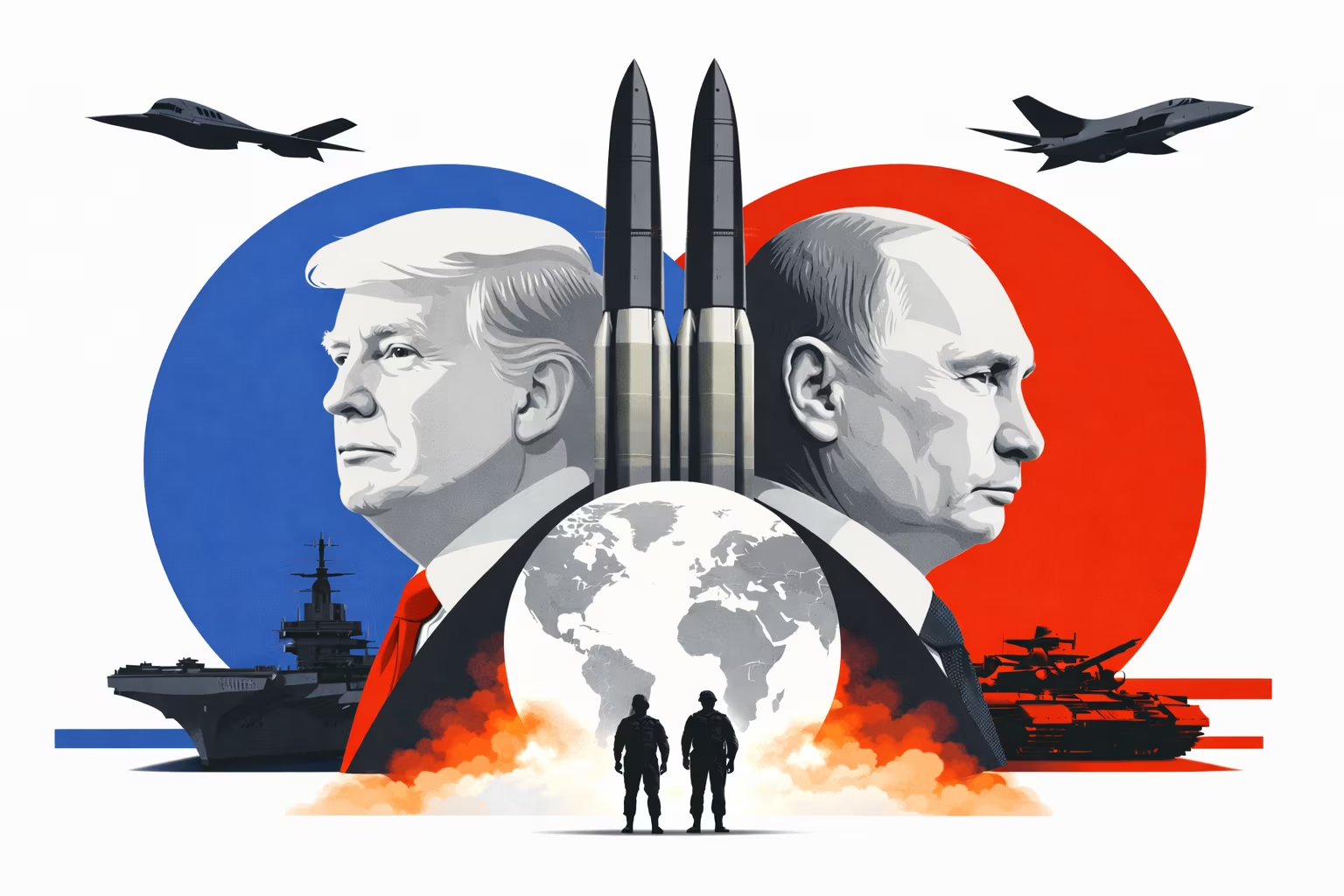
Some questions are commonly treated as rhetorical. One of them sounds roughly like this: how does Russia’s invasion of Ukraine or Georgia differ from an American operation in Venezuela or strikes on Iran?
It is usually asked to corner an interlocutor or to sidestep an uncomfortable conversation. Yet if taken seriously, the question turns out not to be rhetorical at all, but genuinely important—and the answer is uncomfortable for everyone involved.
What the Law Says
Let us begin with what does not provoke disagreement among international lawyers. The UN Charter prohibits the use of force against the territorial integrity of another state. There are precisely two exceptions: self-defence under Article 51 and a direct mandate from the Security Council. If neither condition is met—the state’s actions are classified as aggression, regardless of the flag on the soldiers’ uniforms.
This is not an abstraction. It was precisely this criterion that led the international community to condemn Iraq’s invasion of Kuwait in 1990, and it is the same standard invoked in qualifying Russia’s actions in Ukraine in 2014 and 2022. In legal terms, the rule is simple and unambiguous.
The complications begin where law ends and politics begins.
The Art of Justification
No state resorts to military force in silence. Every invasion comes wrapped in its own rhetoric—and the form that rhetoric takes often reveals much about those who produce it.
When Russia sent troops into Ukraine, it appealed to the protection of Russian-speaking populations in the Donbas, to historical and territorial claims, and to invitations from entities it had itself recognized. Yet the central argument was different: preventive self-defence. Had Russia not acted first, the Kremlin argued, NATO would sooner or later have attacked Russia itself. Ukraine, in this narrative, was becoming a springboard for aggression against the Russian state. War, according to this logic, was not a choice but a forced response to an inevitable threat.
This argument is worth remembering—we will return to it later.
The United States, when justifying military action abroad, has traditionally relied on a different vocabulary. Iraq in 2003—weapons of mass destruction and a threat to regional security. Afghanistan—the fight against terrorism after September 11. Panama in 1989—the protection of American citizens and the restoration of democracy. Today’s rhetoric surrounding Iran follows the same structure: if a strike is not carried out now, Iran will build nuclear weapons and destabilize the entire region. Once again—preventive self-defence. Once again—a threat that has not yet materialized, but inevitably will if action is not taken immediately.
The structure of the arguments is identical. The vocabulary is different.
A Pattern That Is Awkward to Name Aloud
Over the past thirty years, a persistent narrative has taken shape—one that Western media rarely formulate directly, yet continually reproduce implicitly. Russia’s military actions against its neighbours are framed as a return to Soviet imperialism, an attempt to restore a lost sphere of influence, a threat to the sovereignty of smaller nations and to the European order. American military actions, by contrast, are described as democratization, humanitarian intervention, or a response to real or potential threats.
One side annexes, the other liberates. One occupies, the other stabilizes.
This narrative is not entirely without foundation—Russia has indeed annexed territory and has twice carried out full-scale ground invasions followed by prolonged occupation.
Ukraine is not Iraq, and the scale, duration and consequences of these wars differ fundamentally. But the narrative becomes problematic when it turns into a universal filter through which the same actions receive fundamentally different moral assessments depending on who carries them out.
When Russian troops crossed the Ukrainian border in February 2022, Western leaders immediately called it aggression and a violation of international law. Several years later, American special forces carried out an operation on Venezuelan territory aimed at capturing the country’s lawfully elected—albeit authoritarian—president. Russia condemned the episode as an “act of armed aggression”. China reacted with “outrage”, accusing Washington of violating international law.
The Cost of Inconsistency
The United States voted for UN resolutions condemning violations of sovereignty—and invaded Iraq without Security Council authorization. It ratified conventions banning torture—and practiced it in Abu Ghraib and Guantanamo. It called for the accountability of war criminals—and has not allowed a single one of its own officials to face proceedings at the ICC. Pedro Sánchez, commenting on the strikes against Iran, captured the point precisely: «One cannot respond to lawlessness with even greater lawlessness—that is how humanity’s great catastrophes have begun». The argument is impeccable. But it works symmetrically—and it applies to those who voice it as well.
It is precisely here that double standards cease to be merely a moral problem and become a strategic one. One analyst noted that the Venezuelan operation “will significantly complicate the West’s efforts to rally the global South against Russia’s invasion of Ukraine”. Countries that for decades have watched American interventions unfold without consequences for Washington are unlikely to view appeals to international law as a universal principle—rather as a situational instrument.
What This Means
None of the above constitutes a justification for Russia’s actions. The invasion of Ukraine is a documented act of aggression against a sovereign state that has resulted in tens of thousands of civilian deaths. Calling it a crime is not Western bias but the application of the very norms invoked by international law.
But this is precisely why it matters that these norms are applied consistently. A world in which aggression remains aggression only when committed by a geopolitical rival is not a rules-based international order. It is an order based on power—simply with a more sophisticated vocabulary.
And that vocabulary is perhaps the only thing that truly distinguishes these invasions from one another.