The Trump administration’s strikes on Venezuela and the capture of President Nicolás Maduro marked a major victory for advocates of a hardline foreign policy within Donald Trump’s inner circle. Among them are Secretary of State Marco Rubio and Defense Secretary Pete Hegseth, who over recent months had pressed for intensified pressure on Caracas, seeking the removal of a leader they described as an authoritarian drug trafficker.
The move stands in sharp contrast to Trump’s approach during his first term, when he floated the idea of an invasion of Venezuela but was checked by then Secretary of State Rex Tillerson, Defense Secretary James Mattis, and National Security Adviser H.R. McMaster.
The raid, carried out early Saturday morning, January 3, amounted to a demonstrative escalation of U.S. involvement in another country’s internal affairs and coincided with Trump’s public threats to come to the defense of Iranian demonstrators against their own government. The operation appears to serve as a symbolic conclusion to Trump’s first year after returning to power—a period marked by far deeper engagement in foreign conflicts than candidate Trump and the Trump of his first term had promised.
Although several Republican lawmakers criticized Saturday’s operation, most of the MAGA movement appears to have rallied behind the president. Even Trump strategist Steve Bannon, who typically champions an “America First” agenda, praised the president immediately after the military action, calling it a “bold and brilliant raid.” Former Senate majority leader Mitch McConnell, not considered an ally of Trump, described Maduro as a “thug” and likewise endorsed the use of force.
It remains unclear whether advocates of regime change in Venezuela will achieve their desired outcome. Power in the country is currently concentrated in the hands of Maduro’s appointed successor—Vice President Delcy Rodríguez—and the prospects for a democratic transition remain uncertain. Trump, for his part, said the United States would assume control of the country for a transitional period.
Even so, a move of this kind against Maduro would have been almost unthinkable during Trump’s first term and at the height of the 2024 campaign, when he embraced a posture of restraint, expressed skepticism about unconditional support for Ukraine, and spoke of ending U.S. involvement in “endless wars.”
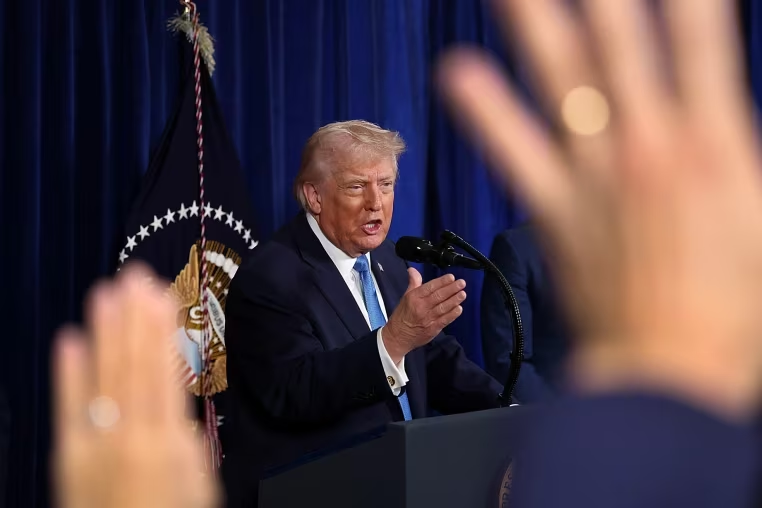
“We will run this country,” Trump said at Mar-a-Lago after the military operation, adding that the United States “wants to surround itself with good neighbors…stability…energy.”
“I’m surprised, because we talked about not pursuing regime change, but at the same time I’m not surprised, because this is Marco’s dream,” said a source close to the White House, who spoke on condition of anonymity due to the sensitivity of the matter.—“Rubio’s influence is rising rapidly.”
Part of the success lay in decisions inside the administration to frame the action not as a political intervention but as a law-enforcement operation—an approach that resonates well with the MAGA base.
“They can go out and say this was not necessarily ‘regime change.’ Yes, that’s what happened, but the purpose was to execute a warrant—he’s a narco-terrorist,” the same source explained.
Rubio managed to fuse his long-standing drive to remove Maduro with Trump’s years-long fixation on reclaiming control over Venezuela’s oil resources.
“This is clearly Rubio’s initiative,” said a White House ally familiar with the internal discussions, who requested anonymity. According to the source, the secretary of state’s case rested on several pillars: economic gains for the United States tied to oil; national-security considerations aimed at pushing China and Russia out of a country in close proximity to the U.S.; and a significant political payoff among Hispanic voters whose families had experienced repressive regimes.
Finally, Rubio, who has pressed for Maduro’s removal since at least 2019, argues that he is not Venezuela’s legitimate president. “This is not just our position,” Rubio said while speaking at Mar-a-Lago.—“The first Trump administration, the Biden administration, the second Trump administration—none of them recognize them.”
What makes the episode even more telling is the absence of an outcry from the party’s right flank, which had previously been sharply opposed to foreign-policy interventions.
While a small number of Republican lawmakers voiced criticism, most of the MAGA movement appears to have fallen in line behind the president. The clearest signal came from Bannon.
Even as he criticized Trump’s rhetoric on Iran as echoing Hillary Clinton’s interventionist line, Bannon used his War Room podcast and video show on Saturday to back the operation in Venezuela.
He opened the broadcast by praising the raid, and his first guest was Blackwater co-founder Erik Prince, who described the actions of U.S. forces as a “magnificently executed operation.” The endorsement from a figure previously associated with MAGA’s antiwar instincts underscored how far the coalition has shifted—or how carefully the administration framed this particular operation.
Other figures close to the MAGA base have justified the strike as a direct extension of Trump’s core campaign promise—to “make America safe again.”
“Isolationists and Reaganites rarely agree, but one of the few exceptions is the Western Hemisphere,” said a former senior Trump administration official, who also spoke on condition of anonymity.—“It is easier for isolationists to be a bit more internationalist when it comes to our own backyard. Beyond the Western Hemisphere, however, they start to think that perhaps we should not be getting involved.”
Matthew Kroenig, vice president and senior director of the Scowcroft Center for Strategy and Security at the Atlantic Council and a former Pentagon official, noted that the breadth of support, including from isolationists within the administration, reflects political calculation more than a carefully calibrated strategy.
“If you look at the internal balance of power within the administration, you do not want to find yourself on the wrong side of Stephen Miller or other White House officials close to the president,” he said.
At the same time, another former official pointed to a split between hardliners and advocates of restraint that emerged during the drafting of the National Security Strategy. According to the source, hawks succeeded in pushing the White House toward backing more expansive military objectives with regard to Venezuela and the wider region.
“The Western Hemisphere section in both documents is the most amorphous, and the region that departs most sharply from the broader standards,” the former official said. Figures such as Rubio, he added, were able to link migration flows and the drug epidemic to military operations in Venezuela, despite concerns from restraint-minded officials who warned of the risk of the Pentagon becoming bogged down in the region.
Asked whether MAGA voters would accept the operation, Trump adviser Alex Bruesewitz drew a sharp distinction between intervention and what he described as accountability.
“This is not regime change, this is justice,” Bruesewitz wrote in a message.—“Maduro sent thousands of violent and dangerous criminals into our country along with deadly drugs that took the lives of countless Americans. President Trump promised on the campaign trail to make America safe again, and he is delivering on that promise.”
That framing—justice rather than regime change—has become central to the administration’s effort to unify its own factions.
U.S. ambassador to the United Nations Mike Waltz, another hardliner within Trump’s team, used similar language.
“Maduro was an indicted and illegitimate dictator who led a declared narco-terrorist organization responsible for the deaths of American citizens,” Waltz wrote on X.
By tying Maduro directly to crime, migration, and drugs, Trump and his allies recast a sweeping foreign-policy operation as a matter of domestic security.
As a result, the Republican Party—at least for now—appears more willing to countenance the use of force than it has been in recent years, provided it is presented as decisive, limited, Trumpist, and still consistent with the America First principle.
Even conservatives who had previously been willing to criticize Trump on other issues backed his move in Venezuela. “The ‘TRUMP DOCTRINE’ puts America first in the Western Hemisphere,” Representative Chip Roy, a Republican from Texas, wrote on X after Saturday discussions with Rubio.—“…the dismantling of drug cartels and the promotion of free markets and democracy.”
At the same time, both moderate and conservative lawmakers have voiced caution about the administration’s more ambitious plans for the South American oil state.
“The only country the United States of America should ‘run’ is the United States of America,” said influential moderate Representative Brian Fitzpatrick, a Republican from Pennsylvania.—“The U.S., together with the international community, should focus on monitoring and ensuring free and fair elections in Venezuela, giving the Venezuelan people a path to genuine democracy.”