The White House’s attempt to turn the country’s anniversary into a major concert on a Washington lawn is unraveling in plain sight. Within days of the announcement, musicians whose names were supposed to draw a crowd began pulling out one after another: first Morris Day, Young MC, The Commodores and Martina McBride. Each new withdrawal made the project more contentious—performing on a stage the public now firmly associates with Trump and MAGA has become a reputational risk few are willing to take. Now a fifth—and perhaps the most conspicuous—refusal has been added to the list.
By the morning of Friday, May 29, the Freedom 250 festival in Washington had effectively lost much of its announced lineup: of the nine artists unveiled roughly 48 hours earlier, five had formally said they would not take part in the concerts on the National Lawn. The events were organized as part of a public-private partnership established by Donald J. Trump.
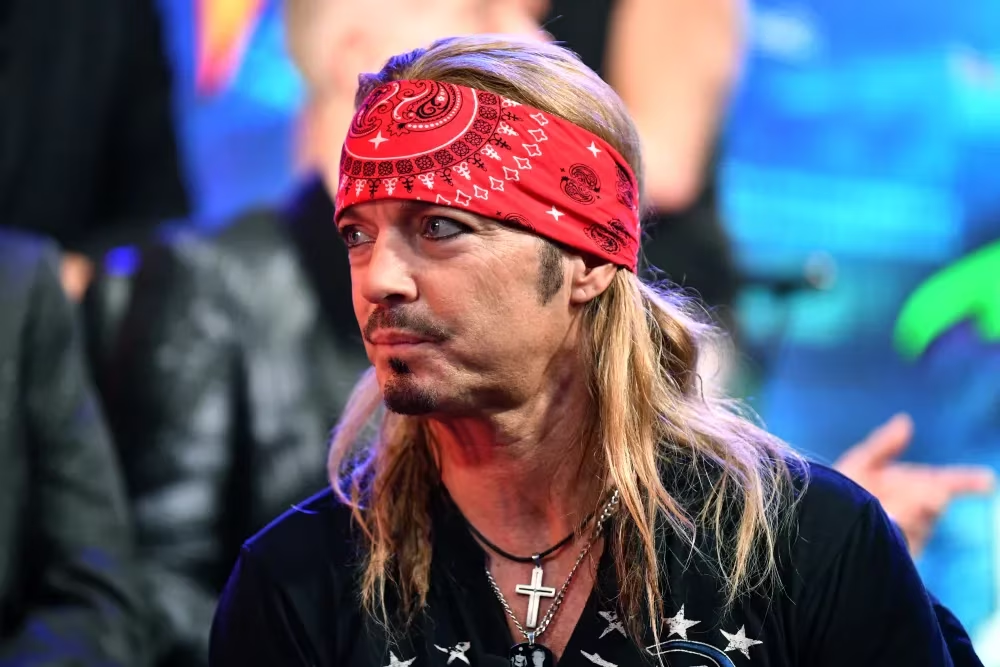
The fifth artist to announce his withdrawal was the rock musician Bret Michaels, best known as the frontman of Poison. In his statement, he in effect made clear that the atmosphere surrounding the concerts had become toxic, and that threats made amid the controversy over the festival had caused him serious concern.
“When this opportunity was first presented to my team, it was described as a celebration of our country through music and a chance to honor our veterans, active-duty service members, first responders, teachers and hardworking Americans from all walks of life,” Michaels wrote in a statement posted on social media. “As the son of a veteran and someone from a family that has proudly served our country, I have always considered it an honor to support such things.”
“Unfortunately, what was presented to us as a celebration of our country has turned into something far more divisive than what I agreed to be part of. Concerns were also raised about the safety of my fans, band, crew, family and myself, including threats that are completely baseless and unforgivable. I have therefore made the difficult decision to withdraw from this performance,” he continued.
Michaels stressed that “this is not about politics.” He said it was about staying true to what he had always believed. “Everyone is entitled to their own opinion. That is one of the freedoms our veterans fought for, and something I have always respected. But as a father, a friend and a bandmate, I have to take threats and safety concerns seriously,” he wrote.
By the time Michaels pulled out, the list of artists who had quickly withdrawn from the concerts over the previous two days already included Morris Day, Young MC, The Commodores and Martina McBride. Of the nine announced performers, only two had publicly confirmed that they still intended to appear—Vanilla Ice and Fab Morvan of Milli Vanilli. C&C Music Factory frontman Freedom Williams said he had not yet decided whether he would take part. Of the entire original lineup, only Flo Rida had made no public comment on the matter.
The division Michaels referred to was also visible in the comments beneath his posts. Fans interpreted his statement in different ways, since the musician did not say directly what he thought of Trump or whether he had considered the festival itself a good idea from the start.
Most comments under his posts were supportive: many wrote that they would have found it difficult to keep listening to his music had he performed at a festival that a significant part of the audience associated with the president and the MAGA movement. Some disappointed conservative fans, however, noted that the most concrete element of Michaels’s statement was his reference to threats, and that his withdrawal may have been driven by those concerns rather than by any attempt to distance himself from Trump or his initiatives.
Among the comments on Michaels’s pages were these: “As a veteran, thank you for choosing not to participate. Much respect to you.” “The current politics around the celebration are clearly distracting from the 250th anniversary. So thank you for making this difficult decision.” “You are giving in to the Democrats who wanted you to back down. Shame on you.” “I am so proud of you!!! Great job standing up for what is right.” “So disappointed in you for backing out and, as always, caving to the intolerant left. Your character was tested…and you failed miserably.” “Others who withdrew simply explained that they had been lied to about the real purpose of the performance. There was no need to invoke safety concerns. Just be honest.”
Other comments said: “This makes me happy. I have tickets to your concert this summer, and I came here to sell them when I found out you were performing there. Now I think I can respect you again, because this whole thing is a big mess I would not want to see you be part of.” “This is absolutely about politics. Glad you pulled out.” “An invitation to anything from the current administration should immediately be seen as a divisive red flag. How anyone could think otherwise is beyond me.” “Thank you for refusing this event! I am the wife of a veteran. This administration is destroying veterans’ benefits.” “Folded like a cheap lawn chair. Your loss, not ours. The same PR person wrote this for Martina too.”
If the concerts do go ahead, they will be part of a multiweek event on the National Mall called the Great American State Fair. It is one of many programs under Freedom 250—an initiative created by Trump as a public-private partnership to celebrate the 250th anniversary of the United States. Democratic critics argue that Trump established Freedom 250 to take full control of this year’s patriotic events, bypassing congressional plans and funding already allocated for a more independent commemoration of the country’s semiquincentennial.
Before the concert series became a public controversy, the last major dispute surrounding Freedom 250 centered on a religious rally on the National Mall held on May 17 under the same brand and formally called Rededicate 250. At the event, which NPR described as a “conservative prayer gathering,” House Speaker Mike Johnson led a prayer, and participants included administration officials such as Pete Hegseth, Marco Rubio and the president himself, as well as the evangelists Franklin Graham and Paula White-Cain. More centrist religious groups objected to the event, seeing it as close to a MAGA gathering, even though the official language for this and all other Freedom 250 events uses the word “nonpartisan.”