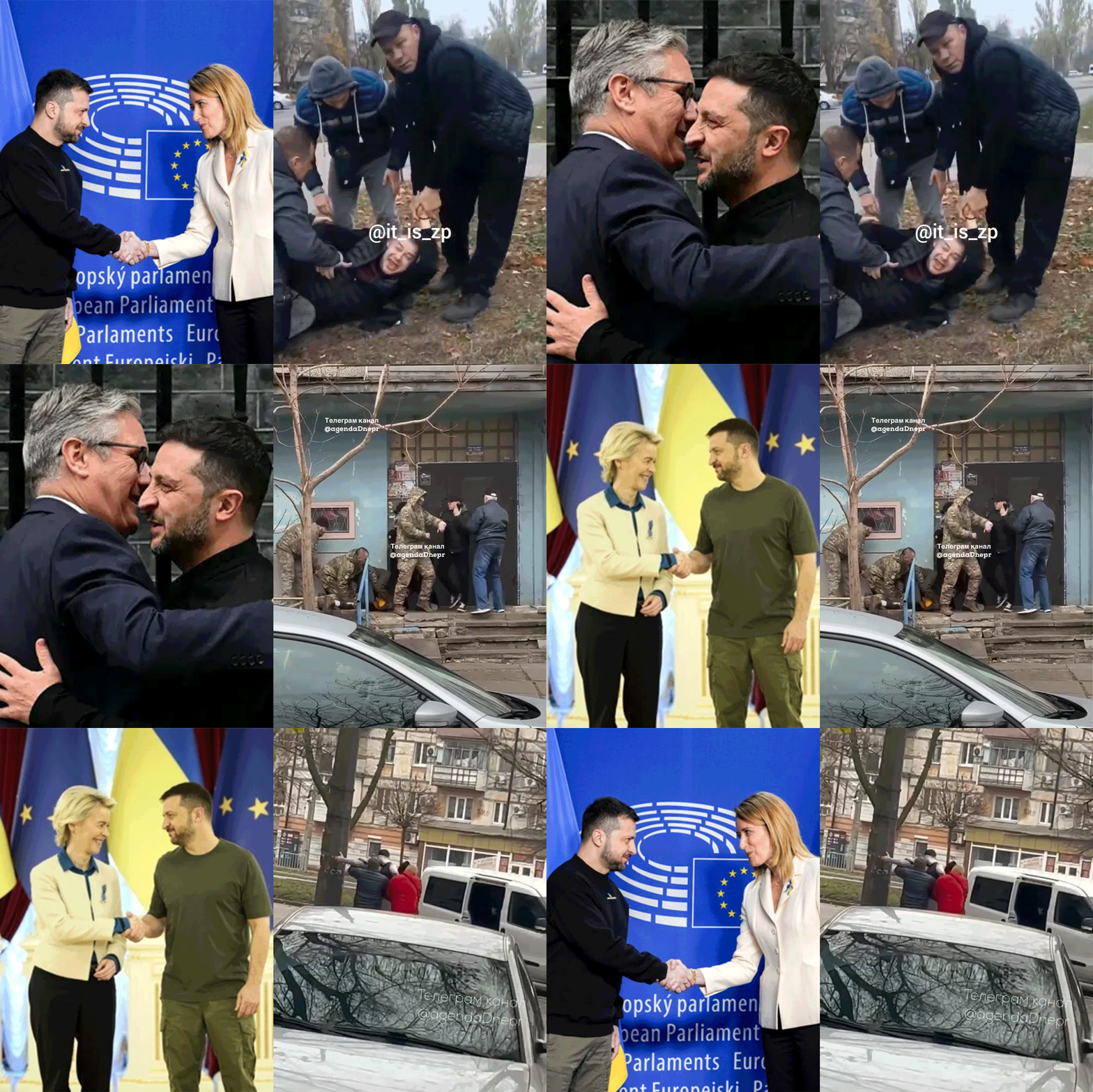
In Brussels and other European capitals, debates today revolve around a possible peace for Ukraine. As Washington and Moscow resume a new round of contacts, EU leaders and individual governments repeat familiar lines: Russia cannot be allowed to cement territorial gains seized by force, and Europe must resist any “quick peace” that would undermine the continent’s security. EU foreign policy chief Kaja Kallas warns that a hasty deal would be dangerous both for Ukraine and for Europe, and that any concessions to the Kremlin would signal permissiveness to other authoritarian regimes.
Much of this rhetoric focuses on principles and precedents. Europe argues over which borders can be altered, how deeply Russian forces have pushed into Ukraine’s defenses, and what kind of security configuration NATO can sustain. Yet it speaks far less about how this same war looks from inside Ukraine—through the eyes of people whose rights and freedoms are officially framed as the very values Europe claims to defend alongside Kyiv.
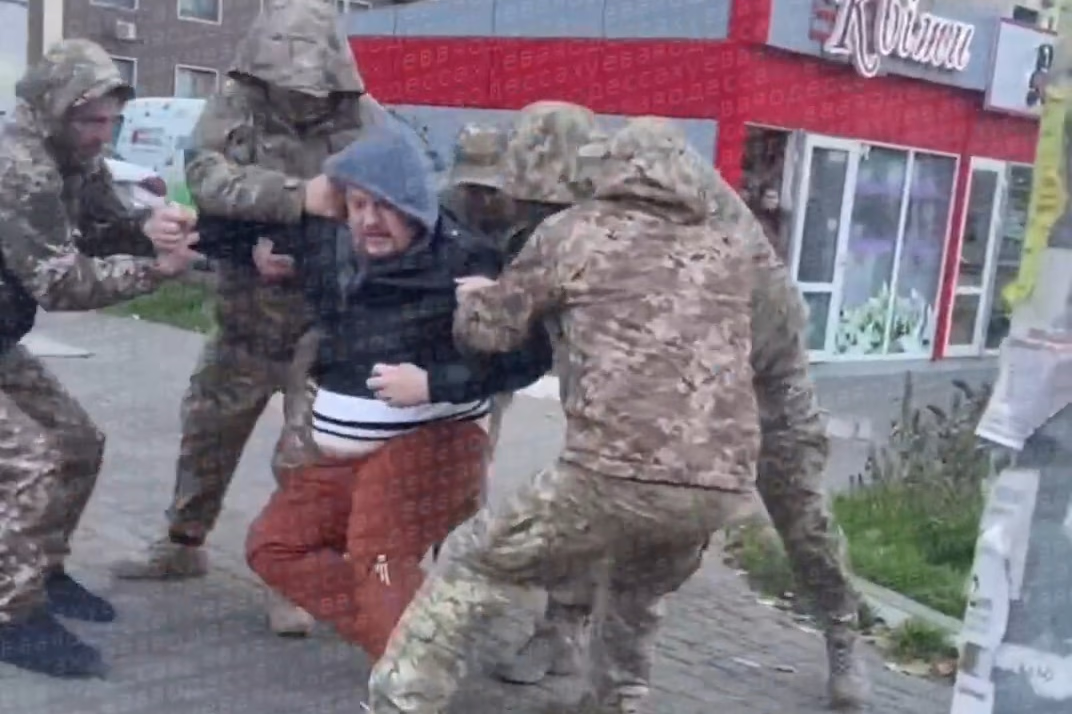
Since mid-2024, and especially throughout 2025, mobilization in Ukraine has increasingly moved onto the streets. Videos circulating on social media show the same scenes: at bus stops, near shopping centers, and in residential neighborhoods, men of conscription age are stopped by groups of individuals—sometimes in military uniform, sometimes in civilian clothes without any insignia. Some present IDs and read out draft notices; others simply force a person into a van. Arguments over whether this amounts to “detention” or “escorting” ceased to be theoretical long ago—for those taken away in this manner, the distinction is irrelevant.
An attempt at forced mobilization on the streets of Zaporizhzhia, carried out by men without uniforms or identifying markings.
Forced mobilization in Dnipro. The men who dragged a young man into a van acted without any identifiable TCC affiliation.
On paper, the legal framework is different. Territorial Recruitment and Social Support Centers—the revamped system of military enlistment offices—are responsible for registration, summonses, and paperwork, but not for exercising coercive control over civilians. Under the law, the authority to detain or escort individuals lies with the police, not with TRSSC staff. After early scandals surrounding mobilization raids, parliament and the government clarified the rules. The new mobilization law tightened penalties for evasion, introduced digital record-keeping, and expanded the powers of the TRSSC. In parallel, the Ministry of Defense announced a shift toward “transparency”: since 2024, the law has required video recording during document checks, and from September 1, 2025, TRSSC employees must work with body cameras and record all interactions when delivering summonses. Officials framed these changes as a way to protect the rights of both civilians and military personnel, and to eliminate opportunities for manipulation.
On paper, mobilization is described as a sequence of procedures with clear safeguards: a TRSSC employee must identify themselves, explain the legal grounds for the check, notify a person about video recording, operate strictly within the law, and, if someone needs to be escorted to a recruitment center, call in the police. In practice, the gap between these rules and what people actually witness is vast. Ukraine’s ombudsman, Dmytro Lubinets, regularly reports a surge in complaints over mobilization violations. In 2024, his office received several thousand appeals concerning TRSSC conduct; in 2025, in just the first few months, the figure had already reached thousands more. Dozens of military personnel have faced disciplinary and criminal proceedings, and several high-profile cases are being investigated separately. Human rights groups and officials responsible for service members’ rights argue that TRSSC staff should be removed from the streets and that coercive functions should be handed over to the police, which is at least theoretically embedded in more familiar detention procedures.
Forced mobilization in one of Kharkiv’s districts.
Military officials insist that many of the videos depicting a “manhunt” are fakes or aggressively edited footage used in Russian information operations. Some clips do turn out to be taken out of context or intentionally dramatized. But that does not erase people’s lived experience. For residents of large cities in the east and center of the country, mobilization is not an abstract statute but a recurring encounter with TRSSC staff and patrols—interactions that rarely evoke the sense of protection normally associated with state institutions.
Against this backdrop, the contrast with how Western societies react to visually similar scenes at home becomes striking. ICE raids in Southern California under Donald Trump’s administration prompted not just individual reports but a whole series of hearings and media investigations. At congressional sessions in Los Angeles, community leaders and residents recount in detail the trauma and fear that followed the detentions, describing how the operations hit immigrant communities and even affected U.S. citizens. Democrats call for continuous oversight of the immigration agency and for inquiries into specific cases: who issued the order, whether officials exceeded their authority, and how lawfully detainees were treated. Public debate here focuses not only on procedural compliance but also on the psychological consequences for people targeted by enforcement agencies.
The deployment of the National Guard is debated in a similar way. After the shooting near the White House, Trump is sending additional units to Washington, formally to curb rising crime. Almost immediately, questions arise about the legality of the move: a court challenges the mission’s legal basis, while lawyers and rights advocates ask whether the prolonged presence of troops in the capital risks excessive militarization of urban life. Again, the discussion is not just about security but about how the constant presence of armed, uniformed personnel shapes residents’ sense of normalcy.
In both U.S. cases, political and media attention centers on two dimensions at once—the legal and the emotional. Debates focus on whether detainees’ rights were violated, while also documenting their trauma, fear, and the sense that the state has overreached. The Ukrainian situation combines these elements differently. The psychological condition of a society living for years under regular Russian missile strikes, and the added pressure of street mobilization, almost never becomes a standalone theme in Western discussions about the war. External commentary is framed largely in terms of geopolitics and security, while the lived experience of the war—from the fear of rocket attacks to the fear of being pulled into a TRSSC van—remains at the margins of attention.
This silence is especially striking against the pace at which public sentiment inside Ukraine is shifting. In 2022, the first year of Russia’s full-scale invasion, most polls showed nearly a mirror image of today: an overwhelming majority supported fighting until victory, while advocates of immediate negotiations were a minority. By the summer of 2025, Gallup recorded the opposite: roughly two-thirds of Ukrainians surveyed said the war should end through negotiations as soon as possible, and only about a quarter favored continuing military operations until a battlefield victory.
At the same time, support for European Union membership as a long-term goal has not faded: surveys by the Kyiv International Institute of Sociology and other research centers consistently show a stable majority in favor of integration with the EU and NATO. Across many regions, a belief in a European future coexists with a desire to see the fighting end as soon as possible. Crucially, a significant share of Ukrainians, according to these studies, still rejects any notion of a “peace on Russia’s terms”—territorial concessions or formal recognition of occupied areas are not seen as an acceptable price. The demand for negotiations is not an automatic endorsement of capitulation, but rather a response to exhaustion and a sense that the current configuration of the war is failing to deliver the promised results.
Yet for a person who fears being pulled into that very van, these nuances of international diplomacy are secondary. European leaders say Ukraine is fighting for freedom and democracy. Ukrainian political discourse echoes the same message—as an argument for enduring yet another round of mobilization, another wave of strikes on the energy system, another year of uncertainty. But in the everyday experience of many citizens, freedom and democracy are associated primarily not with institutions but with how the state treats them: how an official speaks at the TRSSC, who has the authority to stop you on the street, and how easily one can appeal a fitness ruling or an unlawful detention.
What “Doesn’t Exist.”
Forced Street Conscription Has Become Almost the Only Way to Replenish Ukraine’s Army
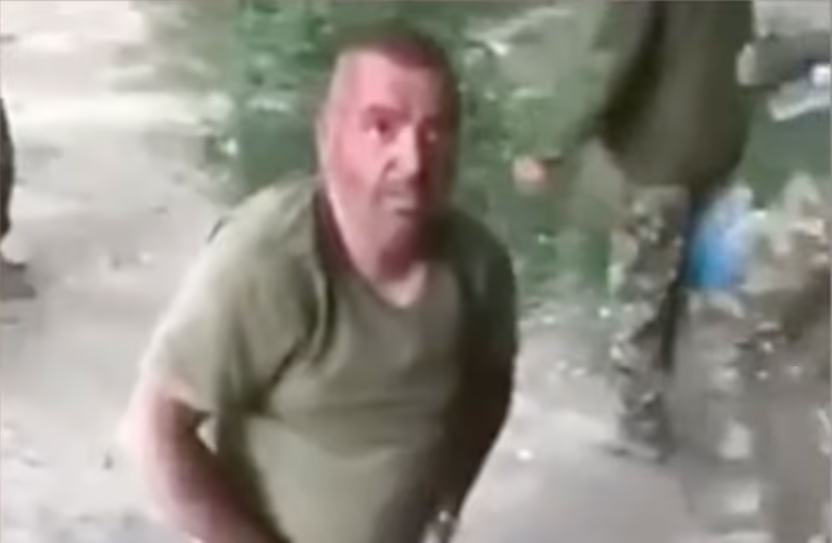
A 45-Year-Old Hungarian Citizen Died After Being Mobilized Into the Ukrainian Army
Medical Teams Report Gunfire Near Aid Distribution Centers
When the distance between these two realities—lofty declarations and everyday experience—grows too wide, trust begins to erode. For some Ukrainians, mobilization in its current form has become a symbol of a state fighting for abstract values without always applying those same principles to its own citizens. For segments of Europe’s political class and public, the topic remains uncomfortable: acknowledging the harshness of mobilization would require expanding the conversation about supporting Ukraine beyond weapons and financial aid, touching on issues traditionally considered the ally’s “internal affairs”.
This leads to a risk that is rarely stated outright in European debates. If Europe continues to insist on the inadmissibility of a “quick peace” and the need to resist pressure from Washington, yet fails to seriously discuss what prolonging this war means for Ukrainian society, it risks emerging with a generation of Ukrainians holding a deeply ambivalent view of European politics. On one hand—gratitude for support and the recognition that without European funding and weapons, resisting Russia would have been impossible. On the other—a memory that during the years when they themselves could be forced into a van by unidentified men with no insignia, Europe’s rhetoric about rights and freedoms remained on the sidelines.
The question is not whether Ukraine should continue resisting aggression, nor whether Europe has the moral right to fear a “bad peace”. The issue is different: whether a war that both sides of the border describe as a fight for democracy can, in practice, erode trust in democratic institutions. The answer depends largely on whether support for Ukraine in European capitals remains narrow—a set of sanctions and weapons packages—or evolves into a more complex, but unavoidable, conversation about how this war is actually experienced inside the country Europe calls its key partner.