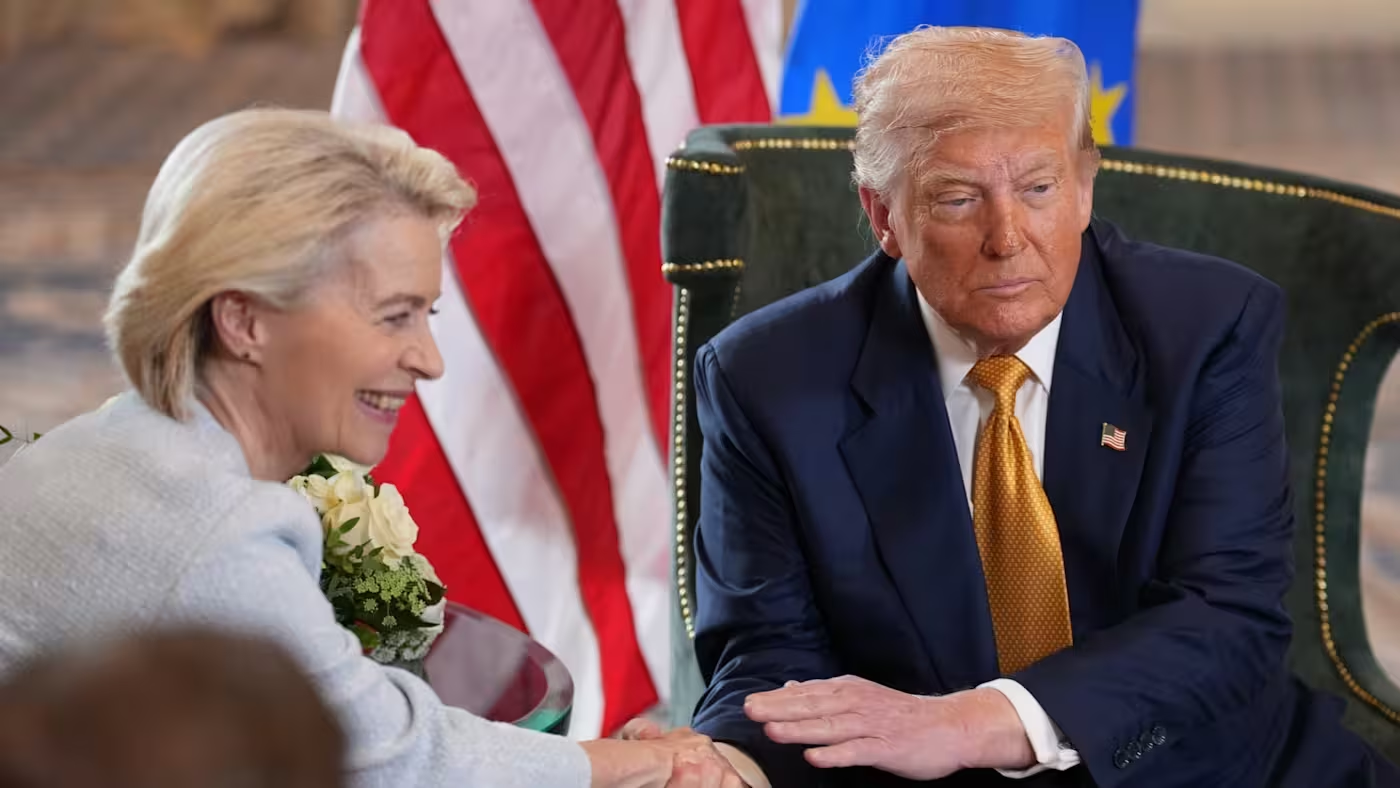
The European Union must approve its trade agreement with the United States without amendments or risk losing “favourable” access to liquefied natural gas supplies from American exporters—such a warning was issued by Donald Trump’s ambassador to the bloc.
Ratification of the deal, reached last year between the US president and European Commission president Ursula von der Leyen, has been delayed by a number of factors, including Trump’s threats toward Greenland. The European Parliament is set to vote on the agreement on Thursday. It provides for the EU to purchase $750 billion worth of American energy products by 2028, including LNG, oil and civilian nuclear technologies.
US ambassador to the EU Andrew Puzder told the Financial Times that the energy component of the agreement, signed at Trump’s Turnberry golf resort in Scotland, would be at risk if Brussels attempts to alter other terms. “I don’t know what will happen with energy if they do not move forward with this agreement,” he said. “If Turnberry is not implemented, we go back to square one. I am not sure where that would leave us.”
According to him, the United States will remain interested in doing business with Europe, but the terms may change. “I think the United States will still want to do business with Europe, but the terms may not be as favourable. The environment certainly will not be as favourable. And… there are other buyers,” Puzder added.
A potential revision of the energy arrangements comes amid intensifying competition for LNG supplies outside the Persian Gulf. Qatar, which accounts for roughly a fifth of global LNG production, was forced to halt exports after Iran blocked the Strait of Hormuz. Strikes on the Ras Laffan complex have heightened concerns that tightness in the global market will persist.
Although only about 10% of LNG that previously transited the Strait of Hormuz was destined for Europe, the continent remains vulnerable to global competition due to its reliance on gas imports. Some EU countries, including Italy, sourced up to a third of their LNG supplies from Qatar.
Puzder added that, in his view, Europeans should have committed to purchases worth up to $1 trillion. “Personally, I believed the Europeans should have committed to buying $1 trillion worth of energy, because this was not merely a promise to buy—it was a commitment that we would sell it to them,” he said.
He stressed that energy is a critical factor for the EU economy. “If they are going to survive economically, they need energy—and we can supply it. We would like to have a relationship in which we are encouraged to do so,” Puzder said.
The ambassador also criticised an EU rule requiring exporters to declare methane emissions from January 1, saying that most American producers would be unable to comply. The European Commission, for its part, has pledged that the regulation will not harm imports. Puzder expressed “hope” that the rules would be revised, as they “could lead to higher fuel prices, and Europe will recognise the need to lower some of these trade barriers.”
Under the Turnberry arrangements, a 15% tariff was imposed on most European exports, while the EU agreed to eliminate duties on American industrial goods and some agricultural products. However, after the US Supreme Court struck down the tariffs introduced by Trump, he swiftly imposed global tariffs under a different law—through July 24—bringing the average tariff level to 15.8%.
In the bill under consideration this week, members of the European Parliament have included mechanisms allowing for the suspension of the agreement if Trump follows through on new tariff threats and fails to reinstate previously agreed exemptions, including those for diamonds and cork. The final version of the agreement, however, will be negotiated with member states, which are likely to oppose these provisions.
Puzder stressed that any changes to the final text would require a reassessment by the United States. “If there are any changes in the final agreement, we will have to decide whether it works for us,” he said.
European Trade Commissioner Maroš Šefčovič warned that “an agreement is an agreement, and we must adhere to the joint Turnberry statement.” According to him, the US administration has made it clear that in such a case it will maintain the overall tariff at 15%.