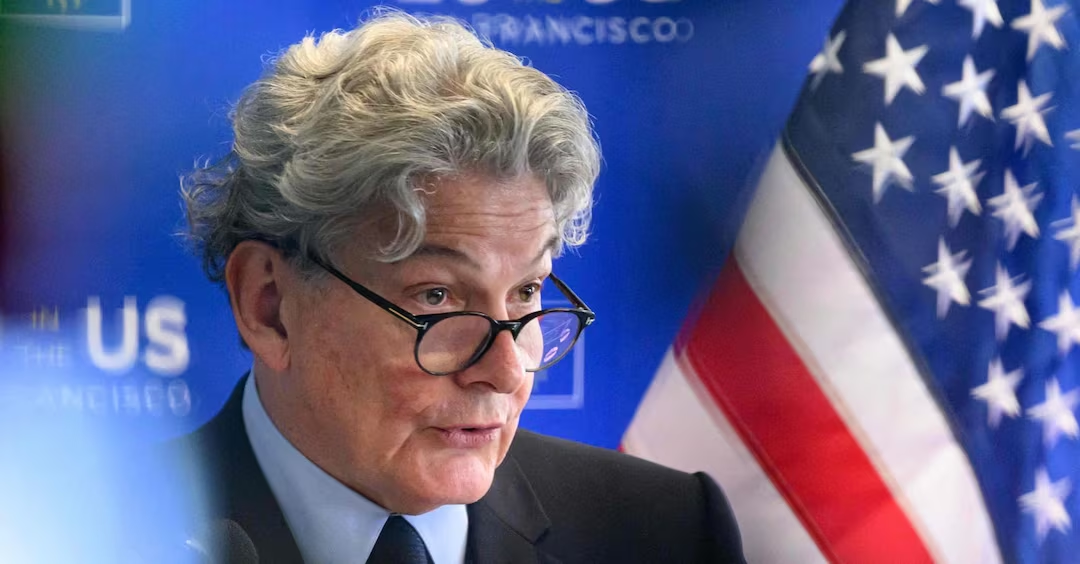
In the final week of 2025, a cold front settled over the Atlantic—one unrelated to the weather. The Trump administration’s decision to impose visa sanctions on five prominent European citizens, including former European Commissioner Thierry Breton, marked a turning point in the unravelling of the Western alliance. By targeting figures who stood at the origins of Europe’s digital regulatory framework, Washington moved beyond familiar trade disputes and into the realm of personal and political coercion.
The formal trigger for the diplomatic rupture was a statement by the U.S. State Department on December 23 announcing entry bans on five individuals accused by American authorities of “extraterritorial censorship”. Alongside Breton, the list included the heads of German and British nonprofit organizations engaged in monitoring online disinformation.
Secretary of State Marco Rubio justified the move in stark terms. He described the targets as radical ideologues who had turned regulation into a tool for suppressing American viewpoints. In the White House’s reading, the Digital Services Act is treated not as a mechanism to protect users, but as a weapon aimed at constraining conservative speech across the global internet.
Europe’s response was swift and unusually forceful. From Brussels to Paris and Berlin, the language of solidarity gave way to a rhetoric of sovereignty. French President Emmanuel Macron described the visa bans as an act of intimidation and coercion. Even the United Kingdom, traditionally cautious when it comes to security-related disagreements with Washington, signaled its support for institutions tasked with protecting the internet from harmful content. This is not a dispute over travel rights, but a fundamental conflict over where state authority ends and the cross-border nature of digital space begins.
The timing of the sanctions appears anything but accidental. Just weeks earlier, the European Commission fined the social media platform X, owned by Elon Musk, €120 million for violations of transparency and content moderation requirements. Given Musk’s role in contemporary American politics, the visa measures increasingly resemble not a defense of the First Amendment, but an attempt to shield the interests of a privileged industry. By labeling Breton the chief architect of the Digital Services Act, the State Department has effectively equated European lawmaking with unlawful conduct.
For the Trump administration, this is a logical extension of the America First doctrine. Within this framework, American technology companies are seen not merely as private businesses, but as key carriers of U.S. soft power and national interests. Any attempt to regulate them abroad is treated as a hostile act. By deploying visa restrictions, Washington is leveraging control over one of the world’s most desirable travel destinations to cool the ambitions of foreign regulators. If an official in Brussels understands that a signature on a regulatory document could mean a lifetime ban from New York or Silicon Valley, the deterrent effect becomes tangible.
Yet the United States may be underestimating the depth of Europe’s resolve. For many in the EU, the digital sovereignty invoked by Macron has become the final line of defense for preserving global influence. Having lost the race to create its own technology giants, Europe has staked its future on becoming the world’s leading regulatory power. The Digital Services Act and the Artificial Intelligence Act are cornerstones of this identity. Retreating under pressure from Washington would amount to an admission—long warned of by some members of the European Parliament—that Europe is sliding toward the status of a U.S. digital colony.
In Brussels, preparations are already under way for a swift and hard-hitting package of countermeasures, expected to be discussed by foreign ministers on January 8. The options under consideration point to a shift toward a more aggressive model of economic deterrence. Alongside reciprocal visa restrictions on U.S. officials, policymakers are weighing the suspension of the simplified ESTA regime for American technology executives and the removal of fast-track airport access for representatives of the U.S. government across Europe.
A far more consequential step would be the activation of the Anti-Coercion Instrument. This mechanism—dubbed the “bazooka” in Brussels—was originally designed to counter external economic blackmail. Its use would allow the EU to bypass lengthy approval procedures and impose rapid retaliatory measures, ranging from targeted tariffs on American digital services and the suspension of data-sharing agreements critical to Silicon Valley, to restricting U.S. companies’ access to EU-funded research programs.
The practical consequences of the conflict are already beginning to surface. Germany has signaled that it may curtail the activities of American lobbyists or accelerate efforts to reduce its 90 percent dependence on U.S. cloud infrastructure. If transatlantic relations turn into a battlefield of personal sanctions, disengagement from American technology will cease to be an abstract ambition and become a matter of national security.
The standoff also undermines the West’s ability to present a united front against the digital authoritarianism of China and Russia. While Washington and Brussels trade accusations, Beijing continues to advance a model of cyber-sovereignty far more restrictive than anything embedded in the Digital Services Act. A fragmented West loses its capacity to set global standards for the ethical use of artificial intelligence and the protection of data.
The central danger of the current course lies in the risk of internet fragmentation, in which rules are shaped not by shared democratic values but by the geography of servers. For the U.S. Congress, the conclusion should be self-evident—deploying visa sanctions against allies is a blunt instrument that may deliver short-term political dividends at home, but carries the risk of long-term strategic disaster abroad.
Thierry Breton’s comparison of the situation to McCarthyism may strike some as excessive, yet the sense of a witch hunt is widely shared across European capitals. When a superpower begins to treat the democratic procedures of its closest allies as a threat to its own security, the foundations of the global order do not merely wobble—they begin to crack.