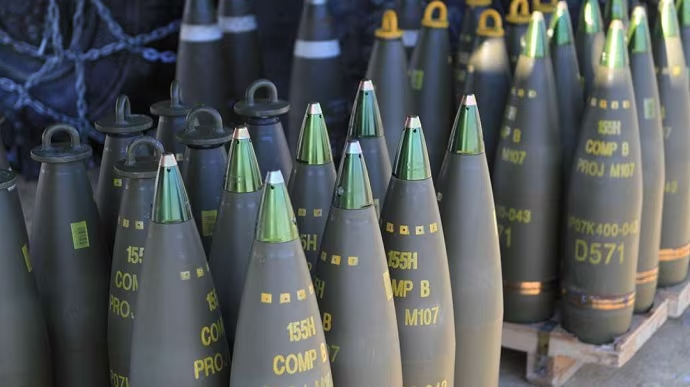
According to a source in Congress familiar with the situation, during the first two days of the U.S. war against Iran the Pentagon expended roughly $5.6 billion worth of munitions.
The cost estimate was delivered by the Department of Defense to Congress the same day. The source did not specify which types of munitions were used or which systems were employed during the first 48 hours of the conflict.
Concerns about ammunition stockpiles have been voiced since the beginning of the war, yet Donald Trump’s administration rejects suggestions that U.S. armed forces are facing pressure on their arsenals.
Military officials have also avoided providing details during briefings—information about ammunition stockpiles falls under matters of security and intelligence.
The war waged by the United States and Israel against Iran has now entered its eleventh day, and it remains unclear how long it may continue.
On Monday, March 9, President Trump described the conflict as “short-term” and suggested it could end in the near future.
“We made a small incursion because we felt it was necessary to eliminate some evil. And I think you will see that this will be a short-term incursion,” the president said. “How good are our military, right? Incredible. How good are they? Short-term. Short-term.”
On Tuesday, March 10, Defense Secretary Pete Hegseth also declined to say how long the war might last, but stressed that “our will is infinite.”
“Ultimately, it is the president who determines what the outcome of these missions should be, right?” Hegseth said during a briefing at the Pentagon. “But he continues to repeat—and I want Americans to understand this—that this is not about an endless war.”
The Pentagon declined to comment on the cost estimate previously reported by The Washington Post.
According to Defense Department officials, since the beginning of the conflict U.S. forces have carried out more than 5,000 strikes on targets inside Iran and have sunk or damaged more than 50 Iranian vessels.
On Tuesday morning Hegseth said that “today will be, once again, the most intense day of strikes on Iranian territory.”
“The largest number of fighter jets, the largest number of bombers, the largest number of strikes. Intelligence is more precise and better than ever. That is one side,” the Pentagon chief told reporters. “On the other hand, over the past 24 hours Iran has launched the smallest number of missiles it has been capable of so far.”