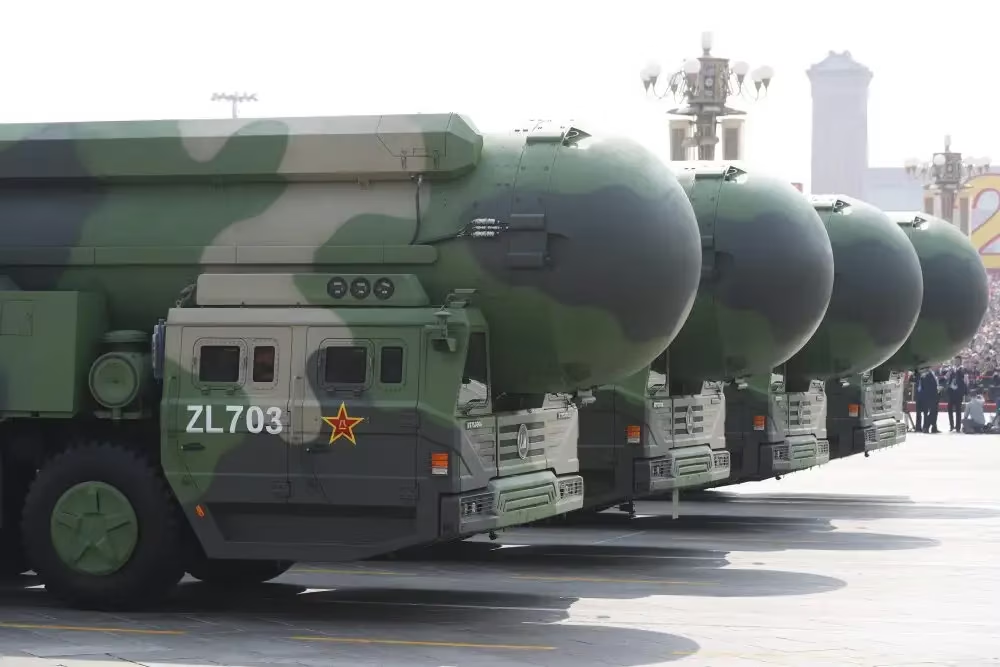
On Friday, February 6, the United States called for a new, broader nuclear arms control treaty that would include not only Russia but also China, while simultaneously accusing Beijing of conducting covert nuclear tests. Thomas DiNanno, the deputy under secretary of state for arms control and international security, wrote on X that, in Washington’s assessment, China had carried out nuclear explosive tests, including preparations for so-called calibrated, high-explosive-yield shots in the hundreds of tons. He said Beijing had used a “decoupling” technique designed to blunt the effectiveness of seismic monitoring and thereby conceal such activity, and claimed that one such “yield-release test” took place on June 22, 2020.
The accusations came against the backdrop of the end of the New Strategic Arms Reduction Treaty—New START—whose term lapsed after President Donald Trump allowed it to fall away. The agreement set limits on the deployment of US and Russian missiles and warheads. With its expiration, for the first time in more than half a century, there is no longer a single operative mechanism between the United States and Russia that restrains the deployment of strategic nuclear arms.
Commenting on the decision, Trump wrote on Truth Social that, rather than extending New START—which he described as a poorly negotiated accord that had been flagrantly violated—the United States should task its nuclear experts with drafting a new, better, and modernized treaty designed for the long term. Secretary of State Marco Rubio said the same day that New START had been signed “in a different era and for different purposes” and no longer serves its intended function.
In a separate statement, Rubio dismissed criticism from Democrats in Congress and arms-control advocates who urged the Trump administration to open talks with Russia on a new agreement covering nuclear arsenals. In their view, such a deal would help avert a new Cold War-style arms race. In a letter to the president sent on Friday, 18 members of the Senate and House expressed dissatisfaction that Trump had not accepted Moscow’s proposal to continue observing the treaty’s terms for another year.
“The lack of progress toward a replacement treaty—or even a mutual commitment to abide by New START’s limits—is deeply disappointing, especially given that the administration acknowledges the agreement’s purpose: to reduce nuclear risks and prevent a new arms race,” the lawmakers wrote in the letter, led by Senator Jeff Merkley.
Rubio, however, stressed that such concerns “ignore the fact that Russia stopped implementing New START back in 2023, after years of violating its provisions.” A treaty, he argued, is only possible with at least two parties, and the United States faced a choice—either to continue observing the limits unilaterally or to accept that a new era demands a different approach. The issue, he said, is not preserving the old START framework but negotiating a new agreement that reflects the reality that the United States may soon be confronting not one but two nuclear peers—Russia and China.
The New START treaty, signed in 2010 and extended in 2021, capped the number of deployed strategic warheads held by the United States and Russia at 1,550 for each side, and set a ceiling of 700 deployed launchers. Early last month, Trump indicated that any new arms-control treaty should also include China, which in recent years has been rapidly expanding its military capabilities and nuclear arsenal. Yet even as he insisted on bringing Beijing in—despite China’s rejection of such proposals—Trump declined to take up Russia’s offer to continue observing New START on an interim basis while talks on a new agreement proceed.
On Friday, Russia said its negotiators had discussed the treaty’s expiration with the US side and agreed on the need to launch new talks as soon as possible. The understanding was reached during a meeting between representatives of the two countries in the United Arab Emirates, where they were also discussing the parameters of a possible peace settlement in Ukraine. Kremlin spokesman Dmitry Peskov told reporters that in Abu Dhabi the sides reaffirmed their intention to act responsibly and recognized the need to begin a dialogue on the issue without delay.
Earlier, Axios reported that Russian and American negotiators had discussed the possibility of an informal extension of New START for at least six months, but Peskov stressed that any such arrangement could only be formal. “It is hard to imagine any informal extension in this field,” he said.