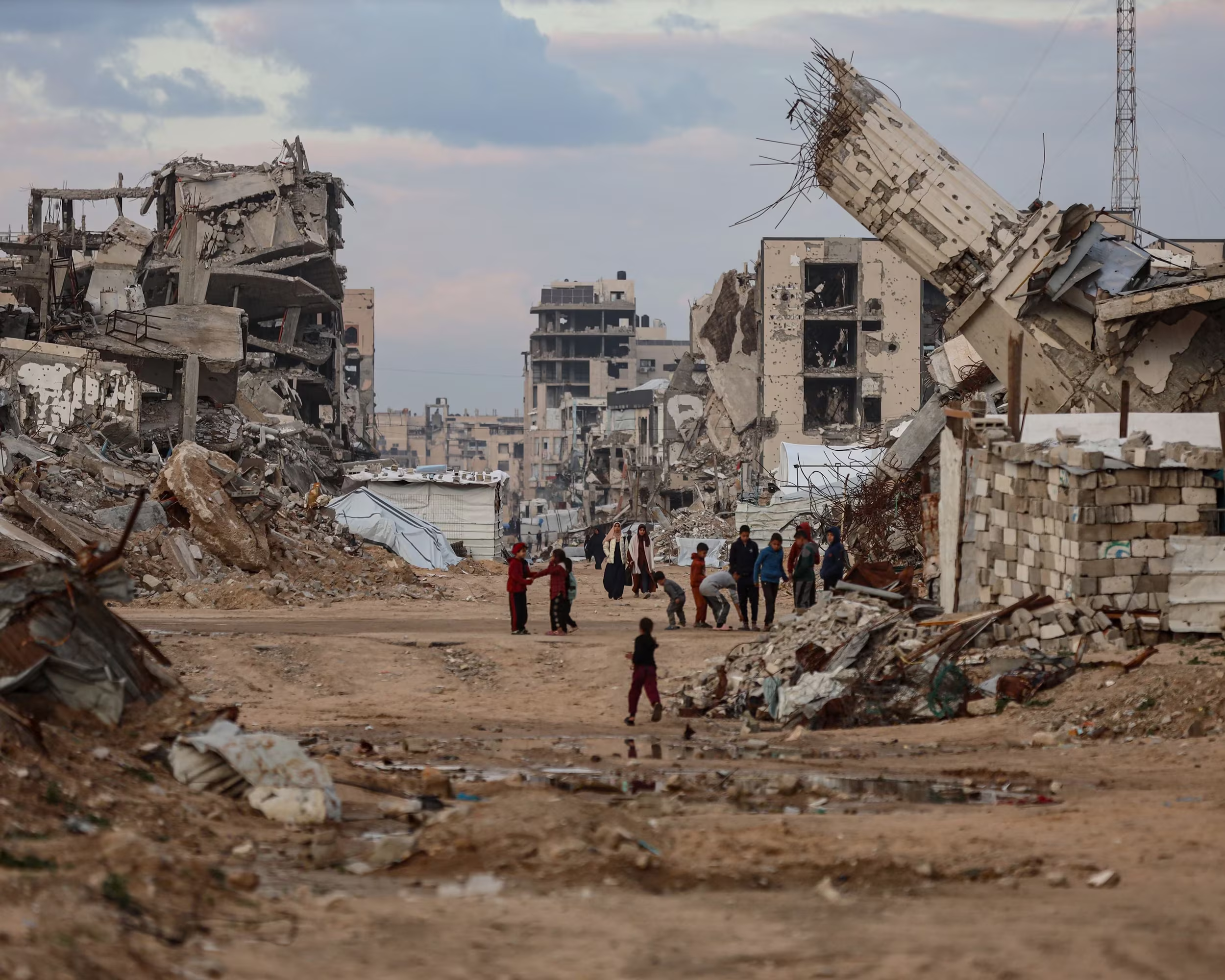
The United States has announced the launch of the second phase of the ceasefire in Gaza, which envisages the creation of a committee of Palestinian technocrats. During the transitional period, it is expected to assume day-to-day administration of the territory.
The announcement was made on social media by Donald Trump’s special envoy, Steve Witkoff, but without any details or indication of potential members of the proposed “national committee for governing Gaza.” The start of its work is linked to the mandate of a so-called “peace council” chaired by Trump, which has yet to be established.
According to Witkoff, the second phase is intended to initiate the “complete demilitarization and reconstruction of Gaza, first and foremost the disarmament of all unauthorized personnel.”
The first phase of the ceasefire plan began on October 10 and included the exchange of Israeli hostages held by Hamas and affiliated groups for Palestinian prisoners held in Israeli jails. Israeli forces withdrew to the so-called yellow ceasefire line while retaining control over most of the territory.
The intensity of Israeli strikes on Gaza has declined, but they have not stopped entirely. Since the ceasefire began, around 450 Palestinians have been killed. No agreement has yet been reached on the disarmament of Hamas.
Two organizations representing former Israeli hostages and their families urged the United States not to announce the start of the second phase until Hamas returns the remains of the last hostage, whose fate remains unclear, Ran Gvili. Hamas said it has so far been unable to locate his body.
“The United States expects Hamas to fully meet its obligations, including the immediate return of the last deceased hostage,” Witkoff said. “Failure to do so will carry serious consequences.”
Although Witkoff did not disclose details of the composition of the interim Palestinian committee, Egypt’s foreign minister, Badr Abdelatty, said several hours before the US envoy’s post that agreement had been reached on all 15 candidates.
According to Abdelatty, the committee will be “deployed in the Gaza Strip to manage day-to-day life and ensure the provision of basic services.”
Its members are expected to be technocrats rather than serving politicians, although some are believed to have ties to Fatah, the dominant movement within the Palestinian Authority. Those cited as potential leaders include Ali Shaath—a former deputy minister of planning in the Palestinian Authority—and Majed Abu Ramadan, the PA’s current minister of health.
According to diplomats in the region, the work of the interim Palestinian committee will be overseen by Nikolay Mladenov—a Bulgarian diplomat and former UN official who has recently been holding consultations with Israeli and Palestinian officials. From early 2015 until the end of 2020, he served as the UN special coordinator for the Middle East peace process and is regarded with respect by both sides of the conflict.
Mladenov, in turn, will report to Trump’s “peace council,” which is expected to consist of a group of world leaders. US officials say its composition could be announced in the coming days.
Talks in Cairo on the second phase also addressed the further withdrawal of Israeli forces from Gaza, the reopening of the Rafah border crossing between Egypt and the Gaza Strip, the delivery of humanitarian aid already stockpiled on the Egyptian side of the border, and a broader increase in the flow of goods and assistance into the territory.