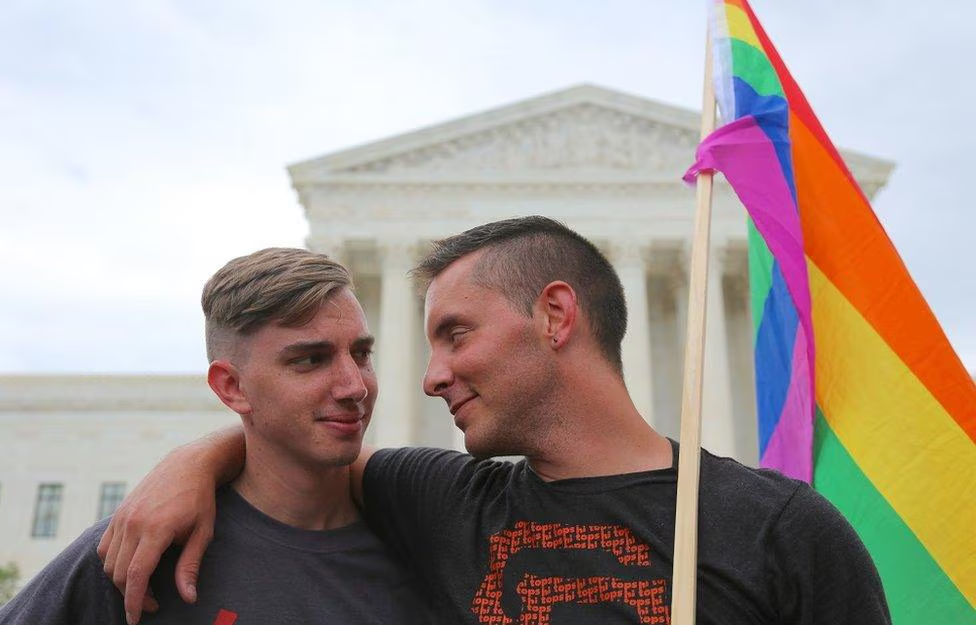
Support for same-sex marriage among Republicans in the United States continues to fall sharply: according to a new Gallup poll, fewer than 4 in 10 party members believe such marriages should be recognized by law.
Overall, a majority of Americans still support the legal recognition of same-sex marriage. Among Republicans, however, that figure has fallen from 55% in 2021–2022 to 37%, according to Gallup data published on Wednesday.
Support for Recognizing Same-Sex Marriage in the U.S. by Party Affiliation
Twenty years ago, about 42% of Americans supported same-sex marriage. Today the figure stands at 65%, though it is below the early-2020s peaks, when roughly 7 in 10 U.S. residents expressed support. Among Republicans, support has returned roughly to its 2015 level.
According to Gallup senior editor Jeffrey Jones, Republicans had for a long time been gradually becoming more open to recognizing same-sex marriage, following the national trend.
“And then, it kind of changed—and I think certainly the 2024 campaign could have been part of it,” he said.
After returning to the White House for a second term, Trump began rolling back diversity, equity and inclusion programs in the federal government and beyond. His administration also advanced measures restricting transgender people’s access to medical care, participation in sports and self-identification in federal documents.
At the same time, Trump appointed openly gay men to senior positions in his administration. But Shannon Minter, legal director of the National Center for LGBTQ+ Rights, notes that major supporters of the president include organizations such as The Heritage Foundation and Alliance Defending Freedom, which he says have an “openly anti-gay agenda.”
In several states, Republican lawmakers have called on the Supreme Court to revisit its decision recognizing same-sex marriage. Justices Clarence Thomas and Samuel Alito have also criticized that decision in recent years.
Minter says recognition of marriage equality led to a “profound transformation” in how society views its LGBTQ+ peers, neighbors and children. “And it’s very painful to see some of that progress being lost again,” he said.
Although the Supreme Court rejected former county clerk Kim Davis’s request to revisit the 2015 ruling, right-wing efforts targeting same-sex marriage continue.
Earlier this year, a coalition of dozens of conservative and religious organizations launched an initiative against same-sex marriage, saying that children’s interests should be at the center of the debate.
Minter notes that in the past, bipartisan support helped the LGBTQ+ community secure important legal victories. He recalls that the conservative lawyer Ted Olson fought against California’s Proposition 8 ban on same-sex marriage, the conservative Justice Anthony Kennedy wrote the Obergefell decision, and some Republicans supported the Respect for Marriage Act.
“All of that now, I think, is almost impossible to imagine, because the country has become so hyperpartisan,” Minter said.
Katie Blair, vice president of advocacy at PFLAG National, stresses that marriage equality is not only about social recognition. It is also, she says, about hundreds of rights and privileges that depend on marital status.
“That is what we are fighting for,” she said, adding that the current rhetoric and policy have effectively legitimized “hateful and harmful” approaches.
Most Americans still believe same-sex marriages should be recognized by law. Blair says that in everyday life, queer families face the same problems as heterosexual families.
“Our families are trying to feed their children, get them through school…and we just don’t have the time or tolerance for something like this,” she said.
The Gallup poll was conducted by telephone from May 1 to 17, 2026, among a random sample of 1,001 adults. The margin of error for the full sample is plus or minus 4 percentage points at the 95% confidence level.