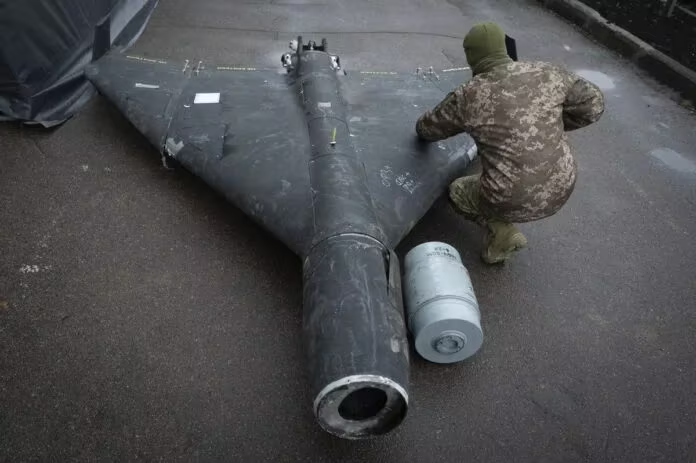
The United States has begun reconsidering Ukrainian technologies for countering Iranian attack drones—after rejecting Kyiv’s proposal several months ago, even though it had been presented before the outbreak of the war with Iran. This was reported by Axios.
Ukrainian officials first presented the plan on August 18 during a closed-door meeting at the White House. During the talks, President Volodymyr Zelensky proposed deploying interceptor drone systems designed to destroy Iranian Shahed attack drones.
Ukrainian officials prepared a PowerPoint presentation for the meeting warning about the growing threat posed by Iran’s expanding drone arsenal. The presentation included a map of the Middle East and warned that “Iran is improving the design of the Shahed one-way attack drone.”
Kyiv proposed creating so-called “drone combat hubs” in countries hosting U.S. military bases—including Türkiye, Jordan and Gulf states—to counter threats from Iran and its allied groups.
“We wanted to build ‘drone walls’ and all the necessary elements—such as radar,” one Ukrainian official said.
Despite the proposal presented, the U.S. administration at the time chose not to pursue the initiative.
One U.S. official later acknowledged that ignoring the plan may have been a serious tactical mistake. According to Axios, officials within the U.S. administration later conceded that the decision not to advance the Ukrainian initiative may have been a miscalculation.
“If there was any tactical error or miscalculation we made leading up to this war with Iran—it was this one,” the official said.
The conflict, which began on February 28, has demonstrated the effectiveness of Iran’s Shahed attack drones. They have been widely used in retaliatory strikes against U.S. positions and allied facilities.
According to U.S. officials, Iranian drone attacks have been linked to the deaths of seven American service members and have forced the United States and its allies to spend millions of dollars intercepting these relatively inexpensive weapons.
The cost of a single Shahed drone typically ranges from $20,000 to $50,000—making them far cheaper than the sophisticated missiles often used to destroy them.
Ukraine has accumulated significant experience in countering such drones during the war with Russia, where Moscow deployed thousands of Shahed-type systems under the name “Geran.”
Ukrainian engineers developed low-cost interceptor drones and detection systems specifically designed to destroy such targets.
Last week, the United States formally approached Ukraine for assistance in countering the threat posed by Iranian drones.
The U.S. military has also begun deploying its own counter-drone systems—including a system known as Merops—and continues to use helicopters such as the AH-64 Apache to intercept unmanned aerial vehicles.
Allied systems are also being brought into use—in particular Wildcat helicopters equipped with Martlet missiles, which the United Kingdom has pledged to provide.
White House spokesperson Anna Kelly said the scale of Iran’s retaliatory attacks has already declined significantly.
“Iran’s retaliatory attacks have decreased by 90% because their capability to deploy ballistic missiles is being completely destroyed,” she said.
Despite this, officials acknowledge the need to develop cheaper and more effective technologies to counter drones as the conflict continues.
Ukraine had previously proposed a broader partnership with the United States that would include establishing drone production facilities in the U.S. while drawing on Ukraine’s battlefield experience.
According to Ukrainian officials, Kyiv estimated that with U.S. investment support, joint production could enable the output of up to 20 million drone systems.