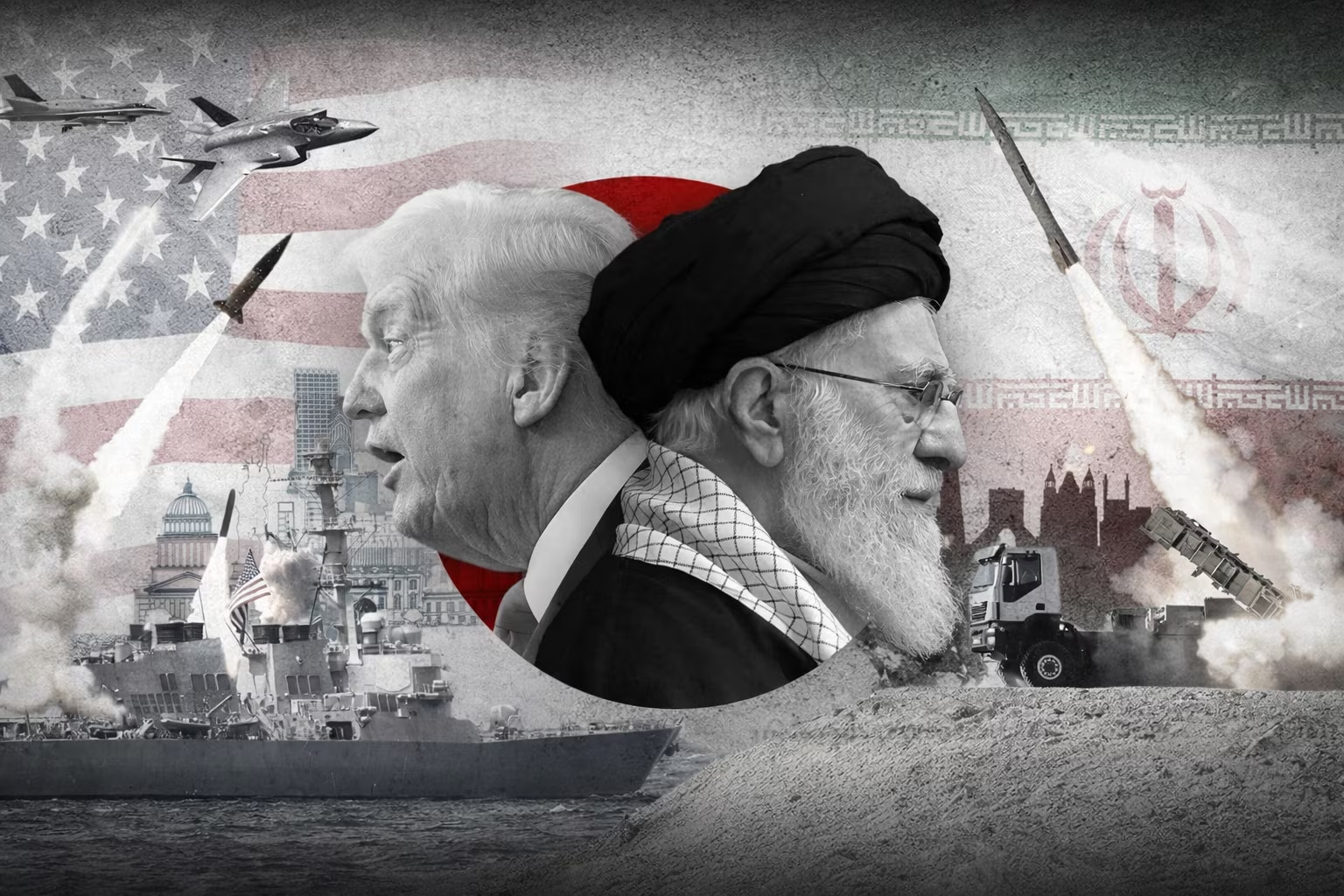
The information space is saturated with reports of a possible large-scale war in the Middle East. Publications claim that the United States, having concentrated substantial military forces in the Persian Gulf, is allegedly preparing to strike Iran in the near future.
For now, it remains unclear whether this reflects Washington’s genuine intentions or an attempt to increase pressure on Tehran as part of a negotiating strategy.
Some media outlets note that Donald Trump has yet to make a final decision. Such hesitation appears logical.
As noted earlier, a potential conflict carries extraordinarily high risks for the United States and for Trump personally.
If a military operation were to evolve into a prolonged confrontation with significant losses among U.S. service members, it would amount to a political catastrophe for the American president and could trigger his collapse. Moreover, such a scenario could draw the country into an extended domestic political crisis.
The reason is that public support inside the United States for new wars initiated by Washington is virtually nonexistent. Opposition comes from both Democratic and Republican voters—especially Trump’s own supporters, who backed him on promises to end wars. A militarily expansionist course is supported only by a narrow circle of “hawks” and neoconservatives, such as Senator Graham.
Under these conditions, American society is prepared to accept only swift operations that are virtually bloodless for the United States—a kind of blitzkrieg. A prolonged war with Iran and rising American casualties would inevitably unleash a political storm of such magnitude that it would, in all likelihood, sweep away Trump and his team, possibly as early as after the congressional by-elections at the end of the year.
Added to this are the secondary effects—a sharp rise in oil prices due to the likely blockade of the Strait of Hormuz and large-scale destabilization across the entire Persian Gulf region.
The current situation differs fundamentally from the campaign against Iraq launched by the United States in 2003 on pretexts that were later acknowledged to be false. At the time, the invasion was framed as a response to the attack on the Twin Towers in 2001 and was perceived by a significant portion of American society as an act of self-defense. Today, by contrast, the United States has not been attacked, and from the standpoint of public opinion Washington lacks any obvious grounds for initiating a war. Accordingly, if the conflict drags on and casualties mount, the public reaction is likely to be far harsher than it was in the early 2000s.
Moreover, unlike in 2003, the United States today does not have such a powerful ground force deployment in the Middle East that could inflict a decisive military defeat on Iran and establish control over the entire country.
This means that the consequences of any potential miscalculation in planning the operation would be colossal for the United States and for Trump personally. The prospect of a prolonged war cannot be ruled out—especially if Iran were to receive substantial support from China.
This is precisely why Washington is buying time, seeking to plan any potential strike with maximum care, banking on a swift and effective outcome—either in the form of regime change in Tehran or its agreement to comply with all U.S. demands.
The most desirable outcome for Washington would be a repeat of the “Venezuelan” scenario, in which military pressure triggers rapid internal processes that alter the country’s political course.
However, in Iran’s case there is no certainty that such a calculation would work.
As a result, Trump finds himself facing an extremely difficult choice—one that could determine not only his personal political fate but also the trajectory of global events for years to come.
As for the potential impact of a strike on Iran on the war in Ukraine, under any scenario it would be negative from the standpoint of prospects for a ceasefire.
If the United States were to achieve a swift blitzkrieg, it would strengthen the position of the “hawks” around Trump, who are convinced that Washington has no interest in ending the war in Ukraine, as it weakens Russia and sustains tensions in Russian-European relations.
If the conflict with Iran were to drag on, Trump would have little room for peace initiatives. His political standing would weaken to the point where he would be unlikely to press for an early ceasefire.
It is therefore no coincidence that the most prominent representatives of the global “party of war” are actively promoting the idea of a strike on Iran.