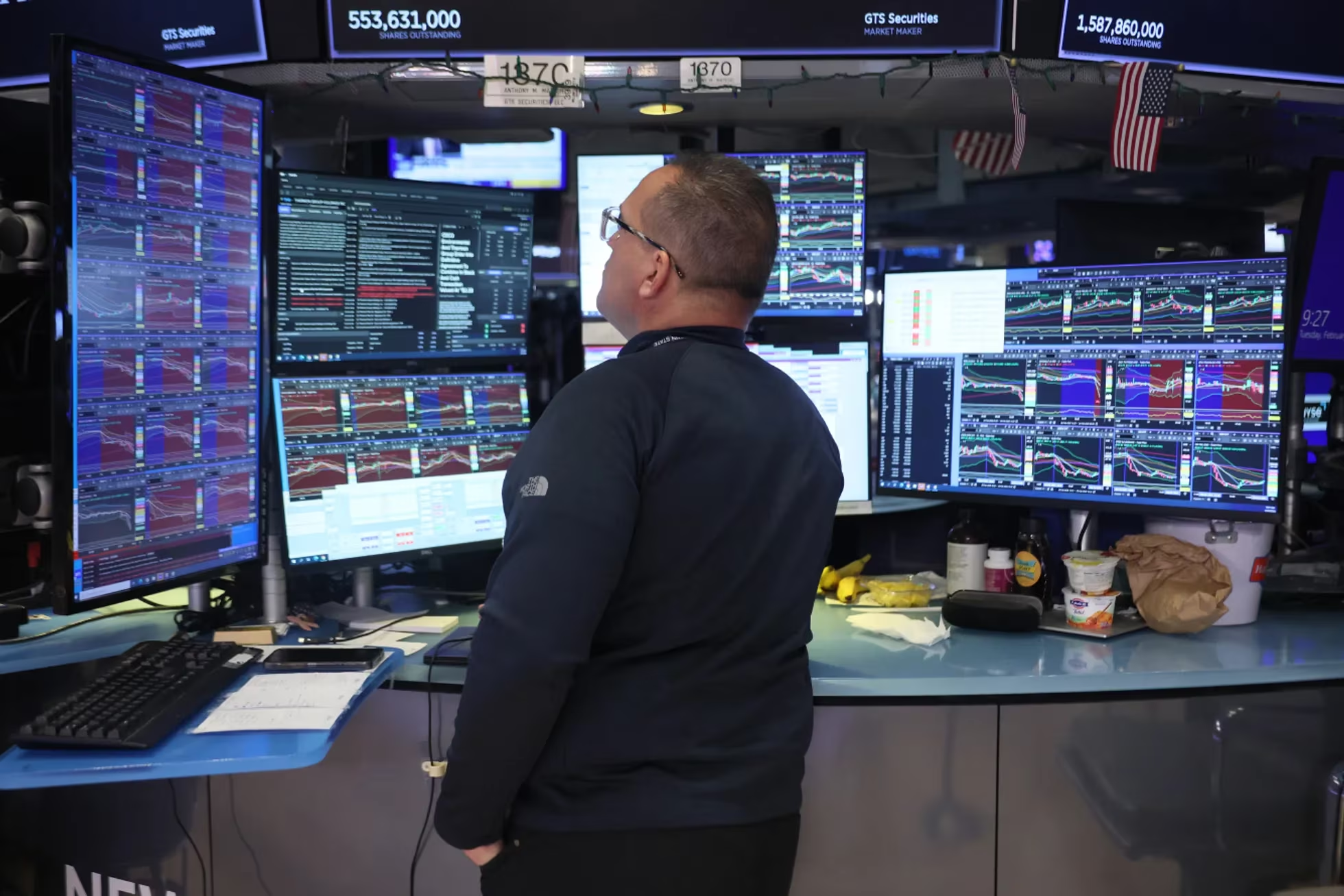
On Monday, February 23, the U.S. stock market suffered a sharp selloff, with all major indices closing in negative territory. The heaviest losses were recorded by the Dow Jones Industrial Average, which fell 1.7%, or 822 points. The S&P 500 declined by 1%, while the Nasdaq Composite dropped 1.1%.
One of the factors behind the selloff, according to data from The Wall Street Journal, was a report by the analytical group Citrini Research outlining a negative scenario tied to new risks emerging around the development of artificial intelligence.
The authors model conditions as of June 2028 and assume that rapid advances in AI will drive a sharp increase in productivity while simultaneously unleashing intense competition for survival among white-collar workers.
In their assessment, the process will unfold in stages. In the first phase, markets will respond positively to layoffs in the office sector: corporate margins will improve, profits will reach new highs, and payroll costs will shrink. But the subsequent wave of job losses will begin to erode consumer demand, as people cut spending after losing their jobs. This will lead to a rise in credit defaults, with stress then spreading to the insurance sector. The next link in the chain will be the mortgage market, followed by an acceleration of asset selloffs. As human labor steadily loses value, the economy will face declining employment, falling consumption, and the destruction of entire industries.
Bloomberg notes that under such a scenario a “negative feedback loop” takes shape: companies cut staff to boost margins and redirect freed-up resources into AI investment, which in turn enables further layoffs.
“This is not an apologia for a bear market, nor is it fan fiction about the end of the world driven by AI. The sole purpose of this text is to model a scenario that has so far received relatively little attention,” the Citrini report emphasizes.
The report references dozens of companies across multiple sectors and highlights food-delivery platform DoorDash as a telling example of a business vulnerable to emerging technologies. The authors argue that AI agents will allow both couriers and customers to organize food deliveries at significantly lower cost. On Monday, DoorDash shares fell 6.6%.
Other companies cited in the Citrini Research study also came under pressure. Shares of software developers Datadog, CrowdStrike, and Zscaler dropped by more than 9%. IBM stock fell 13%—its worst one-day performance since 2000. Payment networks Visa, Mastercard, and American Express declined by 4–7%. Taken together, these concerns, along with renewed uncertainty surrounding the White House’s trade policy, intensified pressure on markets and dragged down the major indices, The Wall Street Journal notes.
One of the report’s authors, Alap Shah, acknowledged that the scale of the reaction caught him off guard. “I thought the response would be modest—it was clearly much larger than we had expected,” he said. Over the next five years, he added, the position of white-collar workers in the U.S. labor market will become a key indicator of AI’s impact, with effects likely to materialize faster than elsewhere due to the high flexibility of the American job market. “It is far easier to lay people off here than in other parts of the world,” Shah said.