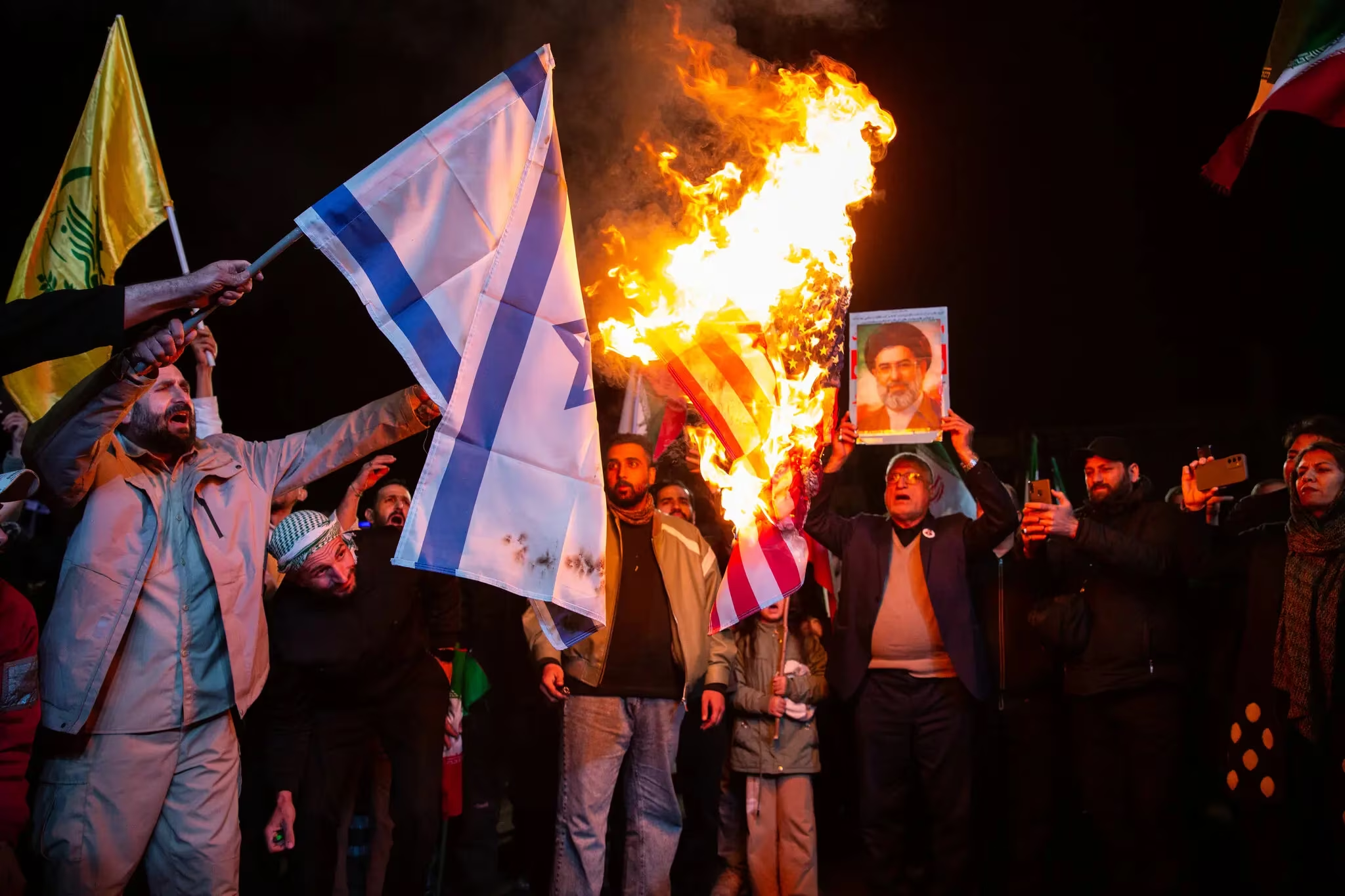
Historical analogies never align perfectly. Even so, against the backdrop of the fragile ceasefire in the U.S. and Israeli war against Iran, the question is being asked with growing frequency: has this episode become Washington’s own “Suez moment”—a sign that its global power and credibility are weakening?
The Suez Crisis unfolded in October 1956, when Britain, France, and Israel attacked Egypt in an effort to reassert control over the canal. U.S. President Dwight Eisenhower, just days before an election, demanded that the operation be halted. British Prime Minister Anthony Eden soon resigned, while Egyptian President Gamal Abdel Nasser emerged as a symbol of the anti-colonial movement.
Since then, Suez has served as shorthand for the moment when Britain, drained by the Second World War, yielded its role as the leading power to the United States.
The current situation, however, is different. The Suez Canal is a man-made structure located entirely within Egyptian territory, whereas the Strait of Hormuz is an international waterway. Nor is there any power in the region capable of replacing the United States—let alone dictating terms to an American president.
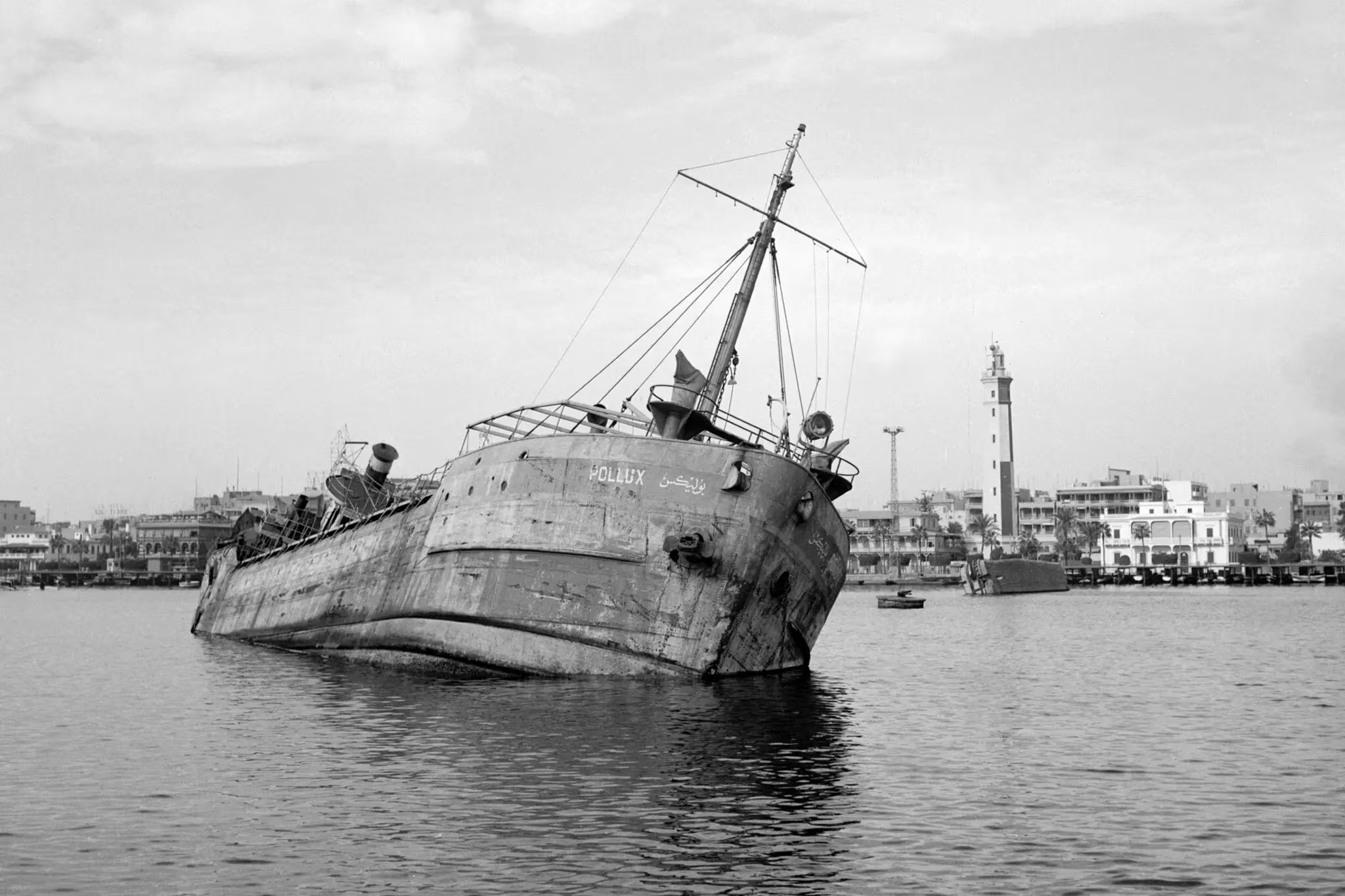
A vessel sunk by the Egyptian authorities to block the Suez Canal. November 1956.
And yet the two-week truce leaves the Islamic Republic in power and preserves its control over the future of the Strait of Hormuz. Iran’s nuclear arsenal and ballistic-missile program remain unresolved. After Donald Trump’s declarations of victory—however questionable they may be—a return to full-scale war appears unlikely.
From the outside, this is beginning to look like a defeat. “The war is beginning to look like a military defeat, more serious than Iraq or Afghanistan,” said Bruno Macaes, Portugal’s former secretary of state for European affairs.
“The myth of America’s omnipotence matters,” he added, “and for a global hegemon, the basic requirement is to guarantee the free flow of oil, open the strait, and keep it open. That faith in an America capable of solving any problem is disappearing.”
Safeguarding sea lanes for trade and supply flows is one of the few enduring U.S. interests in the Middle East, as it is in Asia. Yet the war has effectively shut the strait. It now remains under the control of the Iranian military, which will likely demand substantial fees. “The strategic rationale for the American military presence in the region has taken a serious blow,” said Stephen Wertheim of the Carnegie Endowment.
In his view, the comparison with Suez is apt in the sense that the war in Iran demonstrated “in a single episode the dangers of ineffective American governance and flawed decision-making.” The conflict itself and its uncertain outcome only deepen pre-existing concerns in other countries about what to expect from the United States amid a decline in the quality of its governance.
Allies may feel dissatisfaction, confusion, and even irritation with the policies of the Trump administration, yet many of them—especially in the Persian Gulf and in Asia, where countries have been hit by energy restrictions—have few alternatives in the security sphere.
Nevertheless, the war and the subsequent truce have weakened American influence and will inevitably shape how allies judge the reliability of the United States, said Charles Kupchan of the Council on Foreign Relations.
Military action against Iran began without consultations with allies and came as the continuation of a series of moves that had already unsettled them. Trump’s trade wars were an unpleasant surprise, but his threats to use force to seize Greenland from Denmark—a NATO ally—were widely seen as a turning point, pointing to an American tendency toward coercion, unpredictability, and disregard for traditional partners.
“The war with Iran and its economic consequences reinforce the sense that the United States has now become unpredictable and unreliable,” Kupchan said.
International relations and alliances are built on trust. Yet, as Francis Fukuyama of Stanford noted, “never before have the United States been trusted so little—neither by traditional allies nor by rivals.”
In his view, a successful negotiator must at least inspire some degree of confidence that he will uphold his side of an agreement. “But reciprocity is a virtue that Trump has never understood and never practiced,” he added.
The conflict has cast doubt on Washington’s central argument that its global leadership is necessary for the security of world trade and the international order—this is the logic used to justify the network of American bases across the world, especially in the Middle East.
What has unfolded, however, has made the United States look more like a source of destabilization. “By launching a war of choice in a region critical to global trade, and by completely ignoring the likely consequences for the economies of its closest allies, the Trump administration has destroyed the legitimacy of American power,” Anatol Lieven of the Quincy Institute said.
The consequences are felt most acutely in Europe, which relies on NATO and on American security guarantees, including the nuclear umbrella. Even so, Europeans continue to distinguish between trust in the United States as a state and their view of Trump himself—the former endures because the continent’s security depends on it.
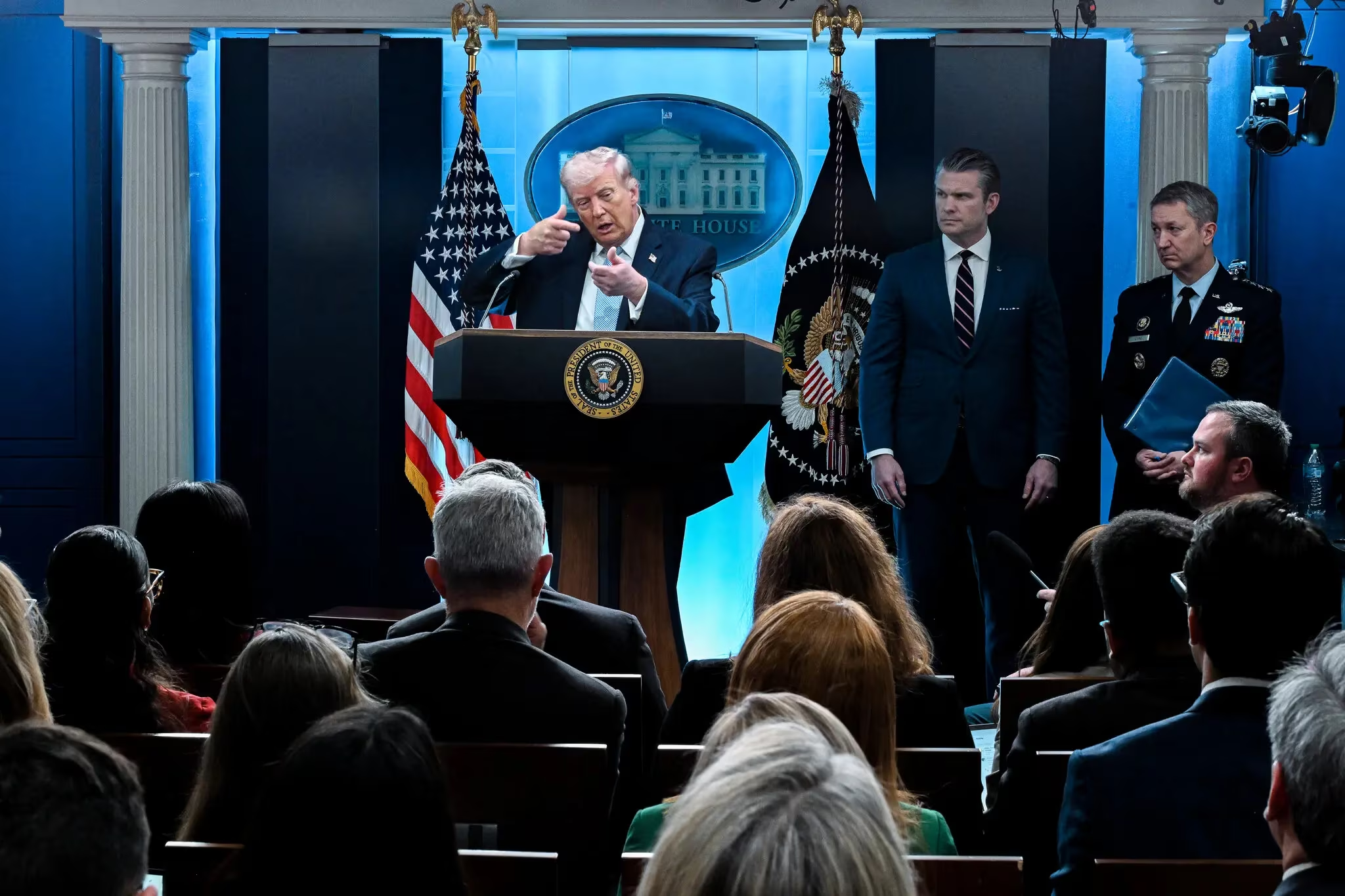
President Donald Trump at a White House press conference. April 6, 2026.
Nevertheless, Trump’s policies are already setting in motion processes that will outlast his presidency. Other countries are seeking to rework their strategy and reduce their dependence on the United States, which, in their view, treats allies like adversaries and traditional rivals such as Russia and China like partners.
Asked whether American hegemony had weakened, Polish Foreign Minister Radoslaw Sikorski said: “We hope not, but we fear that it may have.”
Trump’s policies have also dealt a blow to NATO. He has repeatedly called the alliance a “paper tiger,” even though he has secured a substantial increase in defense spending by its members. During the war with Iran, he criticized the Europeans for failing to ensure that the strait was reopened, even though the more powerful American fleet was unable to do so.
What particularly irritates him is the resistance of allies. “It all started with Greenland, if you want to know the truth,” Trump told reporters on Monday. “They don’t want to give it to us, and I said, ‘Well, goodbye.’”
The cumulative effect on NATO is significant, Rajan Menon of the City University of New York argues. In the long run, China appears to be the chief beneficiary.
“While we look like madmen and talk about bombing a country back to the Stone Age, China is presenting itself as a peacemaker and a source of stability,” he said. Beijing has also gained an opportunity to observe the actions of the U.S. Navy.
“China is watching what is happening with unmistakable satisfaction, and when Trump goes there” for the summit scheduled for mid-May, “his position will be noticeably weaker.”
China, which receives a significant share of its oil through the Strait of Hormuz, pressed Iran to agree to the truce and is expected to take part in safeguarding shipping.
The ultimate significance of what is happening will depend in large part on how the conflict ends, Kupchan warns. If the truce leads to an agreement that substantially limits Iran’s nuclear program and its ability to destabilize the region, that would in the long run be preferable to a protracted conflict that drags on for months and puts pressure on energy markets and U.S. allies.