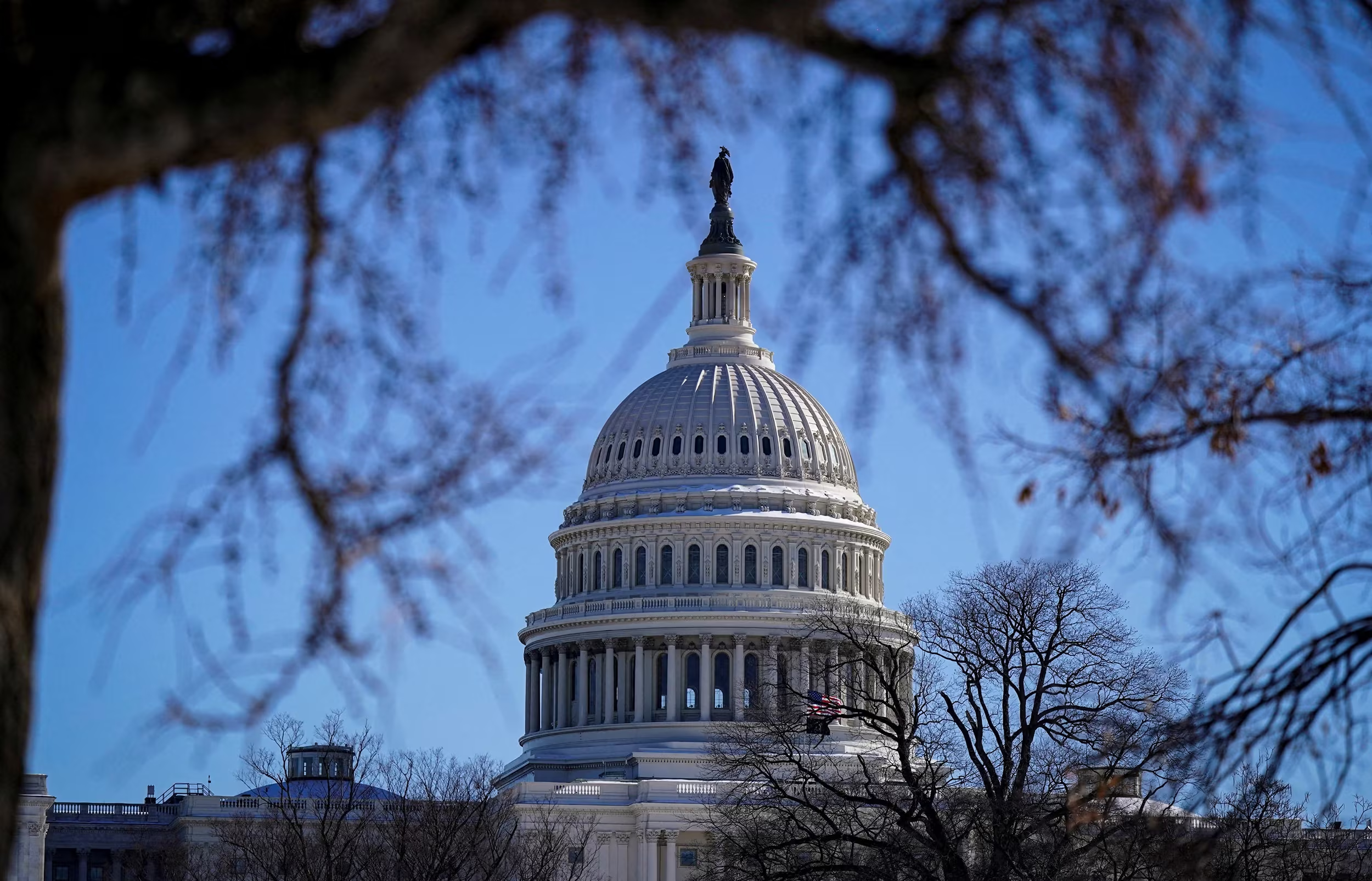
On Tuesday, February 3, the US House of Representatives approved a funding bill that ends the partial government shutdown and gives Democrats time to negotiate with the White House and Republican congressional leaders over potential limits on the mass deportation campaign launched by Donald Trump.
The Republican-controlled chamber backed the $1.2 trillion appropriations package by the narrowest of margins—217 votes to 214. All but 21 Republicans voted in favor, while all but 21 Democrats voted against it. Trump is expected to sign the bill, bringing an end to the shutdown that began after midnight last Friday and disrupted the work of federal agencies, including the Departments of Defense, Health and Human Services, Labor, and Transportation.
Funding became blocked after Democrats refused to extend the budget for the Department of Homeland Security (DHS) following the deaths of US citizens Renee Good and Alex Pretti in Minneapolis. Both were killed by federal agents amid a sharp escalation of immigration enforcement in the city under the Trump administration.
Democrats are demanding strict limits on Immigration and Customs Enforcement (ICE) and other agencies involved in deportations. Their conditions include mandatory body cameras for agents, a ban on face coverings, adherence to a code of conduct, and the requirement to obtain judicial warrants to arrest individuals residing in the country illegally.
“What Democrats are asking for is basic common sense,” said Senate Minority Leader Chuck Schumer earlier on Tuesday.
Last week, Senate Democrats blocked passage of the spending package, after which the White House agreed to a compromise: DHS funding would be extended for two weeks, while other agencies would receive funding through September—the end of fiscal year 2026.
After the vote, House Democratic minority leader Hakeem Jeffries said that the changes his party is pressing for “must be part of any annual budget” for the Department of Homeland Security.
“Americans across the country are demanding accountability and an end to the lawless, quasi-militarized methods that ICE employs in our communities. Without decisive and substantive changes, there is no credible path forward on funding the Department of Homeland Security next week,” Jeffries said.
Prospects for a bipartisan agreement on rules governing agent conduct remain uncertain. On Monday, Homeland Security Secretary Kristi Noem announced that all federal agents in Minneapolis will immediately begin wearing body cameras, with the practice set to be expanded nationwide over time.
In Schumer’s view, this is not enough to quell Democrats’ outrage over the deaths in Minnesota’s largest city, as well as allegations of abuse and racial profiling of US citizens by ICE agents.
“And why only Minneapolis? This is the right policy, and it should apply nationwide. There is no reason to delay,” Schumer said.
“And most importantly, executive actions alone will never be enough for Americans. Laws must be passed. We know how impulsive Donald Trump is—today he says one thing, tomorrow he walks it back.”
House Speaker Mike Johnson, a close Trump ally, spoke out against two key Democratic demands, saying at a Tuesday press conference that he does not support mandatory judicial warrants for arrests.
“Imagine if we had to go through a judicial process and obtain an additional warrant to detain people we know are here illegally. How long would that take? We do not have enough judges. We do not have enough time,” Johnson said.
In an interview with Fox News Sunday, he also said that Democrats’ demand to ban ICE agents from wearing masks and require visible identification would “create an additional threat,” and expressed doubt that Trump would support such measures.