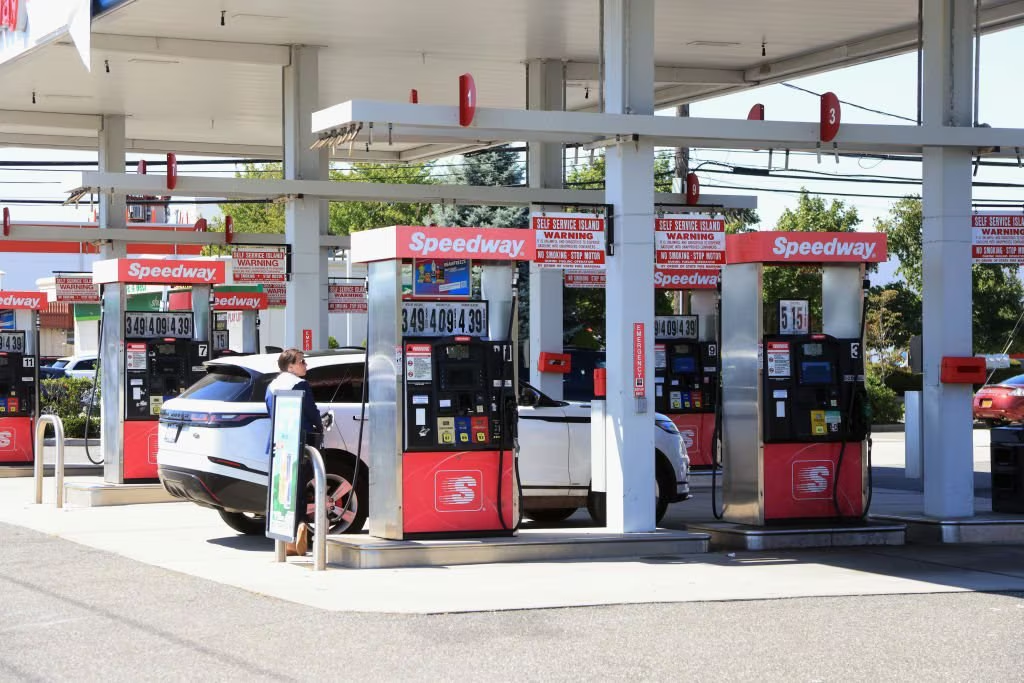
The average price of gasoline in the United States has risen above $4 a gallon for the first time since August 2022—one of the clearest signs of mounting pressure on consumers in the world’s largest economy amid the war with Iran.
According to the American Automobile Association, the average retail price of regular unleaded gasoline reached $4.018 a gallon on Monday. Since the start of the conflict, the price has climbed by more than $1—from $2.98 on the eve of the US and Israeli strikes on Tehran.
Military action against the Islamic Republic has sharply destabilized global energy markets. Oil and fuel prices are rising rapidly as the Strait of Hormuz remains largely closed to shipping. On Monday, US oil held above $100 a barrel for the first time since 2022, while the steepest increases were recorded in products that hit consumers directly—gasoline and diesel. Retail diesel prices have already moved above $5.40 a gallon, adding to pressure across the broader economy.
Rising fuel prices are creating political risks for Donald Trump’s administration in a midterm election year. At the same time, they are complicating the task facing the Federal Reserve: Jerome Powell and his colleagues are trying to contain inflation without undermining employment.
The rise in US fuel prices reflects a broader global pattern that has taken hold since the war began. In Japan, gasoline prices reached a record high this month. In Australia, some filling stations are already reporting supply disruptions. Sharp price increases have also been recorded in Sri Lanka and Thailand.
Over the past 30 days, gasoline prices in the United States have risen by more than $1—a jump comparable to the sharpest surges of the past two decades. Even so, the current increase has outpaced the markets’ initial reaction in 2022 to Russia’s invasion of Ukraine.
The White House has taken a series of steps aimed at containing prices. These include a 60-day relaxation of the Jones Act requirements, allowing foreign vessels to transport fuel between American ports, as well as a fifth consecutive annual extension of an exemption permitting the use of cheaper E15 gasoline during the summer without complying with volatility standards.
Yet none of these measures has so far produced a noticeable decline in prices. According to an Associated Press poll conducted from March 19 to March 23, 61% of American adults disapprove of Trump’s economic policy.
Research by Ryan Cummings and Neale Mahoney of the Stanford Institute for Economic Policy Research shows that for every $1-a-gallon increase in price, the University of Michigan’s consumer sentiment index falls by 4.5 points or more—even after accounting for other economic factors.
“That roughly means people feel about 5% worse about the economy for every dollar increase in prices at the pump,” said Cummings, the institute’s chief of staff and a former economist at the Council of Economic Advisers under the Biden administration from 2021 to 2023, where he worked on gasoline policy.