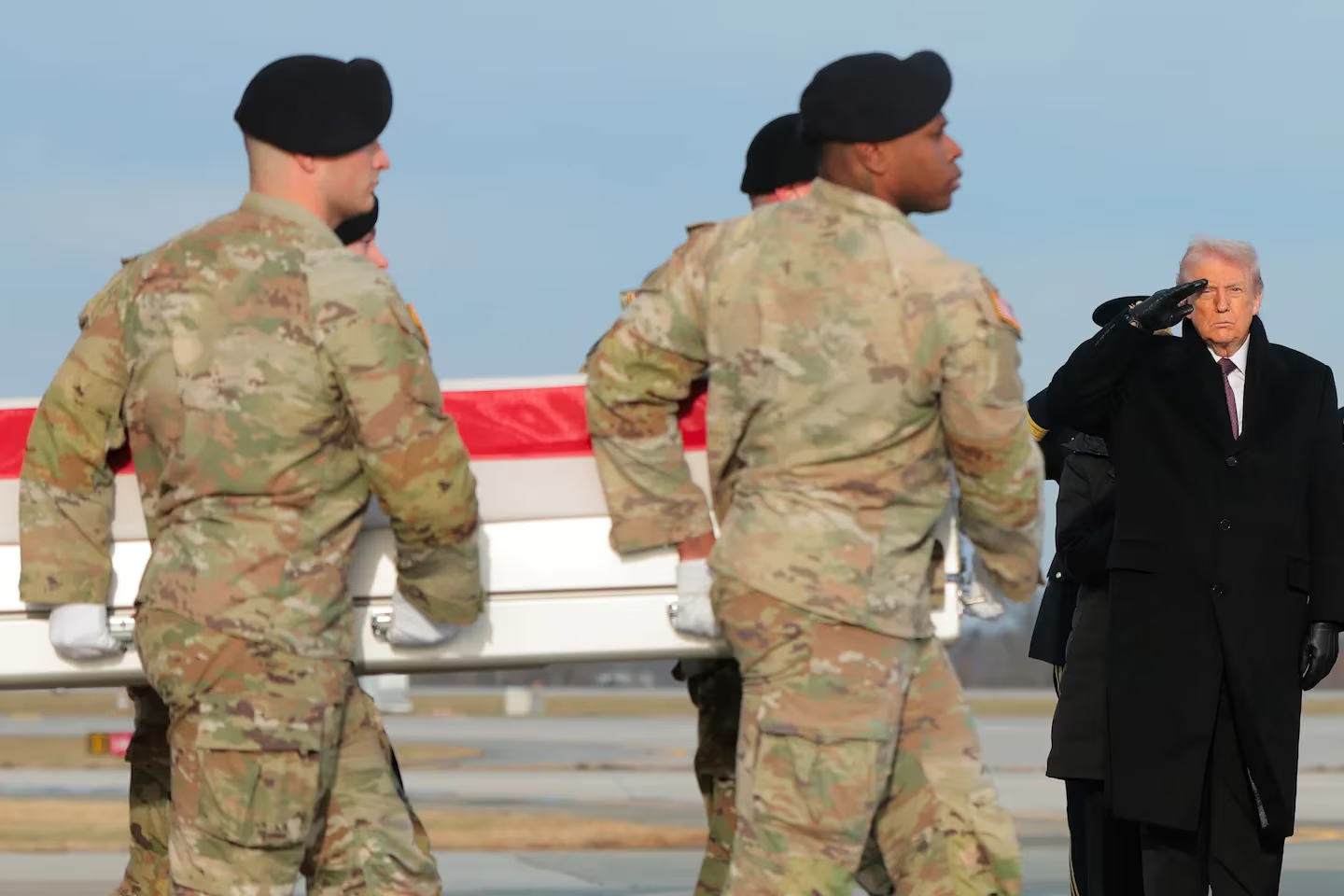
On Tuesday, December 30, U.S. forces said seven Islamic State militants had been killed in Syria and more than a dozen people detained as part of ongoing operations against the group. The actions form part of intensified pressure on ISIS several weeks after an ambush that killed two members of the Iowa National Guard.
The raids and arrests were carried out between December 20 and December 29 and followed large-scale U.S.-and-Jordanian airstrikes on December 19. More than 70 Islamic State targets were hit across the country in response to an attack on U.S. forces at the Palmyra military base earlier in the month.
The United States continues to maintain a force of about 1,000 troops in Syria as the transitional government struggles to establish control over the entire country and to contain pockets of violence following the overthrow of former president Bashar al-Assad. Power shifted in December 2024 to rebel forces led by the current president, Ahmed al-Sharaa.
In recent months, the role of U.S. forces in Syria has gradually shifted toward supporting the new government’s efforts to restore security, after years in which Washington focused on training partner forces and conducting joint combat operations with them.
At the height of its power, the Islamic State controlled vast swaths of territory in Iraq and Syria. According to an assessment by U.S. Central Command released last year, roughly 2,500 ISIS fighters remained at large across the two countries.
In Syria, Kurdish forces backed by the United States are responsible for guarding detained Islamic State members, as well as two camps holding tens of thousands of their relatives. Security experts warn that these camps continue to serve as a potential breeding ground for recruitment.
U.S. Central Command said that in 2025 the Islamic State had inspired at least 11 plots or attacks against targets inside the United States, without providing further details. In response, Centcom said dozens of operations were carried out this year, resulting in the killing or detention of up to 300 ISIS militants. One such operation in September led to the elimination of a senior ISIS operative, Omar Abdul Kader.
U.S. forces in the region will continue to “hunt down terrorist operatives, dismantle ISIS networks, and work with partners to prevent an ISIS resurgence,” U.S. Central Command commander Admiral Brad Cooper said in a statement, using the group’s acronym.
Yet Syria’s fledgling security structures have themselves become a source of serious concern. They have been accused of involvement in mass killings during sectarian violence that left thousands dead in the country’s coastal regions and in southern Syria. The new government’s armed forces have absorbed a patchwork of rebel factions that fought Bashar al-Assad for more than a decade, including foreign fighters and hard-line Islamists.
Commenting on the Palmyra attack, U.S. Central Command said the gunfire on American troops was opened by a lone Islamic State militant who had previously been integrated into Syria’s security forces. The attack occurred during what Centcom described as a “key leader engagement”—a format similar to the force-development missions U.S. troops previously conducted in Iraq and Afghanistan.
The attack killed two members of the Iowa National Guard—Sgt. Edgar Brian Torres-Tovar, 25, and Sgt. William Nathaniel Howard, 29—as well as an interpreter, Ayad Mansoor Sakat, 54, an Iraqi-born resident of Michigan. Three other U.S. soldiers and two members of Syria’s security forces were wounded.
The revelation that the attacker was a member of Syria’s security forces dealt a serious blow to the government of Ahmed al-Sharaa, which has made the development of close ties with the United States a priority as the country emerges from a protracted civil war.
During al-Sharaa’s visit to the White House in November, the Trump administration announced Syria’s accession to the international coalition fighting the Islamic State. The move marked a sharp turn for al-Sharaa himself, who was previously held by U.S. forces in Iraq and later led al-Qaeda’s Syrian branch before his group, Hayat Tahrir al-Sham, severed ties with the transnational extremist network in 2017.
After the Palmyra attack, Syria’s Interior Ministry announced a series of raids against the Islamic State across several provinces, including operations in which authorities said several senior figures of the group were detained in the Damascus governorate and in the country’s southwest.
The Islamic State is viewed as a serious threat at a particularly sensitive moment for Syria, as the authorities seek to attract foreign investment and prevent a resurgence of sectarian tensions. Two recent attacks have heightened anxiety among religious minorities: a deadly bombing near a church outside Damascus in June, which officials attributed to ISIS, and the bombing of a mosque in an Alawite neighborhood of Homs on Friday that killed eight people. The authorities have yet to identify those responsible for the mosque attack.